
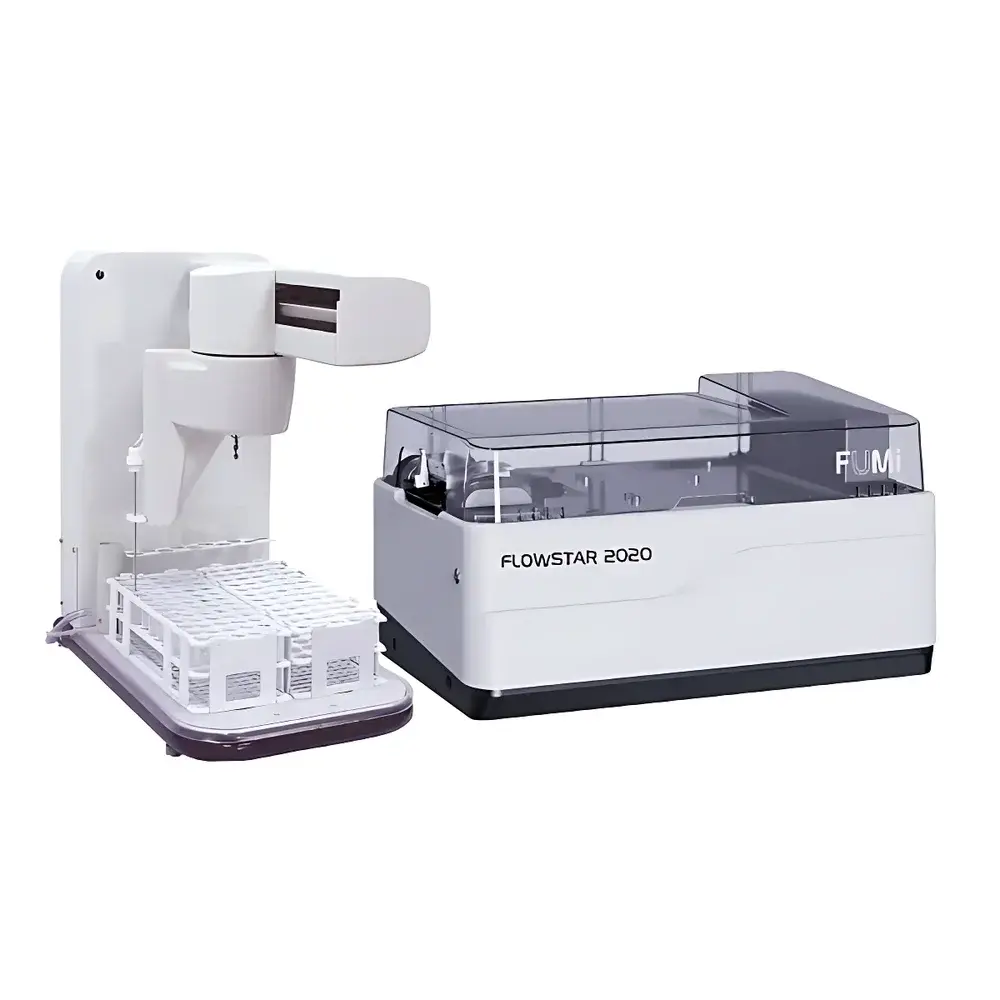
Shanghai Fumi Flowstar 2020FL Fully Automated Nitrogen-Phosphorus-Potassium (NPK) Continuous Flow Analyzer
| Brand | Shanghai Fumi |
|---|---|
| Origin | Shanghai, China |
| Model | Flowstar 2020FL |
| Product Type | Continuous Flow Analyzer (CFA) |
| Wavelength Range | 270–1100 nm |
| Sample Volumes | 5/8/10 mL per cup |
| Capacity | 100/180/270 positions |
| Reagent Positions | 100/180/270 |
| Flow Cell Path Lengths | 10 mm, 30 mm, 50 mm |
| Light Source | LED or Krypton Lamp |
Overview
The Shanghai Fumi Flowstar 2020FL is a third-generation continuous flow analyzer engineered for high-precision, fully automated quantification of total nitrogen (N), orthophosphate-phosphorus (P), and potassium (K) in complex agricultural and environmental matrices. It implements segmented flow analysis (SFA) — a robust, ISO-standardized technique wherein discrete sample segments are separated by air bubbles within a continuous carrier stream, enabling controlled reaction timing, precise mixing, and reproducible dispersion profiles. Unlike flow injection analysis (FIA), SFA supports extended reaction durations (up to 40 minutes), making it suitable for multi-step protocols such as on-line distillation, UV digestion, and membrane dialysis — all executed without manual intervention. The system complies with GB/T 22923–2008 for fertilizer analysis and aligns with internationally recognized methodologies including EPA 365.3, ISO 11905-1 (N), ISO 6878 (P), AOAC 971.25, APHA 4500-N and 4500-P, and multiple Chinese environmental standards (HJ 665, HJ 667, HJ 670, SL/T 788, CJ/T 141, HY/T 141). Its design prioritizes operational reliability, low maintenance burden, and compatibility with GLP-compliant laboratory workflows.
Key Features
- True full automation: integrated sample introduction, reagent delivery, air segmentation, reaction heating/digestion, dialysis, detection, and data calculation — eliminating manual pipetting, filtration, or degassing.
- Dual-beam, dual-wavelength photometer with selectable LED or krypton lamp source, supporting simultaneous background correction and enhanced signal stability across 270–1100 nm.
- Modular flow cell options (10 mm, 30 mm, 50 mm path lengths) optimized for sensitivity and dynamic range — the 50 mm cell enables sub-ppb detection limits for phosphate and nitrate in clean water matrices.
- On-board cadmium coil reduction system replaces traditional cadmium column setups, improving longevity, reproducibility, and ease of regeneration.
- Integrated high-pressure autoclave-style UV digestion module compliant with ISO 11905-2 for total cyanide and total phosphorus determination.
- Membrane dialysis unit eliminates interferences from turbidity, color, and particulates — critical for undiluted soil extracts, digested plant tissue, and wastewater samples.
- 2 mm internal diameter tubing provides superior tolerance to suspended solids, reducing clogging risk in high-matrix samples like fertilizer slurries and compost leachates.
- Low reagent consumption (typically ≤1.2 mL per test) and high throughput (>30 samples/hour) ensure cost-efficient operation at scale.
Sample Compatibility & Compliance
The Flowstar 2020FL accepts liquid and extract-based samples without pre-filtration or degassing. Validated applications span fertilizers (solid and liquid formulations), soil extracts (e.g., Mehlich-3, Olsen, ammonium acetate), plant digests (HNO₃/H₂O₂ microwave), irrigation water, seawater, municipal wastewater, industrial effluents, tobacco homogenates, and food processing liquors. All methods adhere to regulatory frameworks requiring auditability and traceability: the system supports electronic signature-enabled method locking, full audit trail logging (per FDA 21 CFR Part 11 principles), and raw signal archiving. Calibration verification, system suitability testing (SST), and blank monitoring routines are programmable and reportable per ISO/IEC 17025 and CNAS-CL01 requirements.
Software & Data Management
Control and data acquisition are managed via FumiAnalytix™ v4.2 — a Windows-based platform featuring intuitive method editor, real-time chromatogram visualization, peak integration using both height and area algorithms, and customizable QC flagging (e.g., drift, carryover, pressure deviation). Raw absorbance traces, peak tables, calibration curves, and instrument status logs are stored in vendor-neutral CSV and XML formats. Export modules support LIMS integration (via ASTM E1384 or HL7-compatible APIs) and direct upload to national monitoring platforms (e.g., China’s National Environmental Monitoring Network). Software validation documentation (IQ/OQ/PQ templates) and electronic record retention policies are provided for GMP/GLP environments.
Applications
- Fertilizer quality control: NPK content verification per GB/T 22923–2008, ISO 8157, and ISO 8158.
- Environmental compliance: nutrient monitoring in surface water (GB 3838), groundwater (HJ 670), wastewater discharge (HJ 665/667), and marine outfalls (HY/T 141).
- Agricultural research: rapid screening of soil fertility indices, crop tissue nutrient status, and fertilizer efficiency trials.
- Food safety labs: P and K quantification in dairy, cereals, and processed vegetables under GB 5009 series standards.
- Tobacco industry: leaf and extract analysis per YC/T 241 and ISO 11905-1.
FAQ
Does the Flowstar 2020FL require sample filtration prior to analysis?
No — the 2 mm ID fluidic path and integrated dialysis membrane allow direct injection of turbid or particulate-laden samples, including undiluted fertilizer suspensions and soil extracts.
Can the system perform total phosphorus and total nitrogen determinations?
Yes — via on-board UV/persulfate digestion (for total P) and alkaline persulfate or high-temperature catalytic digestion (for total N), both aligned with ISO 11905-2 and HJ 670.
Is method validation support available for regulatory submissions?
Yes — Fumi provides application notes, standard operating procedures (SOPs), and method validation packages compliant with ISO 17025, including LOD/LOQ, linearity, precision, and recovery studies.
What maintenance intervals are recommended for routine operation?
Daily: visual inspection of tubing and bubble generation; Weekly: cleaning of dialysis membrane and cadmium coil; Quarterly: photometer wavelength verification and pump tube replacement — all documented in the included Preventive Maintenance Logbook.





