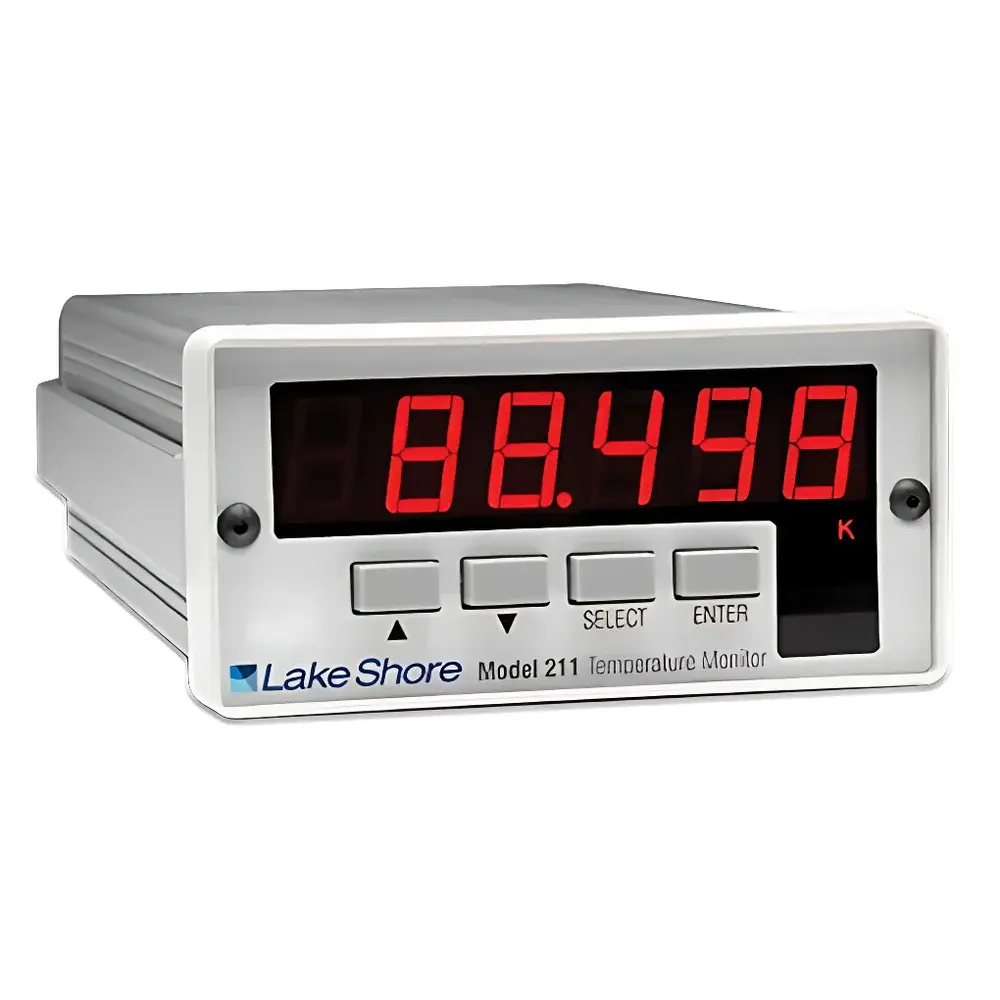
Lake Shore Model 211 Single-Channel Temperature Monitor
| Brand | Lake Shore |
|---|---|
| Origin | USA |
| Model | 211 |
| Temperature Range | 1.4 K to 800 K |
| Input Channels | 1 |
| Sensor Types Supported | Silicon Diode, GaAlAs Diode, 100 Ω Pt, 1000 Ω Pt, Carbon-Glass, Cernox®, Rox™ |
| A/D Resolution | 24-bit |
| Measurement Update Rate | 7 Hz |
| Display Resolution | 0.001 K (0–99.999 K), 0.01 K (100–999.99 K), 0.1 K (>1000 K) |
| Display | 5-digit LED |
| Output Options | 0–10 V, 4–20 mA, Relay, RS-232/RS-485 Serial Interface |
| User Calibration Curves | 1 × 200-point non-volatile memory |
| Excitation Method | Constant-current, 4-wire differential |
| Isolation | Not chassis-ground isolated |
| Compliance | Designed for cryogenic vacuum and magnetic field environments |
Overview
The Lake Shore Model 211 Single-Channel Temperature Monitor is a precision-engineered instrument designed for accurate, stable, and repeatable temperature measurement in demanding low-temperature and high-stability applications. Operating on the principle of resistance or voltage-to-temperature conversion—calibrated against standardized sensor response curves—the Model 211 delivers traceable thermal metrology across an extended range of 1.4 K to 800 K. Its architecture integrates a high-resolution 24-bit analog-to-digital converter with four-wire differential sensing, eliminating lead resistance errors and enabling robust performance in cryogenic systems, ultra-high vacuum chambers, and moderate magnetic fields (up to ±0.5 T, depending on sensor selection). Unlike general-purpose thermometers, the Model 211 is purpose-built for laboratory and industrial environments where sensor compatibility, long-term stability, and deterministic calibration are essential—particularly in helium cryostats, dilution refrigerators, superconducting magnet test stands, and materials characterization setups.
Key Features
- Single-channel architecture optimized for integration into compact or space-constrained systems
- Support for industry-standard cryogenic sensors: silicon diodes (e.g., DT-470, DT-670), gallium-aluminum-arsenide (GaAlAs) diodes, platinum resistance thermometers (PT-100, PT-1000), carbon-glass, Cernox®, and Rox™ sensors
- Four-wire differential measurement with constant-current excitation ensures minimal self-heating and high common-mode rejection
- Five-digit LED display with selectable units (K, °C, °F, V, Ω) and dynamic resolution scaling: 0.001 K below 100 K, 0.01 K up to 1000 K, and 0.1 K above
- Standard analog outputs (0–10 V or 4–20 mA), programmable relay alarm outputs, and dual serial interfaces (RS-232 and RS-485) for system-level control and data logging
- Non-volatile memory for one user-defined 200-point calibration curve—loadable via serial interface and retained during power cycling
- Front-panel configuration without software dependency; intuitive four-button interface with brightness control and keyboard lock
Sample Compatibility & Compliance
The Model 211 is compatible with a broad spectrum of commercially available cryogenic and high-temperature resistance and diode sensors. Its input circuitry accommodates both low-resistance (e.g., 100 Ω Pt RTDs) and high-impedance (e.g., silicon diodes at <1 kΩ) devices without hardware modification. While not certified to specific ISO/IEC 17025 or ASTM E1137 compliance out-of-the-box, the instrument supports traceable calibration workflows when used with NIST-traceable sensors and documented calibration curves. Its non-isolated input design requires careful grounding practices in multi-instrument systems but aligns with standard cryogenic instrumentation grounding schemes per IEEE 1100 and IEC 61000-6-2. The unit meets FCC Class A and CE electromagnetic compatibility requirements for laboratory use and is rated for operation in ambient temperatures from 0 °C to 50 °C and relative humidity up to 80 % non-condensing.
Software & Data Management
The Model 211 operates as a stand-alone monitor with full front-panel functionality; no host computer is required for basic operation. However, its RS-232 and RS-485 interfaces support ASCII command protocols for remote configuration, real-time data streaming, and firmware-assisted calibration updates. Third-party SCADA, LabVIEW, Python (via PySerial), and MATLAB environments can integrate the device using documented command sets—including sensor type selection, output scaling, alarm threshold programming, and curve upload. All user-entered calibration data resides in non-volatile memory and persists through power cycles. While the instrument does not implement FDA 21 CFR Part 11 electronic signature or audit trail features natively, its deterministic output behavior, fixed update rate (7 Hz), and reproducible calibration loading make it suitable for GLP-compliant environments when paired with procedural documentation and version-controlled curve files.
Applications
- Monitoring liquid nitrogen and liquid helium storage dewars with integrated level and temperature feedback loops
- Feedback control of closed-cycle cryocoolers and pulse-tube refrigerators
- Thermal mapping of superconducting magnets during quench testing and field ramping
- In-situ temperature monitoring during low-temperature material synthesis (e.g., thin-film deposition, quantum dot growth)
- Calibration reference in metrology labs supporting ITS-90 traceability chains for sub-10 K measurements
- Process temperature supervision in semiconductor fabrication tools requiring cryogenic stage stability
FAQ
What sensor types are natively supported without external signal conditioning?
The Model 211 directly accepts silicon diodes (including DT-470 and DT-670), GaAlAs diodes, 100 Ω and 1000 Ω platinum RTDs, carbon-glass resistors, Cernox®, and Rox™ sensors—all configured via front-panel menu.
Is the input channel isolated from chassis ground?
No. The input is referenced to instrument common and is not galvanically isolated from the chassis. Proper system grounding per cryogenic instrumentation best practices is required.
Can multiple Model 211 units be daisy-chained via RS-485?
Yes. RS-485 supports multi-drop configurations; each unit must be assigned a unique address via front-panel setup.
How is calibration traceability maintained?
Traceability relies on the use of NIST-traceable sensors and documented calibration curves. The instrument stores one 200-point user curve non-volatily and applies it deterministically during conversion.
What is the minimum measurable temperature with standard sensors?
When used with calibrated silicon diodes (e.g., DT-670), the Model 211 achieves reliable readings down to 1.4 K; some users report stable operation near 1.2 K under controlled conditions, though this falls outside the manufacturer’s specified range.