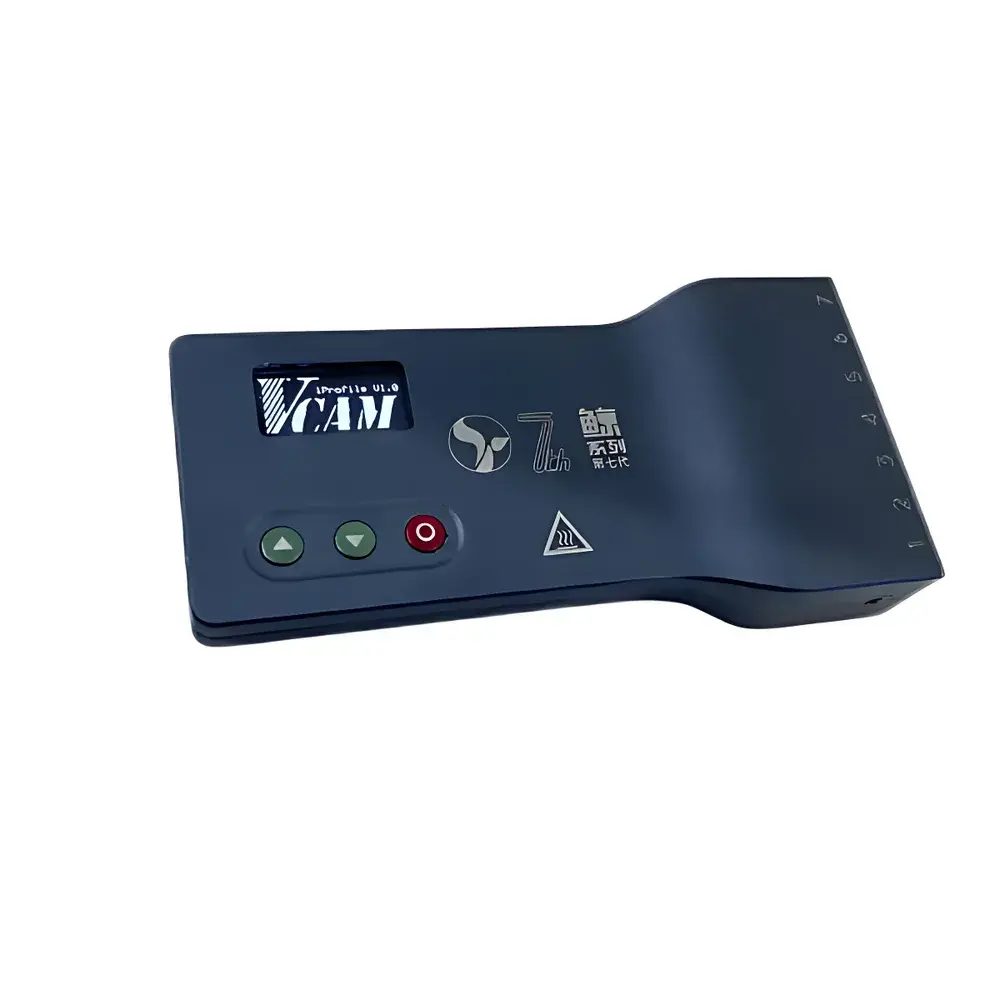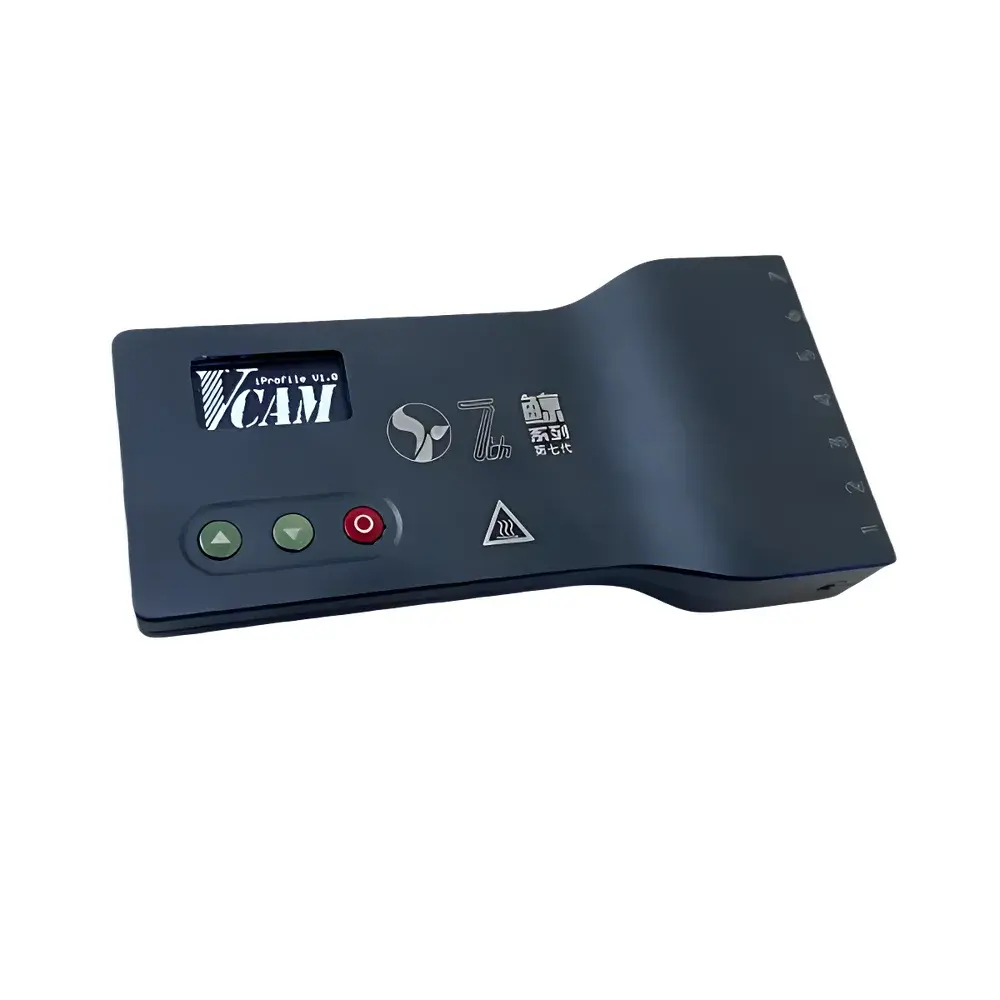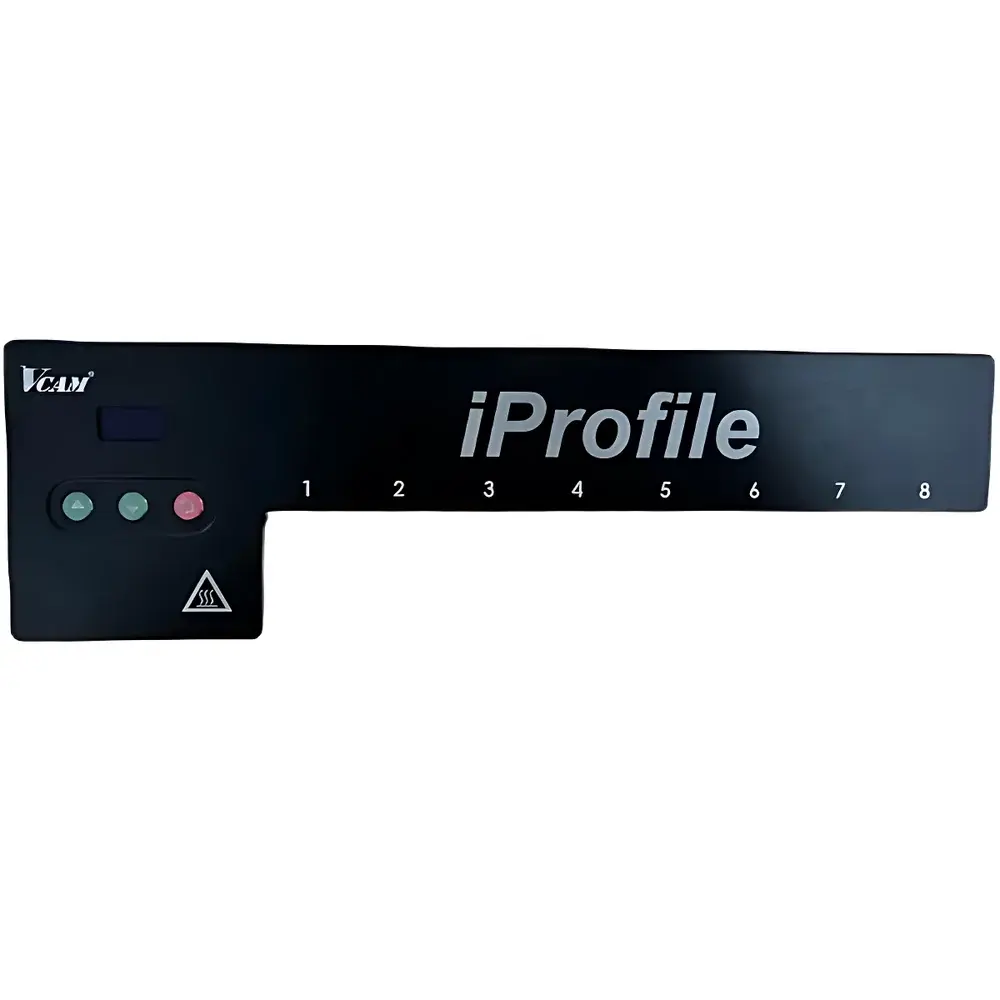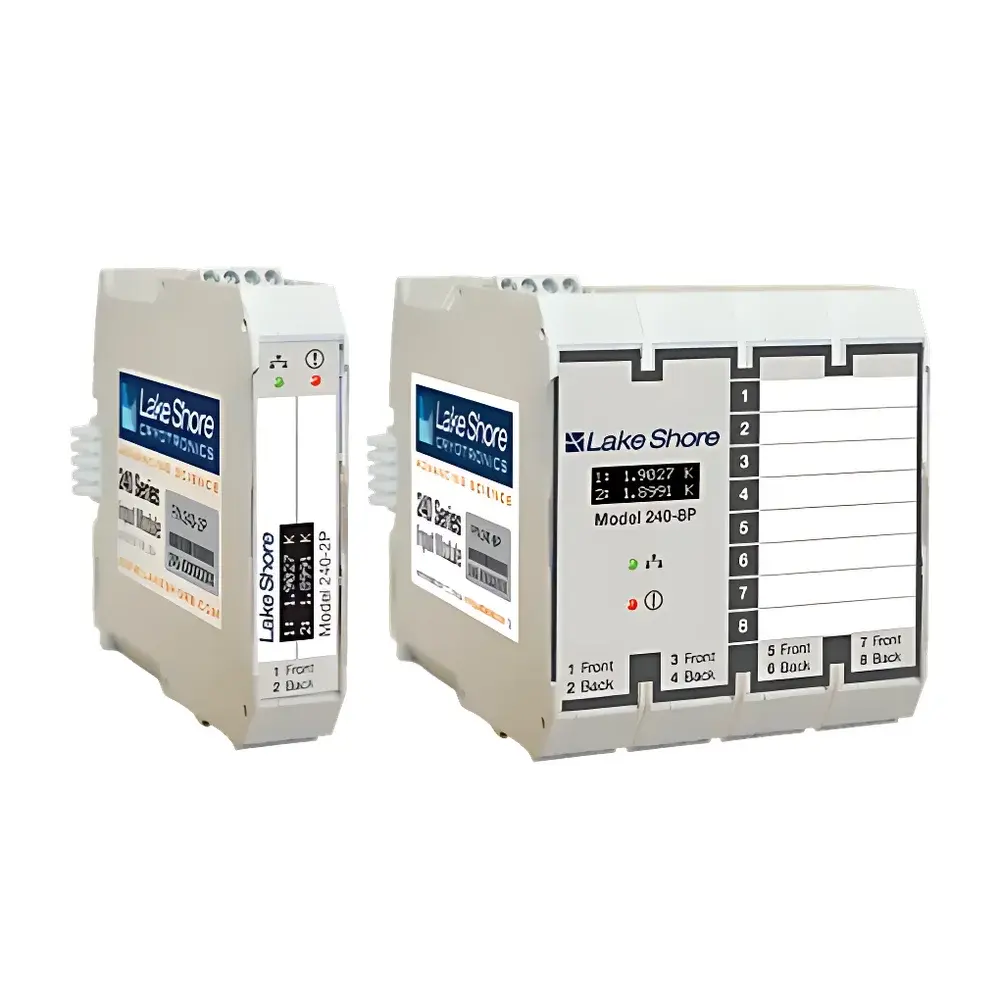
Lake Shore 240 Series Temperature Input Module
| Brand | Lake Shore |
|---|---|
| Origin | USA |
| Model | 240 |
| Channel Options | 2-channel (240-2P) or 8-channel (240-8P) |
| Temperature Range | 1 K to 800 K |
| Sensor Compatibility | Cernox®, Platinum RTDs, DT-670/DT-470 Diodes, Germanium, Carbon-Glass, RhFe, Rox™, GaAlAs |
| Excitation | 4-wire differential, constant current (10 µA) with polarity reversal |
| Isolation | Opto-isolated sensor inputs (channel-to-ground), non-isolated channel-to-channel |
| Communication | PROFIBUS-DP v1, USB 2.0 |
| Display | 128×32-pixel OLED, dual-parameter real-time readout (K/°C/°F/V/Ω), update rate: 2 Hz |
| Calibration | User-loadable 200-point curves per channel |
| Mounting | DIN-rail compatible, rear busbar for shared power & fieldbus |
| Compliance | CE, RoHS, PROFIBUS Nutzerorganisation (PNO) certified |
Overview
The Lake Shore 240 Series Temperature Input Module is a precision-engineered, industrial-grade signal conditioning and digital conversion platform designed specifically for distributed low-temperature measurement in high-reliability, large-scale cryogenic systems. Built upon Lake Shore’s decades of expertise in cryogenic metrology, the 240 series bridges the gap between laboratory-grade temperature accuracy and ruggedized, programmable logic controller (PLC)-centric automation architectures. Unlike conventional analog I/O modules that require external signal conditioning and complex PLC-side linearization routines, the 240 performs full sensor excitation, voltage/resistance acquisition, cold-junction compensation (where applicable), and nonlinear calibration curve interpolation—entirely onboard—delivering native temperature values directly over PROFIBUS-DP. Its architecture is grounded in four-wire differential resistance measurement with polarity-reversal current sourcing, eliminating thermoelectric offset errors and enabling stable sub-millikelvin resolution across extended cable runs. This makes it uniquely suited for applications where sensors reside in high-radiation, ultra-high-vacuum, or magnetically active environments—such as superconducting magnet test stands, particle accelerator beamlines, fusion plasma diagnostics, and large-scale quantum computing infrastructure.
Key Features
- Modular channel scalability: Choose between 2-channel (240-2P) and 8-channel (240-8P) configurations, both housed in compact DIN-rail-mountable enclosures with integrated rear busbars for shared power and PROFIBUS trunking.
- Native cryogenic sensor support: Direct interface with industry-standard low-temperature transducers—including Cernox® thin-film resistors, platinum RTDs (PT-100/PT-1000), germanium, carbon-glass, rhodium-iron, Rox™, and silicon diode sensors (DT-670, DT-470)—without external signal conditioners.
- Onboard calibration engine: Each input supports user-loaded 200-point temperature-resistance/voltage lookup tables using linear interpolation, plus pre-installed standard curves compliant with IEC 60751, ASTM E1137, and Lake Shore’s proprietary calibration databases.
- Radiation-tolerant cabling architecture: Enables sensor-to-module distances exceeding 100 m without degradation in noise immunity or accuracy—critical for remote mounting of electronics outside radiation zones while keeping sensors inside beam pipes or cryostats.
- Dual-mode operation: “Normal” mode prioritizes stability and noise rejection via adaptive filtering and thermal EMF cancellation; “High-Speed” mode reduces latency for rapid transient detection (e.g., quench monitoring in superconducting magnets).
- Local and networked accessibility: Real-time temperature data accessible simultaneously via PROFIBUS-DP (to PLC master), USB 2.0 (for configuration/maintenance), and front-panel OLED display (128×32 pixels, dual parameter readout with auto-cycling on 8-channel units).
Sample Compatibility & Compliance
The 240 Series is engineered for seamless integration with cryogenic and ultra-low-temperature sensor ecosystems deployed in regulated scientific and industrial facilities. It natively supports sensors qualified per ASTM E220, IEC 60751, and ISO/IEC 17025-accredited calibration protocols. Its PROFIBUS-DP implementation conforms to EN 50170 and PNO Class 3 specifications, ensuring deterministic cyclic data exchange with cycle times down to 10 ms. The module meets CE marking requirements for electromagnetic compatibility (EN 61000-6-2/6-4) and safety (EN 61010-1). While not FDA-regulated, its deterministic behavior, audit-ready configuration logs (via MeasureLINK™), and traceable calibration workflows align with GLP/GMP principles for instrument qualification in research infrastructure subject to DOE, CERN, or ITER QA programs.
Software & Data Management
Configuration, calibration, and real-time monitoring are managed through Lake Shore’s MeasureLINK™ software—a Windows-based application accessible via USB connection. MeasureLINK™ provides role-based access to three functional layers: (1) module-level settings (PROFIBUS address, baud rate, watchdog timeout), (2) per-channel sensor configuration (curve selection, unit preference, excitation current, filter bandwidth), and (3) live multi-channel readout with timestamped logging export (CSV, TXT). All configuration changes are stored non-volatilely and persist across power cycles. No runtime dependencies or PLC programming are required to deploy calibrated temperature values—PROFIBUS GSD files enable automatic device recognition in Siemens TIA Portal, Rockwell Studio 5000, and other major engineering frameworks. Audit trails, firmware versioning, and sensor curve provenance are retained for compliance documentation.
Applications
- Large-scale physics infrastructure: Beamline temperature monitoring in synchrotrons and free-electron lasers; cryogenic thermal mapping of superconducting RF cavities; magnet coil temperature control in tokamaks and stellarators.
- Quantum technology deployment: Dilution refrigerator stage monitoring, qubit package thermal profiling, and cryo-cooler feedback control in quantum annealing and gate-based processors.
- Industrial cryogenics: LNG plant instrumentation, helium liquefier process control, and vacuum chamber thermal management in semiconductor fabrication tools.
- Standards laboratories: Secondary calibration reference nodes in metrology institutes requiring traceable, multi-sensor, networked temperature acquisition with minimal drift and documented uncertainty budgets.
FAQ
Does the 240 Series require external power supplies or signal conditioners to operate with cryogenic sensors?
No. The module provides regulated excitation current, performs 4-wire resistance measurement, applies calibration curves, and outputs temperature values directly—eliminating the need for external analog I/O modules or PLC-side linearization code.
Can multiple 240 modules share a single PROFIBUS segment without repeaters?
Yes. Up to 126 devices can coexist on one PROFIBUS-DP segment. The 240 uses standard PNO-compliant addressing and supports bus-powered operation when used with compatible power feeders.
Is USB connectivity only for setup, or can it be used for continuous data streaming?
USB is intended for configuration, diagnostics, and offline verification. Continuous high-integrity data acquisition is performed exclusively over PROFIBUS-DP to ensure deterministic timing and integration with safety-rated control systems.
How is sensor calibration traceability maintained across firmware updates or module replacements?
Each sensor curve is stored per channel in non-volatile memory with metadata (date, operator ID, source certificate ID). MeasureLINK™ exports full configuration snapshots—including curve coefficients and sensor IDs—for archival and re-deployment.
What is the maximum recommended cable length between a DT-670 diode and the 240 module?
For optimal noise immunity and stability, Lake Shore recommends ≤100 m using twisted-pair shielded cable (e.g., Belden 8761). Longer runs are feasible but require site-specific EMI assessment and grounding validation.