
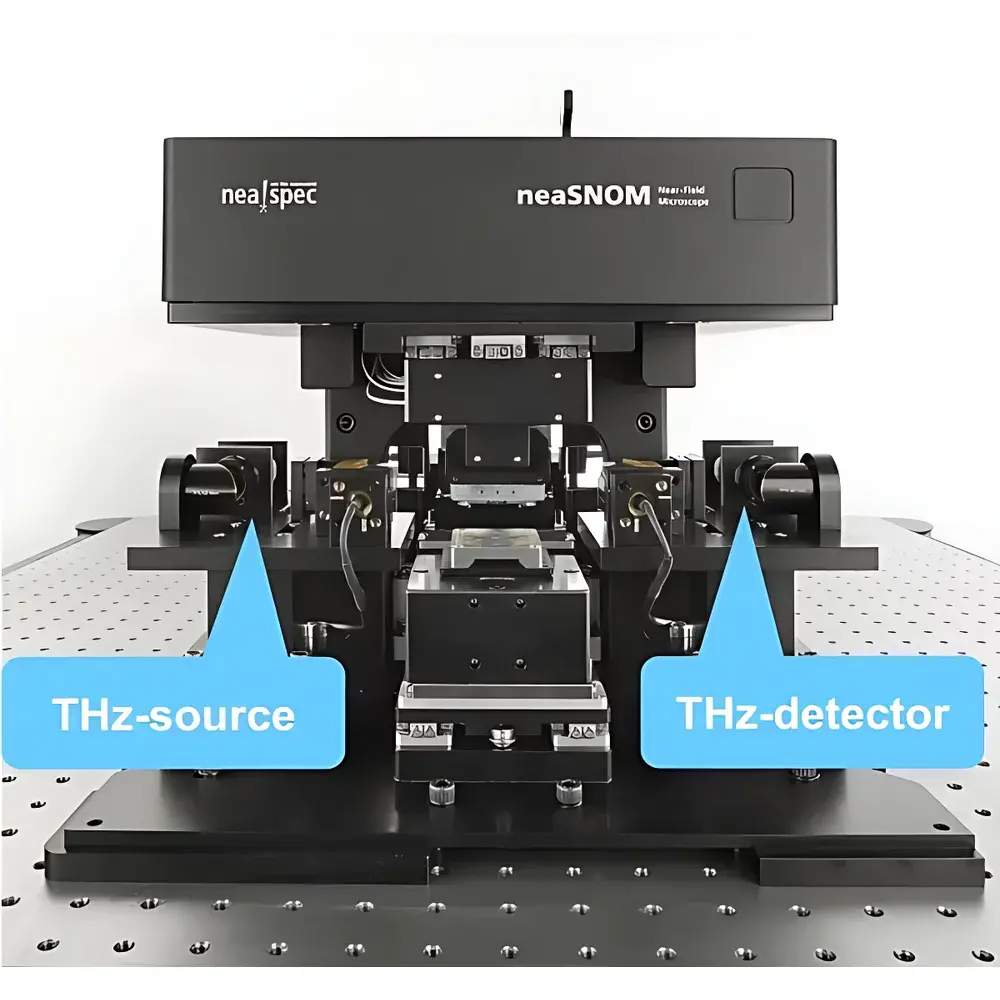
Neaspec THz-NeaSNOM Terahertz Near-Field Scanning Optical Microscope
| Brand | Neaspec |
|---|---|
| Origin | Germany |
| Model | THz-NeaSNOM |
| Spatial Resolution | <30 nm |
| THz Frequency Range | 0.1–3 THz |
| Compatible Light Source | Femtosecond Laser for THz-TDS |
| AFM Probe Compatibility | Commercial tapping-mode AFM probes |
| Optical Collection | Broadband Parabolic Mirror Optics |
| Application Domain | Nanoscale Semiconductor Metrology, Ultrafast Carrier Dynamics, 2D Material Characterization |
Overview
The Neaspec THz-NeaSNOM is a high-performance terahertz near-field scanning optical microscope engineered for nanoscale optical imaging and spectroscopy beyond the diffraction limit. Unlike conventional far-field THz systems—whose spatial resolution is fundamentally constrained by the long wavelength of THz radiation (≈300 µm at 1 THz) to ~150 µm—the THz-NeaSNOM leverages scattering-type scanning near-field optical microscopy (s-SNOM) principles to achieve true nanoscale resolution. It operates by coupling broadband THz pulses generated via femtosecond laser-driven photoconductive antennas or optical rectification into a sharp, metallized atomic force microscope (AFM) tip. The tip acts as a nanoscale antenna, locally enhancing and confining the THz field within a volume smaller than λ²/100. This enables detection of near-field THz signals with sub-30 nm spatial resolution—fully decoupled from the free-space wavelength—and quantitative mapping of complex permittivity, carrier density, and phonon resonances at the nanoscale.
Key Features
- Sub-30 nm spatial resolution in THz amplitude and phase imaging, validated across multiple peer-reviewed publications (e.g., Nature Photonics 8, 841, 2014; Nature 456, 454, 2008)
- Broadband THz spectral coverage from 0.1 to 3 THz, compatible with both time-domain spectroscopy (THz-TDS) and frequency-modulated heterodyne detection schemes
- Integrated s-SNOM platform based on Neaspec’s proven neaSNOM architecture, featuring interferometric homodyne/heterodyne signal demodulation at higher harmonics (n ≥ 3) to suppress background scattering
- Optimized parabolic mirror optics with >90% reflectance across the full THz band, enabling efficient collection and collimation without chromatic aberration
- Full compatibility with standard commercial AFM probes—including Pt/Ir-coated, Au-coated, and sharpened Si tips—allowing seamless integration into existing AFM workflows
- Robust mechanical design with active vibration isolation and ultra-stable laser-triggered synchronization, ensuring long-term measurement reproducibility under ambient lab conditions
Sample Compatibility & Compliance
The THz-NeaSNOM supports a wide range of solid-state and layered samples without requiring vacuum or cryogenic environments, including semiconductor heterostructures (Si/SiO₂, GaAs/AlGaAs), van der Waals materials (graphene, h-BN, MoS₂), topological insulators, plasmonic metasurfaces, and polymer thin films. Sample preparation follows standard cleanroom-compatible protocols; no metal coating or conductive substrates are required. The system complies with ISO 14644-1 Class 5 cleanroom operational guidelines when deployed in controlled environments. Data acquisition adheres to GLP-aligned documentation practices, and raw interferograms and demodulated near-field signals are stored in HDF5 format with embedded metadata (timestamp, scan parameters, laser power, tip oscillation amplitude), supporting traceability for regulatory submissions under FDA 21 CFR Part 11 where instrument qualification is performed per ASTM E2500-13.
Software & Data Management
Control and analysis are executed via Neaspec’s proprietary neaVIEW software suite, built on a modular Python/C++ framework. The software provides real-time feedback during scanning, synchronized dual-channel lock-in acquisition (amplitude and phase), and batch processing pipelines for Fourier-transformed THz spectra extraction. All near-field datasets include native support for vectorial field reconstruction using rigorous tip-sample interaction models. Export options include ASCII, TIFF, and MATLAB .mat formats; spectral libraries can be annotated with user-defined material labels and cross-referenced against NIST THz database entries. Audit trails record operator ID, parameter changes, calibration events, and software version history—enabling full compliance with ISO/IEC 17025 requirements for accredited testing laboratories.
Applications
- Nanoscale mapping of carrier concentration and mobility in transistor gate stacks, finFETs, and 2D channel materials
- Non-invasive characterization of interfacial phonon polaritons and hyperbolic dispersion in anisotropic crystals
- Time-resolved THz near-field imaging of ultrafast photocarrier relaxation and plasmon decay dynamics in nanowires and quantum dots
- Correlative metrology combining THz near-field contrast with topographic, KPFM, and Raman channels on the same platform
- Quantitative dielectric function retrieval at sub-100 nm scale for metamaterial unit cell validation
- In situ monitoring of ion intercalation and phase transitions in battery electrode thin films
FAQ
What THz source options are supported?
The THz-NeaSNOM is designed for integration with fiber-coupled femtosecond Ti:sapphire or Yb-fiber lasers (center wavelength 780–1040 nm) driving either PCA-based emitters or ZnTe/OH1 nonlinear crystals. Optional OEM THz-TDS modules from Menlo Systems or TOPTICA are fully compatible.
Can the system perform time-resolved measurements?
Yes—by introducing optical delay lines into the pump-probe beam path, the platform supports pump-probe THz near-field spectroscopy with sub-100 fs temporal resolution, enabling direct observation of carrier thermalization, intervalley scattering, and coherent phonon generation.
Is vacuum operation required?
No—measurements are routinely performed in ambient air. For enhanced signal-to-noise ratio below 0.3 THz or humidity-sensitive samples, optional dry-air purge or nitrogen-flushed sample chambers are available.
How is calibration performed?
Spatial calibration uses certified grating standards (NIST-traceable, 100 nm pitch); THz spectral calibration employs gas-phase absorption lines (e.g., water vapor at 0.557 THz, methanol at 0.658 THz) and reference silicon wafer fringes. Tip apex radius is verified via SEM post-experiment.
Does the system support third-party AFM controllers?
The THz-NeaSNOM interfaces natively with Park Systems XE-series, Bruker Dimension Icon, and Asylum Cypher controllers via analog I/O and digital trigger protocols; custom drivers are provided upon request.




