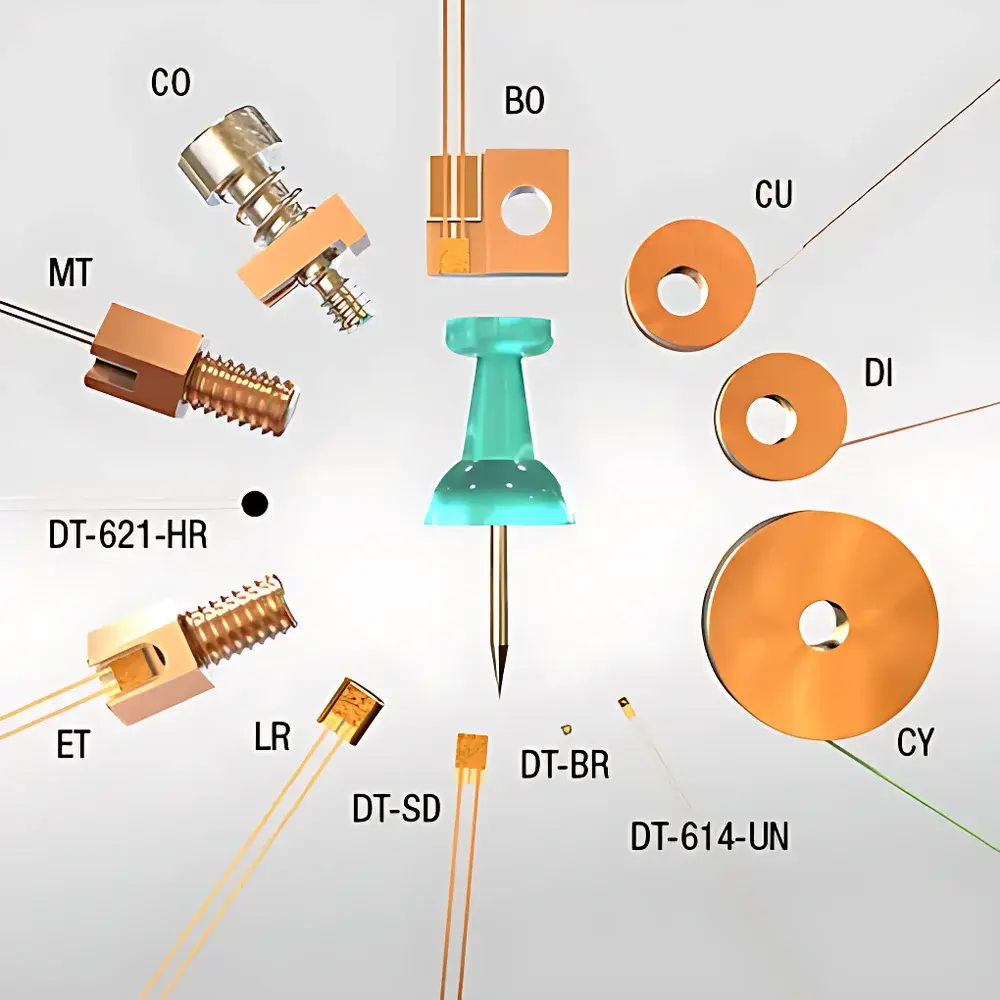
Lake Shore DT-670 and Cernox® Cryogenic Temperature Sensors
| Brand | Lake Shore |
|---|---|
| Origin | USA |
| Model Series | DT-670, Cernox® CX-1050/CX-1070, Rox™ RX-102B-RS/RX-102A, DT-621-HR, GR-100, CT-400, TC-E/K, Pt-100/200 |
| Temperature Range | 0.005 K to 1543 K (model-dependent) |
| Calibration | NIST-traceable, standard curves per IEC 60751 (Pt), ASTM E1137 (RTD), MIL-STD-883 (radiation) |
| Vacuum Compatibility | Up to 1×10⁻¹⁰ Pa (ultra-high vacuum) |
| Magnetic Field Tolerance | < ±0.1% reading up to 20 T (Cernox®, Rox™) |
| Radiation Hardness | Qualified to 1×10⁸ rad(Si) (Cernox®, GR-100, HR series) |
| Interchangeability | DT-670, Rox™, and Pt-series sensors comply with standardized resistance-vs-temperature curves (e.g., DT-670 curve, Rox™ Curve #1, Pt-100 DIN 43760) |
Overview
Lake Shore cryogenic temperature sensors are precision resistive and capacitive transducers engineered for metrological-grade thermal measurement across extreme low-temperature regimes—from dilution refrigerator base temperatures below 10 mK to high-temperature environments exceeding 1500 K. These sensors operate on well-established physical principles: Cernox® and Rox™ devices utilize the temperature-dependent resistivity of thin-film metal oxides (e.g., RuO₂, IrO₂ composites); silicon diode sensors (DT-670 series) rely on the forward voltage drop across a p–n junction; germanium resistance thermometers (GR-100) exploit the exponential rise in resistivity below 4.2 K; platinum RTDs (Pt-100/200) conform to the Callendar–Van Dusen equation; and capacitive sensors (CT-400) measure dielectric constant shifts in ceramic dielectrics. All sensor families are manufactured under ISO 9001-certified processes and calibrated against NIST-traceable reference standards, with full documentation including individual calibration reports, resistance vs. temperature tables, and uncertainty budgets per ISO/IEC 17025.
Key Features
- Multi-technology portfolio enabling optimal sensor selection across 0.005 K–1543 K: Cernox® (100 mK–420 K), Rox™ (5 mK–40 K), DT-670 silicon diodes (1.4 K–500 K), GR-100 germanium (0.05 K–100 K), Pt-100/200 (14 K–873 K), CT-400 capacitive (1.4 K–290 K), and E/K-type thermocouples (1.2 K–1543 K)
- Cernox® sensors exhibit 100 thermal cycles between 0.1 K and 300 K; radiation tolerance validated to 1×10⁸ rad(Si)
- Rox™ RX-102B-RS extends calibrated operation to 10 mK with extrapolated points certified to 5 mK; optical shielding minimizes parasitic radiative heating in ultra-low-T systems
- DT-670-SD and DT-621-HR variants offer hermetically sealed, non-magnetic packaging qualified for spaceflight per ECSS-Q-ST-70-08C and NASA GSFC S-311-P-823
- All interchangeable models (DT-670, Rox™ series, Pt-100) adhere to published standard curves—enabling plug-and-replace functionality without recalibration in multi-sensor cryostat arrays
- HR-series sensors provide full material traceability (15-year lot history), pre-tested resistance/sensitivity data, and GLP-compliant audit trails for regulated aerospace and nuclear applications
Sample Compatibility & Compliance
Lake Shore cryogenic sensors are designed for direct integration into ultra-high vacuum (UHV) and high-magnetic-field environments. Cernox®, Rox™, DT-670E-BR, and CT-400 models achieve vacuum compatibility down to 1×10⁻¹⁰ Pa, meeting requirements for particle accelerator beamline instrumentation and quantum computing dilution refrigerators. Germanium and platinum sensors are rated for 1×10⁻⁴ Pa, suitable for closed-cycle cryocooler systems. Magnetic field immunity is verified per ASTM A977 (for resistive sensors) and IEEE Std 1672 (for capacitive types). Radiation hardness testing follows MIL-STD-883 Method 1019, with post-irradiation calibration stability confirmed per ISO 17025 Annex A.3. Sensor housings comply with RoHS 2011/65/EU and REACH SVHC screening. Documentation includes full compliance certificates, calibration uncertainty statements (k=2), and test reports for outgassing (ASTM E595), thermal shock (MIL-STD-202G), and mechanical vibration (MIL-STD-810H).
Software & Data Management
Lake Shore’s CrossLink™ software suite (v6.5+) supports real-time acquisition, curve fitting, and cross-sensor validation using industry-standard formats (IEEE 1451.2 TEDS, CSV, HDF5). The system enables automated application of NIST-traceable correction algorithms—including magnetic field compensation for Cernox® and Rox™, self-heating corrections for DT-670, and polynomial interpolation for GR-100. Calibration files are digitally signed and version-controlled, with audit logs compliant with FDA 21 CFR Part 11 for electronic records and signatures. For integration into SCADA or LabVIEW-based control architectures, Lake Shore provides IVI-compliant drivers (IVI-3.3), Modbus TCP, and RESTful API endpoints. All calibration data is exportable in SI-traceable units (kelvin, ohms, farads) with associated expanded uncertainties.
Applications
- Quantum computing infrastructure: qubit fridge monitoring (<15 mK), thermal anchoring verification, and magnetocaloric stage control
- Particle physics experiments: beamline temperature mapping in superconducting magnets (up to 20 T), cryogenic target chamber monitoring
- Aerospace & defense: satellite cryocooler health diagnostics, infrared detector focal plane array stabilization, and hypersonic vehicle thermal protection system validation
- Materials science: specific heat and thermal conductivity measurements in PPMS® and DynaCool® platforms
- Medical imaging: MRI magnet quench detection, helium recondensation loop monitoring, and cryoprobe calibration
- Nuclear fusion research: tokamak divertor thermometry, neutral beam injector cryopanels, and blanket module thermal profiling
FAQ
What is the lowest temperature at which Lake Shore sensors are calibrated?
The Rox™ RX-102B-RS sensor is fully calibrated down to 10 mK, with extrapolated data points certified to 5 mK per NIST-traceable procedures.
Can Cernox® sensors be used in 20 T magnetic fields?
Yes—Cernox® CX-1050 and CX-1070 models are characterized to ≤ ±0.05% error at 20 T and 4.2 K, with linearity maintained across full temperature range.
Are DT-670 sensors interchangeable without recalibration?
Yes—DT-670-SD, DT-670E-BR, and DT-621-HR all conform to the standardized DT-670 resistance-vs-temperature curve, enabling drop-in replacement in multi-channel systems.
Do Lake Shore sensors support FDA 21 CFR Part 11 compliance?
CrossLink™ software provides electronic signature workflows, audit trails, and secure user access controls meeting Part 11 requirements for regulated GxP environments.
What vacuum level is required for CT-400 capacitive sensors?
CT-400 sensors require ultra-high vacuum conditions ≤1×10⁻⁴ Pa to minimize gas conduction errors and maintain mK-level stability in strong magnetic fields.