
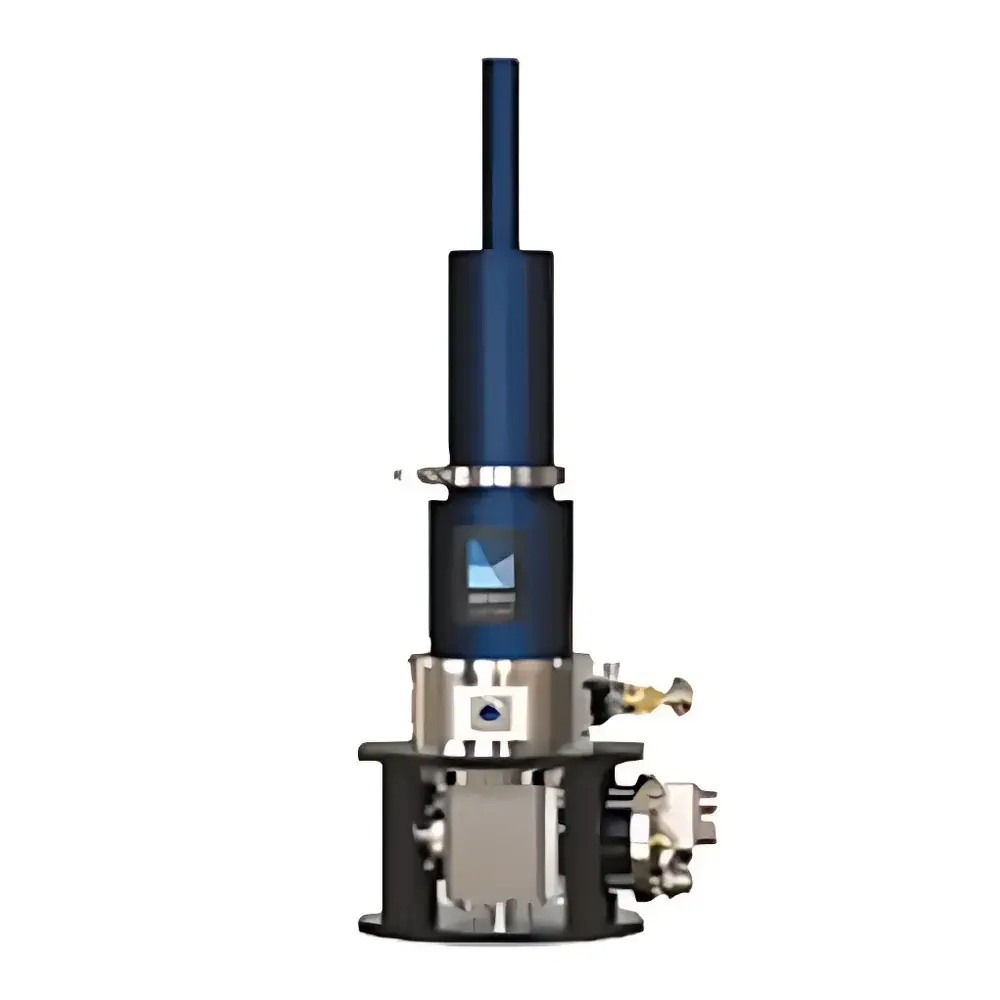
Lake Shore CCS-300S Compact Optical Cryogenic Thermostat
| Brand | Lake Shore |
|---|---|
| Origin | USA |
| Model | CCS-300S |
| Cooling Type | Closed-cycle cryocooler |
| Temperature Range | <4 K to 325 K |
| Sample Environment | High Vacuum |
| Typical Temperature Stability | ±50 mK |
| Cool-down Time | 1.5–2.5 h |
| Vibration Level | <40 nm (RMS) |
| Optical Window | Yes |
| Window Diameter | 38 mm to 85 mm |
| Cold Head Mounting | Flexible (user-configurable orientation) |
| Recommended Cryocooler Maintenance Interval | 13,000 hours |
| Approximate Height | 71–99 cm |
| Approximate Weight | 17–30 kg |
| Compliance | Designed for integration into ISO/IEC 17025-compliant labs and GLP/GMP-adjacent research environments |
Overview
The Lake Shore CCS-300S Compact Optical Cryogenic Thermostat is a closed-cycle, helium-free cryogenic platform engineered for precision low-temperature optical experiments requiring high spatial confinement and vacuum compatibility. Based on the proven Janis cryostat architecture and distributed globally by Lake Shore Cryotronics, the CCS-300S utilizes a two-stage pulse tube or Gifford-McMahon cryocooler to achieve base temperatures below 4 K while maintaining stable operation up to 325 K. Its core design principle centers on minimizing thermal load and mechanical footprint without compromising optical access or sample environment integrity. The sample stage resides in a high-vacuum chamber (<1×10⁻⁶ Torr typical), isolated from ambient vibration and thermal radiation via multi-layer superinsulation and low-conductivity support structures. This configuration supports photon-in/photon-out characterization techniques—including photoluminescence (PL), Raman spectroscopy, Fourier-transform infrared (FTIR), terahertz time-domain spectroscopy (THz-TDS), and magneto-optical Kerr effect (MOKE) measurements—under precisely controlled cryogenic conditions.
Key Features
- Helium-free operation: Eliminates dependency on liquid cryogens, reducing operational cost, safety risk, and logistical complexity.
- Wide temperature range: Continuous, programmable control from <4 K to 325 K with typical stability of ±50 mK over 1 hour (dependent on thermal load and cooling power).
- Optimized optical access: Integrated vacuum-compatible optical windows with selectable diameters (38 mm to 85 mm) and spectral transmission ranges—from X-ray transparent beryllium to THz-grade polyethylene and mid-IR ZnSe.
- Modular electrical feedthroughs: Supports DC, BNC, SMA, and triaxial connectors for resistivity, Hall effect, quantum transport, and low-noise capacitance measurements.
- Compact form factor: Height-adjustable vertical profile (71–99 cm) and mass (17–30 kg) enable integration into constrained spaces—e.g., inside superconducting magnet bores (≥120 mm clear bore), optical tables with limited vertical clearance, or multi-instrument vacuum chambers.
- Vibration-sensitive design: Active and passive damping strategies limit cold-stage RMS vibration to <40 nm, critical for interferometric, scanning probe, and single-photon detection applications.
Sample Compatibility & Compliance
The CCS-300S accommodates a broad class of solid, thermally conductive samples—including semiconductor wafers, thin-film heterostructures, 2D materials (graphene, TMDs), quantum dots, and single crystals—mounted on interchangeable sample holders. Standard configurations include optical sample plates (with alignment fiducials), four-probe carriers with lithographically defined electrode patterns, plug-and-play carriers for rapid sample exchange, and custom-machined mounts for fiber-coupled devices. All internal components are UHV-compatible (electropolished stainless steel, oxygen-free copper, and ceramic insulators), ensuring long-term vacuum integrity and minimal outgassing. The system conforms to vacuum safety standards per ASTM E1527 and is routinely deployed in laboratories adhering to ISO/IEC 17025 calibration traceability requirements. While not a medical or industrial process device, its architecture supports audit-ready documentation practices aligned with GLP and preclinical research workflows involving cryogenic material characterization.
Software & Data Management
Temperature control is managed via Lake Shore’s CrossBridge™ software suite, which provides PID tuning, ramp/soak profiles, real-time logging (100 Hz sampling), and remote operation through Ethernet or USB. CrossBridge supports export of time-stamped datasets in CSV and HDF5 formats, enabling direct ingestion into Python (NumPy/Pandas), MATLAB, or LabVIEW environments. The system includes built-in thermometry inputs for calibrated Cernox® or RuO₂ sensors, with optional integration of diode or PT100 reference channels. Audit trails—including user login, setpoint changes, and alarm events—are recorded in accordance with FDA 21 CFR Part 11 guidelines when operated in validated mode with electronic signatures enabled. No proprietary cloud service is required; all data remains local unless explicitly exported by the user.
Applications
- Low-temperature photoluminescence mapping of perovskite quantum wells and van der Waals heterostructures.
- In situ magneto-optical studies of topological insulator surface states under applied fields up to 9 T (when integrated with split-pair magnets).
- THz spectroscopy of phonon-polariton dispersion in hexagonal boron nitride at 4.2 K.
- High-resolution Raman analysis of strain-induced symmetry breaking in monolayer MoS₂.
- Quantum transport measurements (Shubnikov–de Haas oscillations, quantum Hall effect) requiring sub-100 mK thermal stability and low-noise electrical interfaces.
- Calibration of astronomical detector arrays (e.g., MKIDs, TES bolometers) under representative cryogenic operating conditions.
FAQ
What cryocooler types are compatible with the CCS-300S?
The CCS-300S is designed for integration with standard two-stage pulse tube cryocoolers (e.g., Sumitomo RDK-408D, Bluefors LD series) or Gifford-McMahon systems meeting specified cooling power curves at 4 K and 50 K.
Can the CCS-300S be operated in a horizontal orientation?
Yes—the cold head mounting interface allows arbitrary angular positioning (0° to 360°), enabling horizontal, inverted, or tilted configurations for specialized optical layouts.
Is vacuum pumping hardware included?
No—vacuum pumping is provided externally; the system includes CF-63 or ISO-KF40 flanges and is compatible with turbomolecular + roughing pump combinations meeting UHV specifications.
How is temperature calibrated across the full range?
Factory calibration uses NIST-traceable Cernox® sensors; users may perform secondary calibration using certified reference standards (e.g., ITS-90 fixed points) with optional add-on calibration modules.
What is the maximum allowable thermal load on the cold stage?
At 4 K, the typical cooling power is 0.5–1.2 W depending on cryocooler model; detailed thermal budget analysis is recommended during system integration to maintain stability and minimize cooldown time.



