
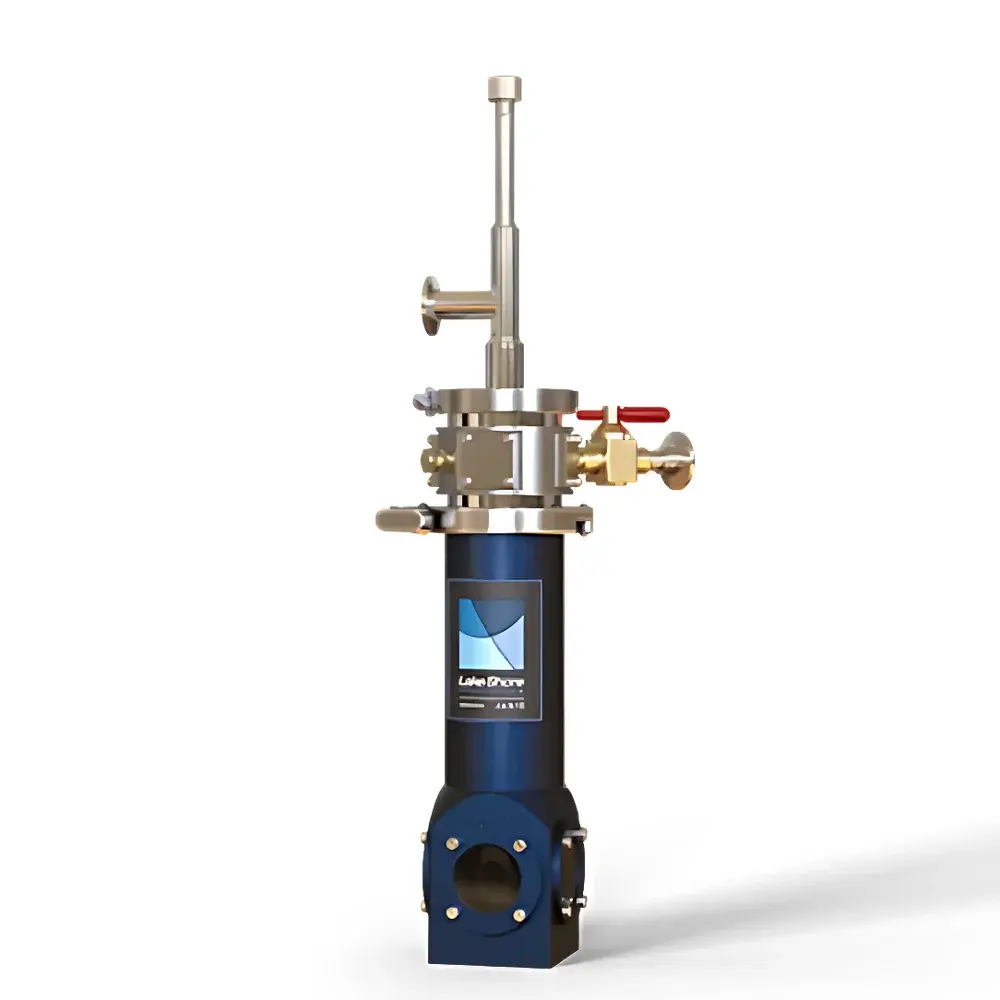
Lake Shore ST-100 Optical Cryogenic Thermostat
| Brand | Lake Shore |
|---|---|
| Origin | USA |
| Model | ST-100 |
| Cooling Method | Liquid Helium or Liquid Nitrogen Continuous-Flow |
| Temperature Range | 2 K to 500 K (ST-100) / 2 K to 800 K (ST-100-H) |
| Temperature Stability | ±50 mK |
| Sample Environment | High Vacuum (~10⁻⁵ Torr typical) |
| Optical Access | Yes, with standard optical windows |
| Cool-down Time | ≤15 min to 5 K |
| System Mass (excl. cryolines) | ~4.6 kg |
| Initial Cryogen Consumption (LHe, RT → base T) | 0.4 L |
| Steady-State LHe Consumption @ 5 K | 0.6 L/h |
| LN₂ Consumption @ 80 K | 0.1 L/h |
| Vacuum Requirement (initial) | ~10⁻³ Torr |
| Mounting Orientation | Omnidirectional |
| Sample Compatibility | Solid, thermally conductive specimens |
Overview
The Lake Shore ST-100 Optical Cryogenic Thermostat is a continuous-flow, vacuum-isolated cryostat engineered for precision low-temperature experimentation requiring optical access. It operates on the principle of direct conductive cooling via a cold finger immersed in liquid helium (LHe) or liquid nitrogen (LN₂), enabling stable thermal environments from 2 K up to 800 K—depending on configuration (ST-100 standard or ST-100-H high-temperature variant). Unlike closed-cycle refrigerators with mechanical vibration and thermal drift, the ST-100 delivers exceptional temperature homogeneity and temporal stability (±50 mK) through a combination of high-efficiency cryogen delivery lines, integrated resistive heating elements, and closed-loop control via the Lake Shore Model 335 Temperature Controller. Its all-metal, UHV-compatible construction ensures compatibility with ultra-high vacuum (UHV) systems, while its compact mass (~4.6 kg, excluding transfer lines) and omnidirectional mounting capability support integration into optical tables, probe stations, and custom experimental chambers.
Key Features
- Vacuum-isolated sample stage operating under high vacuum (typical base pressure ~10⁻⁵ Torr), minimizing conductive and convective heat load
- Standard optical access via sealed, anti-reflection coated windows optimized for UV–NIR transmission (custom window materials and coatings available)
- Rapid cool-down performance: reaches ≤5 K from ambient in under 15 minutes using liquid helium
- Dual-cryogen flexibility: supports both liquid helium (2 K–500 K) and liquid nitrogen (77 K–500 K) operation; optional high-temperature heater extends range to 800 K
- Modular integration with Lake Shore RGC series helium recirculation cryocoolers for fully cryogen-free operation across the full temperature span
- Thermally anchored sample mount designed for optimal thermal contact with solid, high-conductivity specimens (e.g., single crystals, thin films, semiconductor wafers)
- Compact footprint and lightweight design facilitate integration into space-constrained setups including confocal microscopes and magneto-optical platforms
Sample Compatibility & Compliance
The ST-100 accommodates solid-state samples with high thermal conductivity—such as metals, semiconductors, oxides, and epitaxial heterostructures—mounted directly onto the cold finger or via low-thermal-resistance interfaces (e.g., indium foil, silver epoxy). All internal surfaces are electropolished stainless steel or oxygen-free copper to ensure low outgassing and compatibility with UHV (<10⁻⁹ Torr) bake-out protocols when coupled with appropriate pumping. The system meets ASTM E2202-20 standards for cryogenic thermostat performance verification and is routinely deployed in laboratories adhering to ISO/IEC 17025 quality management requirements. When operated with the Model 335 controller and configured with audit-trail-enabled firmware, it supports GLP/GMP-aligned data integrity workflows per FDA 21 CFR Part 11 guidelines.
Software & Data Management
Temperature control, ramp profiling, and real-time monitoring are managed via Lake Shore’s CrossLink™ software suite, which provides native support for LabVIEW™, Python (PyVISA), and MATLAB® APIs. The Model 335 controller logs timestamped temperature, heater power, and sensor resistance data at user-defined intervals (down to 100 ms resolution), with automatic export to CSV or HDF5 formats. All setpoints, PID parameters, and alarm thresholds are stored with metadata—including operator ID, session timestamp, and instrument serial number—to satisfy traceability requirements in regulated research environments. Remote operation over Ethernet or USB is supported without proprietary drivers.
Applications
The ST-100 serves as a foundational platform for optical and electrical characterization at cryogenic temperatures, including but not limited to: photoluminescence (PL) and cathodoluminescence (CL) spectroscopy; Raman and FTIR measurements under controlled thermal bias; magneto-optical Kerr effect (MOKE) and Faraday rotation studies; quantum transport measurements (e.g., Hall effect, magnetoresistance) requiring optical access; calibration of infrared detectors and bolometers; and low-temperature testing of superconducting photonic devices. Its vacuum environment and optical ports also enable in situ annealing experiments and cryo-electron microscopy sample staging in hybrid configurations.
FAQ
Can the ST-100 operate without liquid helium?
Yes—when interfaced with an RGC-series helium recirculation cryocooler, the ST-100 achieves fully cryogen-free operation from 2 K to 500 K.
What vacuum pumps are recommended for initial pump-down and continuous operation?
A turbomolecular pump backed by a dry scroll pump is required to achieve the specified base pressure; residual gas analyzers (RGAs) are recommended for long-term vacuum health monitoring.
Is customization available for non-standard optical paths or electrical feedthroughs?
Yes—Lake Shore offers engineering consultation for bespoke flange configurations, multi-window arrangements, RF-tight shielding, and customized wiring harnesses compliant with MIL-STD-810G environmental testing.
How is temperature uniformity verified across the sample stage?
Lake Shore provides calibration certificates traceable to NIST standards, including spatial temperature mapping data collected using calibrated Cernox™ sensors at multiple radial and axial positions.
Does the ST-100 support automated temperature sweeps synchronized with external measurement hardware?
Yes—via TTL-triggered ramp sequences and programmable digital I/O on the Model 335, enabling synchronization with lock-in amplifiers, spectrometers, and pulse generators.



