
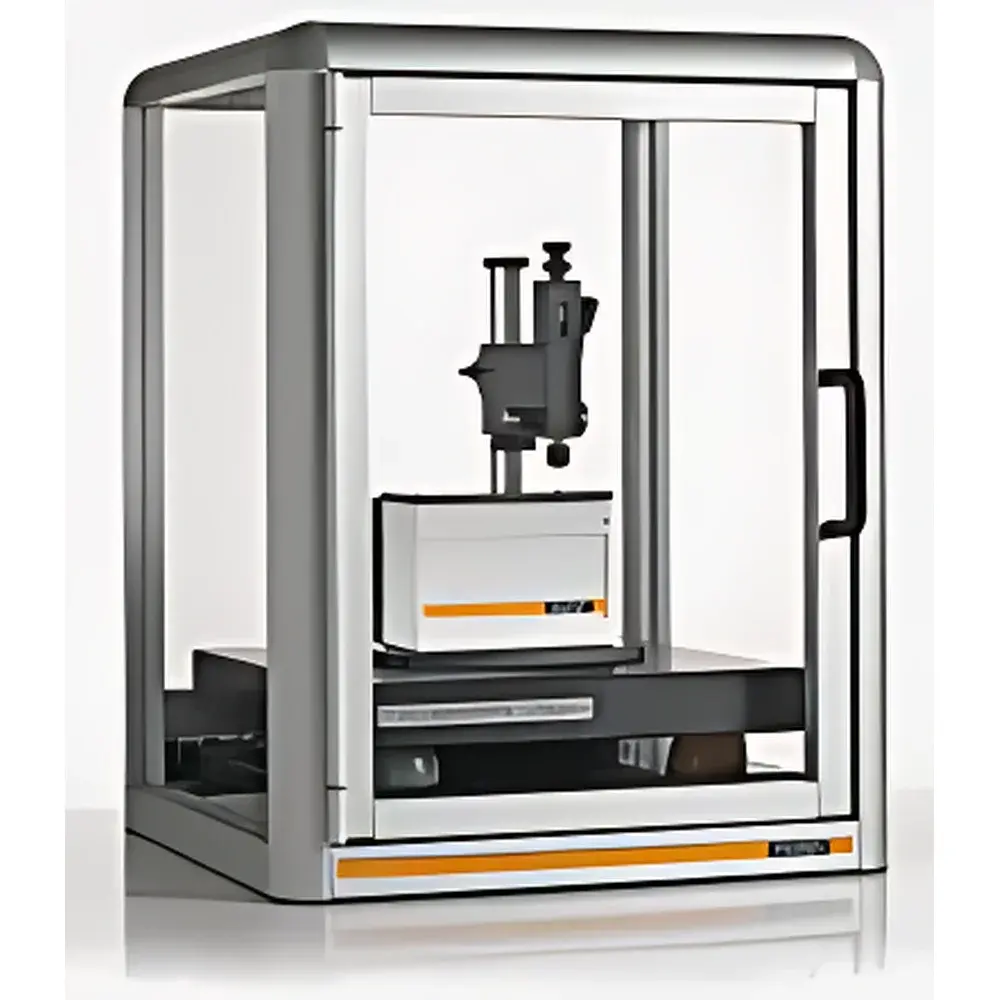
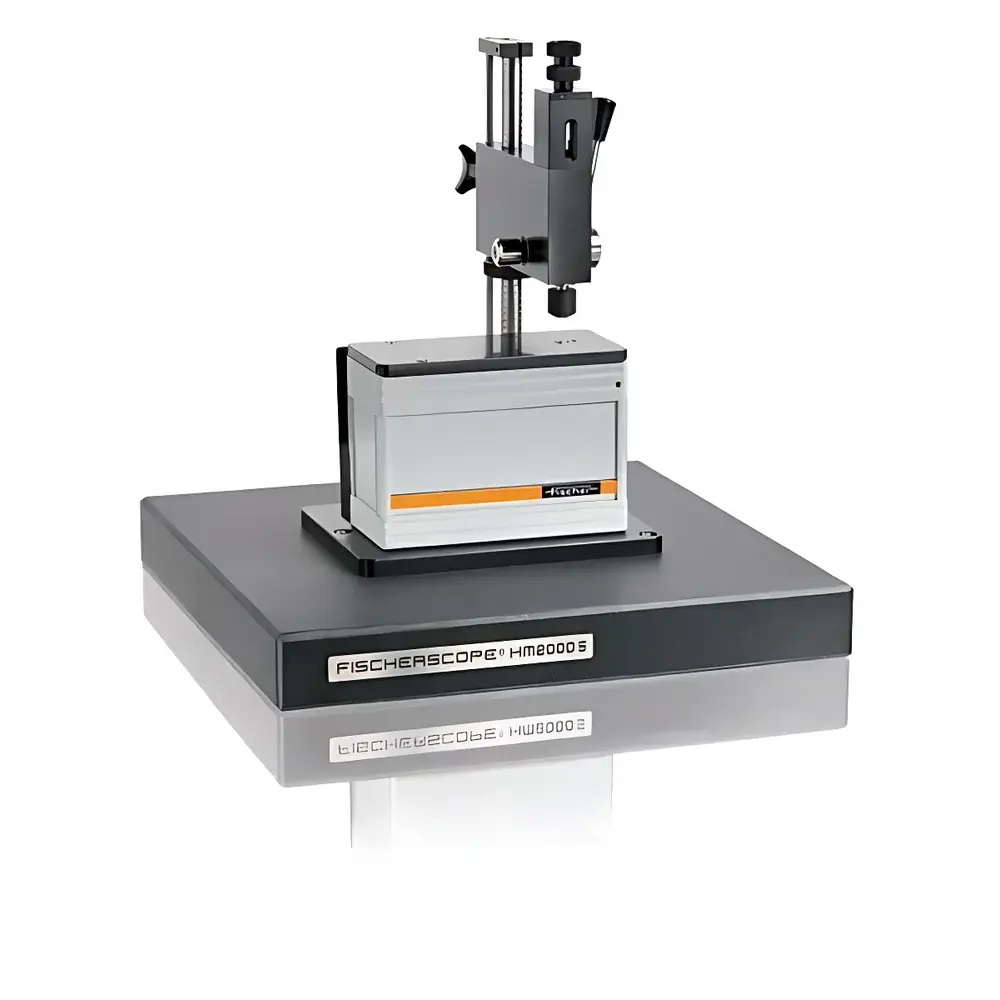
FISCHERSCOPE® HM2000S Nanoindentation Tester
| Brand | Fischer |
|---|---|
| Origin | Germany |
| Model | HM2000_S |
| Compliance | DIN EN ISO 14577 |
| Measurement Principle | Instrumented Indentation Testing (IIT) |
| Output Parameters | Martens Hardness (HM), Indentation Hardness (HIT), Indentation Modulus (EIT), Indentation Creep (CIT), Elastic Work Ratio (ηIT = Welast/Wtotal) |
| Enhanced Stiffness Procedure (ESP) | Yes |
| Load Range | Sub-mN to 1 N (typical for micro/nano-scale IIT systems) |
| Depth Resolution | < 0.1 nm |
| Load Resolution | < 1 µN |
| Sample Height Max | ~100 mm |
| XY Stage Travel | 100 × 100 mm (motorized, optional) |
Overview
The FISCHERSCOPE® HM2000S is a precision-engineered instrumented indentation tester designed for quantitative mechanical characterization of thin films, coatings, and bulk materials at the micro- and nanoscale. Based on the internationally recognized DIN EN ISO 14577 standard, it implements instrumented indentation testing (IIT) — a method in which load and displacement are continuously and synchronously recorded during controlled quasi-static indentation. This enables direct extraction of material-specific parameters including Martens hardness (HM), indentation hardness (HIT), indentation modulus (EIT), indentation creep (CIT), and elastic work ratio (ηIT). Unlike conventional hardness testers, the HM2000S operates without optical alignment dependency for tip positioning, making it particularly suitable for small, irregular, or high-aspect-ratio samples — such as electronic contacts, solder bumps, PVD/CVD-coated cutting tools, anodized aluminum surfaces, and biomedical polymer layers. Its modular architecture supports integration into regulated environments where traceability, repeatability, and audit-ready data handling are essential.
Key Features
- Compliance with DIN EN ISO 14577 for standardized indentation testing across industrial and academic laboratories
- Enhanced Stiffness Procedure (ESP) enabling depth- or load-resolved property mapping — e.g., EIT(HIT) vs. penetration depth — critical for graded or multilayered systems
- High-resolution force and displacement sensing: typical load resolution < 1 µN and depth resolution < 0.1 nm, ensuring sensitivity for soft polymers and stiff ceramics alike
- Motorized XYZ stage with programmable positioning (optional 100 × 100 mm travel), supporting automated grid-based testing and statistical sampling per ASTM E384 or ISO 14577 Annex D
- Interchangeable indenter geometries (Berkovich, Vickers, spherical, cube-corner) mounted via standardized collet system for rapid method switching
- Thermal drift compensation algorithm integrated into real-time control loop, minimizing measurement uncertainty in ambient lab conditions
Sample Compatibility & Compliance
The HM2000S accommodates a broad spectrum of sample types without requiring conductive coating or vacuum environment: electrically insulating polymers, oxide layers, elastomers, metallic alloys, and brittle ceramics. Typical specimen dimensions range from 1 mm² chips to 100 mm diameter wafers or cross-sectioned metallographic mounts. Surface roughness up to Ra ≈ 1 µm remains compatible when using appropriate tip geometry and loading protocol. All test procedures adhere to ISO 14577-defined validity criteria — including minimum indentation depth relative to surface roughness and required unloading rate consistency. For regulated industries (e.g., medical device manufacturing or aerospace component QA), the system supports GLP/GMP-aligned operation through user access control, electronic signature capability, and full audit trail generation compliant with FDA 21 CFR Part 11 requirements when paired with validated software modules.
Software & Data Management
The HM2000S operates under FISCHER’s proprietary WinHardness software platform, which provides guided workflow setup, real-time curve visualization, automatic parameter calculation per ISO 14577 Annex A, and export to CSV, XML, or PDF formats. Raw force–displacement datasets are stored with full metadata (operator ID, timestamp, environmental conditions, calibration history). Batch analysis tools enable statistical evaluation across multiple indentations, including Weibull distribution fitting for brittle materials. Data integrity is reinforced by checksum-verified storage, version-controlled method templates, and optional networked database synchronization for centralized QC reporting. Software validation documentation (IQ/OQ/PQ protocols) is available upon request for pharmaceutical or medical device quality systems.
Applications
- Quality assurance of decorative and functional electroplated layers (e.g., Ni, Cr, Au, Sn) on automotive connectors and PCBs
- Mechanical grading of thermal barrier coatings (TBCs) and wear-resistant PVD/CVD films on turbine blades or orthopedic implants
- Depth-dependent modulus profiling in ion-implanted semiconductor surfaces or graded DLC coatings
- Creep behavior quantification in soft biomaterials (e.g., hydrogels, silicone elastomers) under physiological loads
- Process monitoring of anodization thickness and hardness evolution in aluminum alloys for aerospace extrusions
- Failure analysis of intermetallic compound formation at solder joint interfaces via localized hardness mapping
FAQ
Does the HM2000S require vacuum or inert atmosphere operation?
No — the system performs reliably in standard laboratory air; optional environmental chambers support temperature-controlled testing from −40 °C to +200 °C.
Can HIT values be directly converted to Vickers hardness (HV)?
Yes — WinHardness applies ISO 14577-recommended conversion factors based on indenter geometry and material class, with documented uncertainty propagation.
Is calibration traceable to national standards?
All force and displacement sensors are factory-calibrated against PTB-traceable reference standards; annual recalibration services include NIST-traceable certificates.
How is tip geometry verified prior to testing?
Tip certification is performed via SEM imaging and tip radius quantification (e.g., Berkovich tip radius < 50 nm); routine tip wear monitoring is integrated into software diagnostics.
What sample preparation is required?
Minimal preparation is needed — flat, stable mounting is sufficient; cross-sectional polishing is recommended only for interface-specific measurements in multilayer stacks.



