
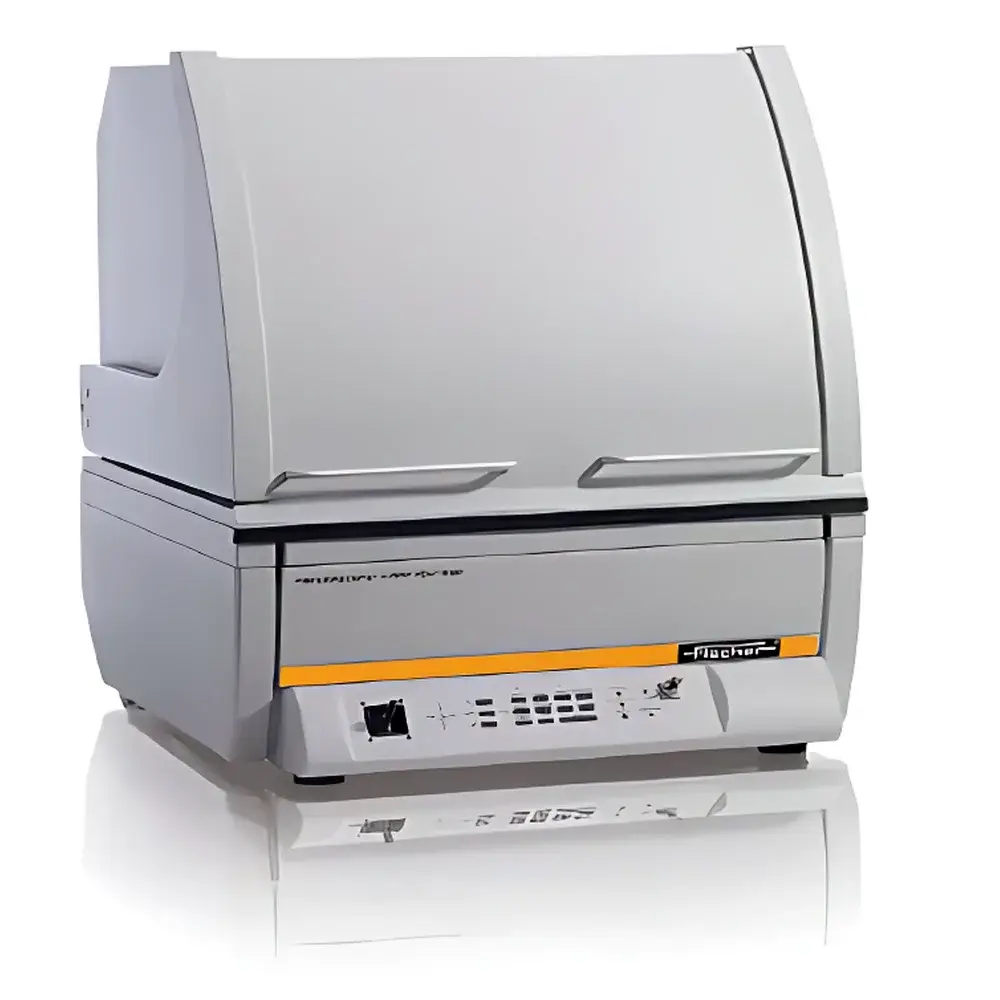
FISCHERSCOPE® X-RAY XDV-SDD® Energy-Dispersive X-ray Fluorescence Thickness Analyzer and Material Analyzer
| Brand | Fischer |
|---|---|
| Origin | Germany |
| Model | XDV-SDD |
| Detector Type | Silicon Drift Detector (SDD) |
| Excitation Source | Micro-focus Tungsten X-ray Tube with Beryllium Window |
| Adjustable Tube Voltage | 3 kV / 15 kV / 50 kV |
| Filter Options | 6 interchangeable primary filters |
| Collimators | Motorized, switchable |
| Elemental Range | Al (13) to U (92), up to 24 elements simultaneously quantifiable |
| Sample Stage | Motorized, programmable X/Y translation stage + motorized Z-axis lift |
| Safety | Interlocked top-hinged measurement door with automatic sample-stage egress |
| Imaging System | Integrated high-resolution video camera with 10× digital zoom, crosshair overlay, and real-time positioning feedback |
| Software Platform | WinFTM® v8.x (compliant with ISO 3497, ASTM B568, DIN 50981, and EN ISO 3497 for coating thickness measurement) |
Overview
The FISCHERSCOPE® X-RAY XDV-SDD® is a benchtop energy-dispersive X-ray fluorescence (ED-XRF) analyzer engineered for non-destructive, high-precision measurement of ultra-thin metallic coatings and quantitative elemental analysis of solid materials. Based on the fundamental principle of X-ray fluorescence—where incident X-rays eject inner-shell electrons from atoms in the sample, inducing characteristic secondary (fluorescent) X-ray emission—the instrument enables trace-level detection and layer-thickness determination via spectral deconvolution of element-specific peaks. Its micro-focus tungsten X-ray tube with beryllium window delivers optimized excitation across low- to high-Z elements, while the silicon drift detector (SDD) provides high count-rate capability (>100,000 cps), excellent energy resolution (<135 eV at Mn Kα), and stable long-term performance without liquid nitrogen cooling. Designed for metrological rigor in quality control laboratories, R&D facilities, and electroplating production environments, the XDV-SDD meets the physical and operational requirements of ISO/IEC 17025-accredited testing labs.
Key Features
- Motorized, programmable X/Y stage with sub-micron repeatability and software-defined measurement grids for automated multi-point analysis
- Motor-driven Z-axis lift enabling precise focal distance control (optimized for spot sizes ranging from 10 µm to 1 mm)
- Interlocked top-hinged measurement door that triggers automatic stage retraction for safe, ergonomic sample loading
- Integrated HD video system with real-time magnification, crosshair overlay, and live coordinate mapping for accurate positioning
- Motorized collimator and filter changer supporting rapid method switching between thin-film, bulk, and multi-layer applications
- Three-step adjustable tube voltage (3 kV / 15 kV / 50 kV) and six selectable primary filters to optimize excitation efficiency per matrix and coating system
- WinFTM® software platform with full support for calibration curve management, matrix correction (fundamental parameters & empirical), and statistical process control (SPC) export
Sample Compatibility & Compliance
The XDV-SDD accommodates flat, curved, or irregularly shaped samples up to 250 × 250 mm in footprint and 120 mm in height. It supports single-layer, multi-layer (e.g., Ni/Cu/Fe, Sn/Pb, Cr/Ni/steel), and alloyed substrates—including printed circuit boards, automotive fasteners, semiconductor leadframes, and jewelry components. Measurement protocols are fully aligned with international standards including ISO 3497 (metallic coatings — X-ray spectrometric methods), ASTM B568 (standard test method for coating thickness by X-ray spectroscopy), DIN 50981 (XRF-based coating analysis), and EN ISO 3497. Instrument validation documentation, IQ/OQ protocols, and audit-ready electronic records comply with GLP and GMP requirements; WinFTM® supports 21 CFR Part 11-compliant user access control, electronic signatures, and full audit trail functionality.
Software & Data Management
WinFTM® v8.x serves as the central analytical engine—providing intuitive workflow navigation, method template libraries, and embedded uncertainty estimation per ISO/IEC Guide 98-3 (GUM). All measurement data—including raw spectra, peak deconvolution results, layer thickness values, elemental concentrations, and statistical summaries—are stored in a relational database with configurable metadata fields (sample ID, operator, date/time, lot number, method version). Reports are exportable in PDF, CSV, XML, and SPC-compatible formats. Batch processing, trend charting, and automated pass/fail evaluation against user-defined specification limits are natively supported. Data integrity is reinforced through encrypted local storage, role-based permissions, and optional network deployment with centralized license and configuration management.
Applications
- Thickness measurement of nanoscale electroplated layers (e.g., Au, Pd, Ni, Sn, Cr) on PCBs and connectors
- Quantitative analysis of alloy composition in solder pastes, brazing foils, and precious metal plating baths
- Verification of RoHS-compliant surface finishes (Pb, Cd, Hg, Cr⁶⁺, Br) in electronics manufacturing
- Quality assurance of decorative and functional coatings on automotive trim, medical devices, and aerospace components
- Research-grade characterization of diffusion barriers, intermetallic phases, and oxidation layers in thin-film metallurgy
- Batch-to-batch consistency monitoring in continuous plating lines using statistical process control integration
FAQ
What is the minimum detectable thickness for gold on nickel using the XDV-SDD?
Detection limits depend on measurement time, spot size, and substrate composition; typical 3σ detection for Au/Ni is ≤0.005 µm under optimized conditions (60 s, 100 µm collimator, 50 kV excitation).
Can the XDV-SDD analyze multi-layer systems with overlapping fluorescence lines?
Yes—WinFTM® employs fundamental parameter (FP) modeling combined with iterative peak fitting to resolve spectral interferences (e.g., Cu Kβ/Sn Kα, Ni Kβ/Zn Kα) and quantify individual layer thicknesses and compositions.
Is remote operation or integration into factory MES systems supported?
The instrument supports TCP/IP communication via Ethernet; OPC UA and custom API interfaces are available for MES/SCADA integration upon request.
Does the system require annual recalibration or certified reference materials?
While no mandatory annual recalibration is required, periodic verification using NIST-traceable multilayer standards (e.g., Fischer’s certified reference foils) is recommended per ISO/IEC 17025 clause 7.7.
How is radiation safety ensured during routine operation?
The XDV-SDD is classified as a Class I radiation device per IEC 61010-1 and features redundant hardware interlocks, lead-shielded housing, and automatic beam cutoff upon door opening—requiring no additional shielding or licensing in most jurisdictions.



