
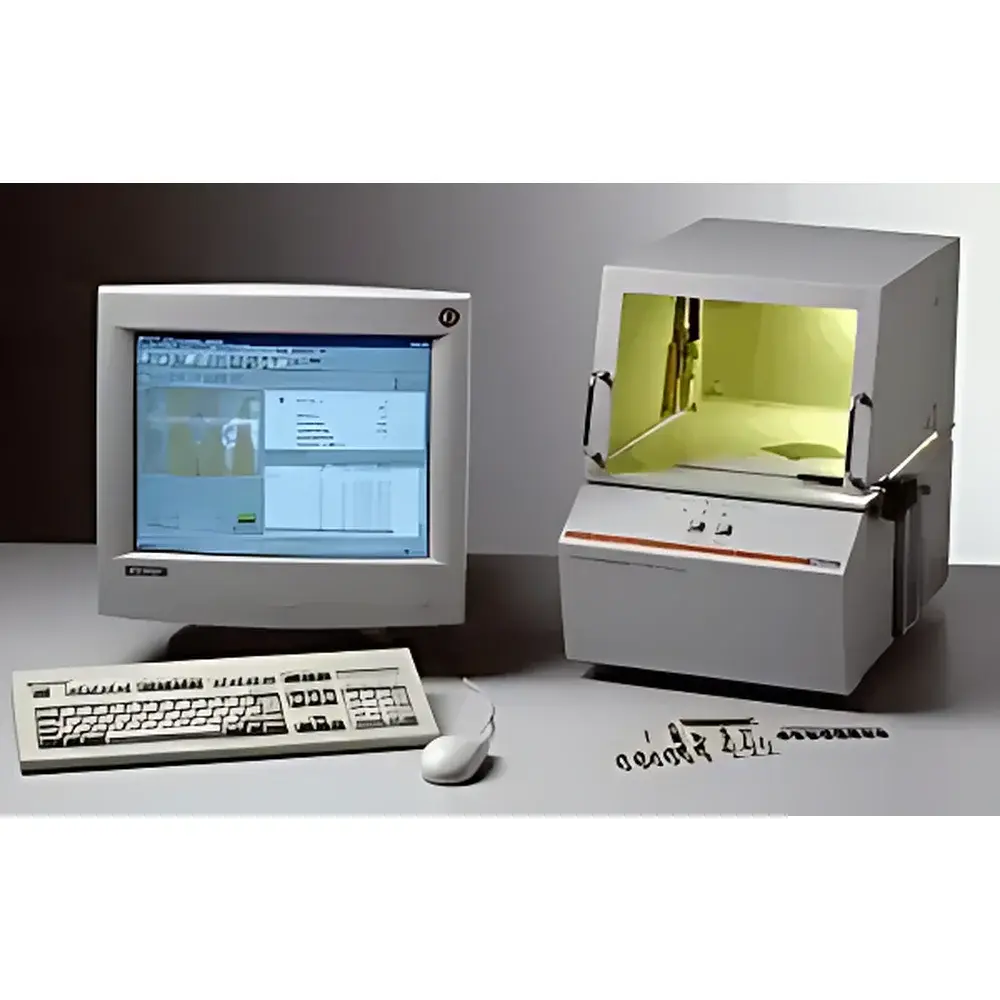
Fischer XUL Series X-Ray Fluorescence Coating Thickness Analyzer
| Brand | Fischer |
|---|---|
| Origin | Germany |
| Model | XUL Series |
| Measurement Principle | Energy-Dispersive X-Ray Fluorescence (ED-XRF) |
| Standards Compliance | DIN 50987, ISO 3497, ASTM B568 |
| X-ray Tube Voltage | Adjustable to 30 kV / 40 kV / 50 kV |
| Collimator Options | Ø0.3 mm circular or 0.05 × 0.3 mm rectangular (optional) |
| Sample Chamber Dimensions (W×D×H) | 455 × 580 × 510 mm |
| Internal Chamber Dimensions (W×D×H) | 360 × 380 × 240 mm |
| Manual X-Y Stage Travel | 50 mm (X) × 50 mm (Y) |
| Imaging System | Integrated color CCD camera with real-time magnified view and auto-focus |
| Beam Indicator | On-screen X-ray beam size overlay synchronized with focal distance |
| Software Platform | WinFTM® v6 (base) or Super WinFTM® (optional, order no. 602-950) |
| Language Support | English, German, French, Italian, Spanish, Chinese |
| Reporting | Graphical reports with embedded sample images, SPC charts, probability plots, histogram analysis |
| Regulatory Readiness | Supports GLP/GMP documentation workflows |
Overview
The Fischer XUL Series X-Ray Fluorescence Coating Thickness Analyzer is an energy-dispersive X-ray fluorescence (ED-XRF) instrument engineered for non-destructive, high-precision quantification of metallic coating thicknesses and elemental composition on solid substrates. Unlike conventional top-down ED-XRF systems, the XUL features a unique inverted geometry: the X-ray tube and Si-PIN or SDD detector are positioned beneath the measurement stage, enabling upward irradiation. This configuration eliminates dependence on precise sample-to-source distance adjustment—critical for irregularly shaped components such as screws, connectors, fasteners, and stamped parts. The system operates in full compliance with internationally recognized standards including DIN 50987, ISO 3497, and ASTM B568, ensuring traceable, repeatable, and metrologically sound measurements across single-, dual-, and triple-layer electroplated systems, as well as binary and ternary alloy coatings. Its design supports both routine QC verification and R&D-grade compositional analysis—including up to four-element alloy quantification and electrolyte metal ion concentration estimation—without requiring destructive sampling or surface preparation.
Key Features
- Inverted measurement architecture: X-ray source and detector mounted below the stage, enabling direct placement of complex-shaped samples onto the measurement surface without manual Z-axis alignment.
- Adjustable high-voltage X-ray tube (30/40/50 kV) optimized for excitation of elements from titanium (Ti) to uranium (U), supporting broad-spectrum application flexibility.
- High-resolution collimation options: standard Ø0.3 mm circular aperture; optional 0.05 × 0.3 mm rectangular collimator for micro-area analysis of fine features or narrow plating zones.
- Real-time visual guidance: integrated color CCD camera with digital zoom, auto-focus, and on-screen crosshair reticle calibrated to actual X-ray beam footprint—visually synchronized with measurement distance.
- Pic-in-pic display mode: simultaneous viewing of live sample image and spectral data during acquisition, enhancing operator confidence and positional repeatability.
- Dual software tiers: base WinFTM® v6 supports pre-configured applications and reporting; optional Super WinFTM® (Order No. 602-950) enables full application development, theoretical accuracy optimization per measurement mode, and rapid qualitative alloy identification via spectrum deconvolution.
Sample Compatibility & Compliance
The XUL accommodates a wide range of industrial components—from miniature electronic contacts and PCB vias to automotive fasteners and jewelry blanks—within its 360 × 380 × 240 mm internal chamber. The manually driven X-Y stage (50 mm travel in both axes) allows precise positioning under the fixed beam, while the upward irradiation path ensures consistent geometry regardless of part height variation. For precious metal assay (e.g., Au content in jewelry), the system integrates seamlessly with Fischer’s GOLDLINE ASSAY calibration kits, delivering certified results aligned with ISO 8654 and national hallmarking requirements. All measurement protocols adhere to ISO/IEC 17025 principles for testing laboratories, and when deployed with appropriate IT governance controls (e.g., password-protected user roles, electronic signatures, and audit-trail-enabled Super WinFTM®), the platform meets foundational expectations for FDA 21 CFR Part 11 and EU Annex 11 compliance in regulated manufacturing environments.
Software & Data Management
WinFTM® v6 provides a graphical, icon-driven interface localized in six languages, supporting customizable report templates with embedded annotated images, statistical process control (SPC) charts (X̄-R, Cpk), probability plots, and histogram-based distribution analysis. Raw spectra, measurement metadata, and operator logs are stored in structured binary format, exportable to CSV, XML, or PDF. Super WinFTM® extends functionality with full spectral library management, custom application creation using reference standards, dynamic limit setting based on theoretical detection limits, and automated batch processing for multi-site production monitoring. Both versions support secure data archiving and role-based access control—enabling implementation of GLP-aligned documentation practices in quality assurance departments.
Applications
- Thickness measurement of single-layer coatings (e.g., Ni, Cr, Sn, Zn, Ag, Au) on conductive and non-conductive substrates.
- Simultaneous determination of layer thickness and composition in duplex systems—e.g., Cu/Ni/Cr trilayers or Sn-Pb/Cu bimetallic finishes.
- Quantitative analysis of alloy electrodeposits: Ni-P, Sn-Cu, Zn-Ni, and Pb-Sn compositions, including independent thickness resolution of individual layers in stacked configurations.
- Gold purity verification in jewelry and dental alloys using Fischer GOLDLINE ASSAY methodology.
- Electrolyte bath monitoring via calibration transfer to aqueous standards for real-time Ni²⁺, Cu²⁺, or Sn²⁺ concentration estimation.
- Failure analysis support: identification of intermetallic diffusion, incomplete coverage, or selective corrosion through comparative spectral mapping.
FAQ
Does the XUL require radioactive sources or external cooling systems?
No. It uses a sealed, air-cooled X-ray tube with no isotopic materials—eliminating licensing, disposal, or regulatory oversight associated with radioisotope-based gauges.
Can the system measure coatings on curved or recessed surfaces?
Yes. The upward-beam geometry and large depth-of-field imaging allow reliable measurement on convex, concave, and stepped geometries—provided the target area remains within the collimated beam path and field of view.
What calibration standards are required for new applications?
Application-specific calibration requires traceable reference standards matching substrate/coating combinations. Pre-installed “no-standard” applications are available for common systems (e.g., Au/Ni/Cu); full method development requires ordered calibration kits (e.g., Gold Assay set).
Is remote diagnostics or firmware updates supported?
Yes—via secure HTTPS-based connection to Fischer’s service portal, subject to customer network policy and prior authorization.
How is measurement uncertainty estimated and reported?
Uncertainty budgets follow ISO/IEC Guide 98-3 (GUM), incorporating contributions from counting statistics, peak fitting residuals, matrix effects, and calibration standard uncertainties—all documented in test reports when enabled in Super WinFTM®.



