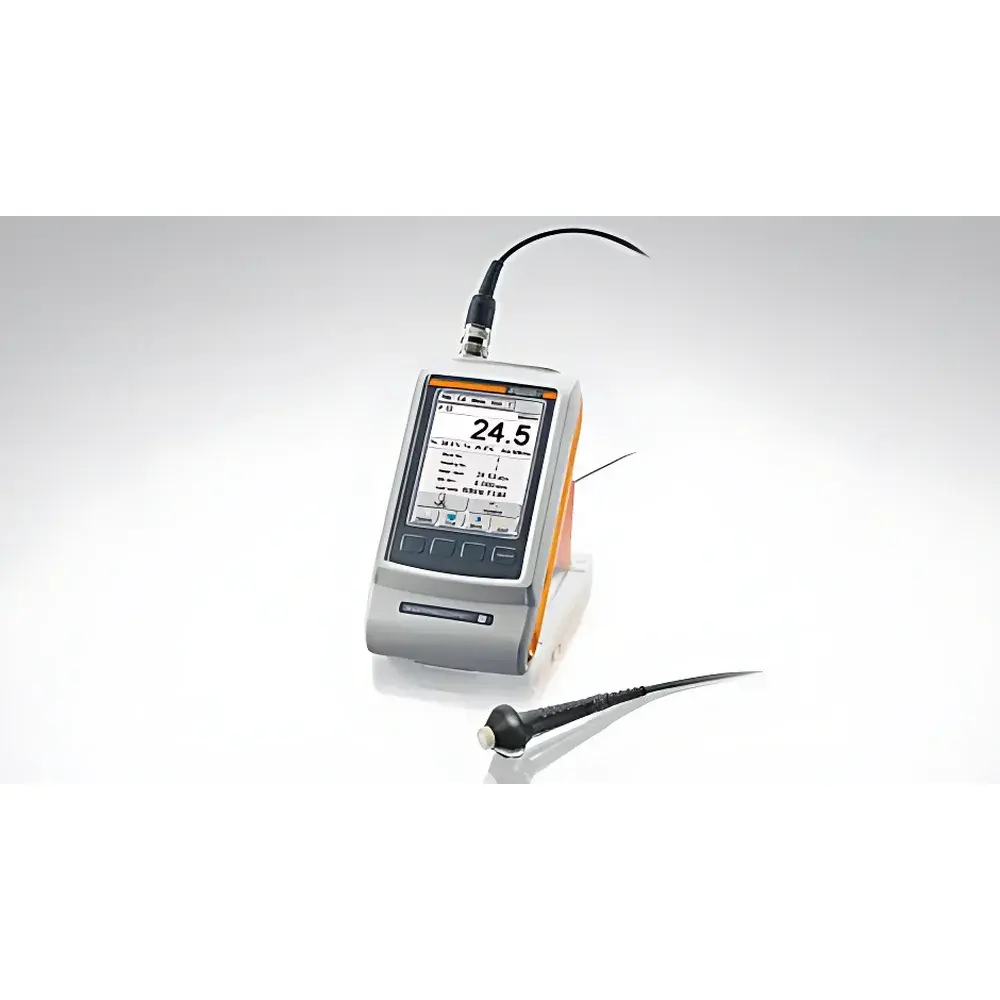
Fischer SIGMASCOPE SMP350 Handheld Eddy Current Conductivity Analyzer
| Brand | Fischer |
|---|---|
| Origin | Germany |
| Model | SIGMASCOPE SMP350 |
| Measurement Principle | Phase-Sensitive Eddy Current Method |
| Compliance | DIN EN 2004-1, ASTM E1004 |
| Frequency Range | 15 kHz to 1 MHz |
| Calibration Standards | Traceable to International Reference Standards (MS/m and %IACS) |
Overview
The Fischer SIGMASCOPE SMP350 is a portable, phase-sensitive eddy current conductivity analyzer engineered for high-reproducibility, non-destructive electrical conductivity measurements on non-ferromagnetic metals—including aluminum, copper, brass, and their alloys. Unlike DC resistance or four-point probe methods, the SMP350 employs a calibrated, frequency-tunable eddy current excitation system that induces a controlled alternating magnetic field in the sample surface. The resulting secondary field’s phase shift and amplitude attenuation are directly correlated to the material’s bulk electrical conductivity—enabling quantification with traceability to internationally recognized metrological standards. This principle underpins its acceptance in quality-critical aerospace, automotive, and precision manufacturing environments where thermal history, microstructural evolution, and alloy homogeneity must be verified without part removal or surface preparation.
Key Features
- Phase-sensitive eddy current measurement architecture optimized for conductivity resolution ≤0.1% IACS in routine operation
- Adjustable test frequency range (15 kHz – 1 MHz) via interchangeable probes—enabling depth-selective evaluation of near-surface conductivity gradients
- Automatic curvature compensation algorithm validated for cylindrical specimens down to 6 mm diameter, minimizing geometric error in tubing, rods, and fasteners
- Integrated temperature sensor and real-time thermal drift correction—critical for field measurements subject to ambient fluctuations
- On-device calibration verification using NIST-traceable reference standards (supplied as MS/m and %IACS certified foils)
- Ruggedized IP65-rated housing with ergonomic grip and glove-compatible touchscreen interface for shop-floor usability
Sample Compatibility & Compliance
The SMP350 is validated for use on flat, curved, or irregularly shaped non-ferromagnetic conductors with minimum thickness ≥3× skin depth at selected frequency. It supports rapid screening of extrusions, forgings, rolled sheets, and cast components across aerospace (e.g., 2024/7075 Al alloys), power transmission (Cu–Cr–Zr busbars), and coinage (Euro alloy validation per EN 14804). All measurement protocols conform to DIN EN 2004-1 “Non-destructive testing — Electrical conductivity measurements — Part 1: General principles” and ASTM E1004 “Standard Practice for Determining Electrical Conductivity Using the Electromagnetic (Eddy Current) Method”. Device firmware and calibration records support GLP-compliant data integrity requirements, including user-accessible audit trails and electronic signature capability (21 CFR Part 11 ready when paired with Fischer’s optional LabLink software suite).
Software & Data Management
Data acquisition, reporting, and fleet management are supported via Fischer’s Windows-based FISCHER DataCenter software (v5.2+). The platform enables batch export of conductivity values with full metadata (probe ID, frequency, temperature, operator, timestamp, GPS coordinates if enabled), statistical process control (SPC) charting, and automated pass/fail threshold mapping against material specification limits (e.g., AMS2658, EN 586-2). Raw phase/amplitude signals are stored in HDF5 format for third-party analysis. Calibration certificates—including uncertainty budgets per ISO/IEC 17025—are generated directly from instrument logs and digitally signed.
Applications
- Sorting incoming raw materials by alloy grade based on conductivity deviation thresholds
- Verifying heat treatment efficacy in age-hardened aluminum (e.g., T6 temper confirmation via σ = f(Tₐ, tₐ))
- Monitoring phosphorus segregation in oxygen-free copper (OF-Cu) during continuous casting
- Assessing thermal degradation in aircraft skin panels following lightning strike events
- Validating homogeneity of precipitation-hardened Cu–Cr–Zr after solution annealing and aging cycles
- Recycling stream qualification—distinguishing high-conductivity electrolytic tough pitch (ETP) copper from lower-grade scrap
FAQ
Does the SMP350 require physical contact with the sample surface?
Yes—consistent probe lift-off (≤0.1 mm) is required; the device includes spring-loaded probes with integrated wear indicators to maintain repeatability.
Can it measure conductivity through paint or anodized layers?
No—non-conductive coatings >10 µm thick attenuate the eddy current field beyond reliable detection; surface cleaning or localized coating removal is necessary.
Is probe calibration required before each measurement session?
A daily verification using the supplied reference standard is recommended; full recalibration is performed annually or after mechanical shock per ISO 17025 guidelines.
How does temperature affect measurement accuracy?
Conductivity exhibits linear thermal coefficient behavior (e.g., α ≈ −0.39%/°C for pure Cu); the SMP350 applies automatic compensation using its built-in thermistor and user-input material-specific α values.
What documentation is provided for regulatory audits?
Each unit ships with a factory calibration certificate (traceable to PTB/Germany), uncertainty budget, conformity statement to DIN EN 2004-1, and software validation report for DataCenter v5.2.
Related Products