
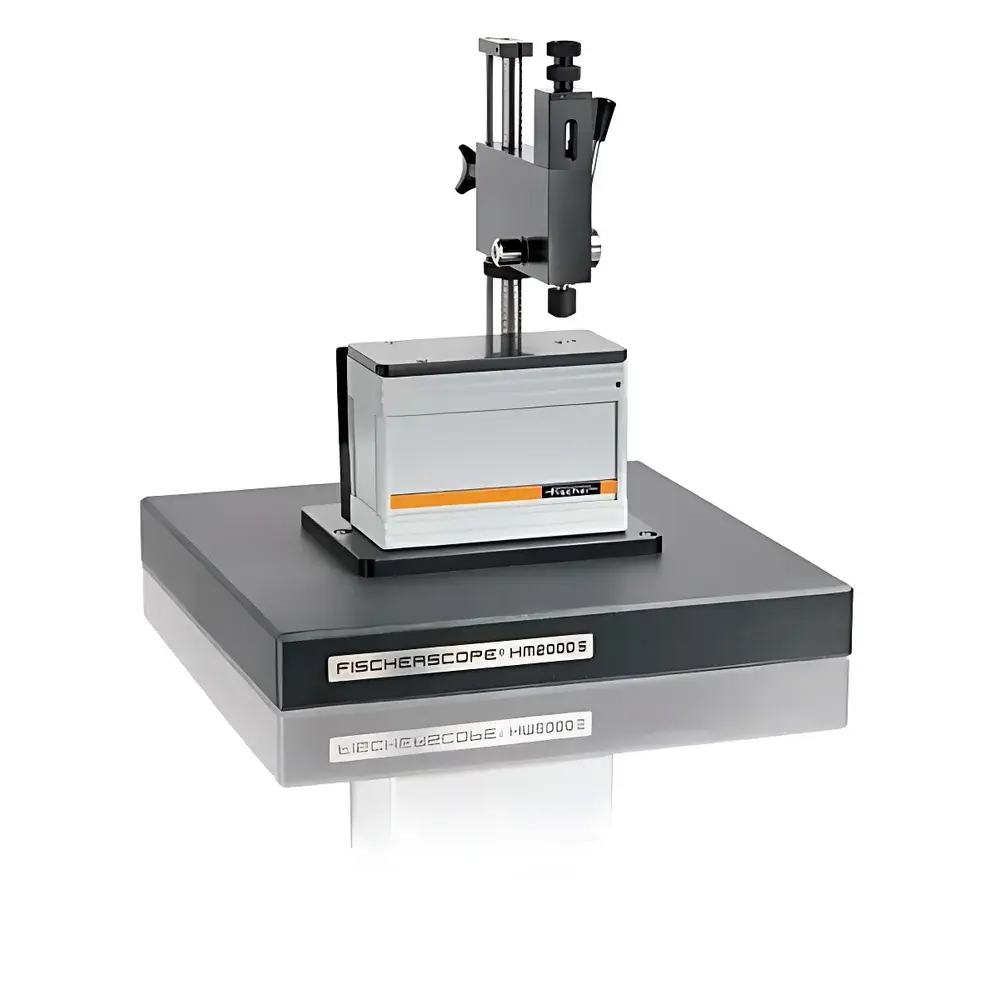
FISCHERSCOPE HM2000S Instrumented Indentation Tester
| Brand | Fischer |
|---|---|
| Origin | Germany |
| Model | HM2000S |
| Instrument Type | Microhardness Tester |
| Compliance | DIN EN ISO 14577 |
| Measurement Principle | Instrumented Indentation Testing (IIT) |
| Key Output Parameters | Martens Hardness (HM), Indentation Hardness (HIT), Indentation Modulus (EIT), Indentation Creep (CIT), Elastic Work Ratio (ηIT), Depth- and Load-Dependent Property Mapping via ESP Mode |
Overview
The FISCHERSCOPE® HM2000S is a precision-engineered instrumented indentation tester designed for quantitative mechanical characterization of thin films, coatings, and bulk materials at micro- and sub-micrometer scales. Operating in full compliance with DIN EN ISO 14577, it implements the standardized instrumented indentation testing (IIT) methodology—where force, displacement, and time are continuously and synchronously recorded during controlled loading–holding–unloading cycles. Unlike conventional Vickers or Knoop microhardness testers relying on optical impression measurement, the HM2000S derives material properties directly from the physical response curve, eliminating operator-dependent interpretation and enabling traceable, repeatable quantification of hardness, modulus, creep, and energy partitioning. Its high-resolution piezoelectric actuation system and closed-loop force-displacement control ensure sub-nanometer depth resolution and sub-micronewton force stability—critical for characterizing nanoscale PVD/CVD layers, electroplated finishes, anodized oxides, and soft polymeric or elastomeric systems.
Key Features
- Full compliance with DIN EN ISO 14577 for instrumented indentation testing, supporting audit-ready reporting in regulated environments.
- Integrated Enhanced Stiffness Procedure (ESP) mode: enables continuous acquisition of EIT and HIT as functions of indentation depth or applied load—ideal for gradient materials and interfacial property profiling.
- Automated positioning with high-precision motorized XYZ stage and integrated HD coaxial camera, allowing rapid targeting of features <5 µm in size—even on curved or textured substrates.
- Multi-scale indenter options: standard Berkovich (115°) diamond tip; optional cube-corner, spherical, or flat-punch geometries for specialized applications including viscoelastic analysis and contact-area calibration.
- Thermally stabilized measurement head and low-drift electronics minimize thermal drift (<0.1 nm/s), ensuring data integrity during extended hold periods required for CIT evaluation.
- Modular design supports future upgrades—including environmental control modules (temperature, humidity) and in-situ electrical property coupling for multifunctional thin-film metrology.
Sample Compatibility & Compliance
The HM2000S accommodates diverse sample geometries—from flat wafers and cross-sectioned metallographic mounts to irregularly shaped electronic components, medical implants, and coated polymer parts. Sample height range: 0–120 mm; maximum weight: 5 kg. Surface roughness tolerance up to Ra 5 µm without compromising measurement fidelity, thanks to real-time surface detection and adaptive zero-point calibration. All generated hardness and modulus values are traceable to SI units via certified reference standards (e.g., NIST SRM 2099, PTB-certified fused silica). The system meets requirements for GLP-compliant laboratories and supports FDA 21 CFR Part 11–ready software configurations when paired with validated firmware and audit-trail-enabled operation protocols.
Software & Data Management
Equipped with FISCHER’s proprietary Win-HCU software, the HM2000S provides comprehensive test definition, real-time visualization of load–displacement curves, automated parameter extraction (HM, HIT, EIT, CIT, ηIT), and customizable report generation per ISO 14577 Annex A. Data export formats include CSV, XML, and PDF with embedded metadata (operator ID, timestamp, calibration status, environmental conditions). Software architecture supports multi-user role-based access control, electronic signatures, and full audit trail logging—including all parameter modifications, result re-calculations, and report exports. Integration with LIMS and MES platforms is achievable via OPC UA or RESTful API interfaces, facilitating seamless incorporation into digital quality management workflows.
Applications
- Coating R&D: Quantifying mechanical performance of TiN, CrN, DLC, and AlTiN PVD/CVD layers on cutting tools and aerospace components.
- Electroplating QC: Verifying hardness and elastic recovery of decorative Ni/Cr stacks or functional Au/Pd plating on PCBs and connectors.
- Medical Device Validation: Measuring surface hardness and creep resistance of anodized titanium orthopedic implants and hydroxyapatite coatings.
- Electronics Reliability: Assessing mechanical integrity of solder bumps, bond wires, and under-bump metallization (UBM) layers under thermo-mechanical stress.
- Automotive & Aerospace: Characterizing wear-resistant oxide layers on aluminum alloys and thermal barrier coatings on turbine blades.
- Soft Materials Analysis: Determining time-dependent deformation behavior of silicone encapsulants, hydrogels, and pressure-sensitive adhesives using extended hold protocols.
FAQ
Does the HM2000S require regular recalibration against physical standards?
Yes—annual traceable calibration using certified reference materials (e.g., fused silica, sapphire, hardened steel) is recommended per ISO/IEC 17025 guidelines. Built-in self-diagnostic routines verify force and displacement sensor linearity before each test series.
Can the HM2000S measure coatings thinner than 100 nm?
Yes, provided substrate effects are minimized via appropriate test depth selection (typically ≤10% of coating thickness) and use of high-sensitivity ESP mode. Data interpretation must account for substrate influence using established models (e.g., Oliver–Pharr with bilayer correction).
Is the system compatible with non-flat or curved samples?
Yes—the motorized Z-axis with active surface detection automatically establishes the zero point on inclined, convex, or concave surfaces. Sample tilt compensation up to ±5° is supported via software-assisted alignment routines.
How does the HM2000S handle viscoelastic materials like rubber or gels?
Through programmable multi-cycle loading sequences and extended dwell times (up to 10,000 s), the system captures time-dependent recovery and creep behavior. CIT and ηIT parameters are calculated directly from the unloading segment and holding phase, respectively.
What documentation is provided for regulatory submissions?
A complete IQ/OQ protocol package, software validation summary, and ISO 14577-compliant test reports—including raw force–displacement datasets, uncertainty budgets, and metrological traceability statements—are available upon request for FDA, CE, or MDR submissions.



