
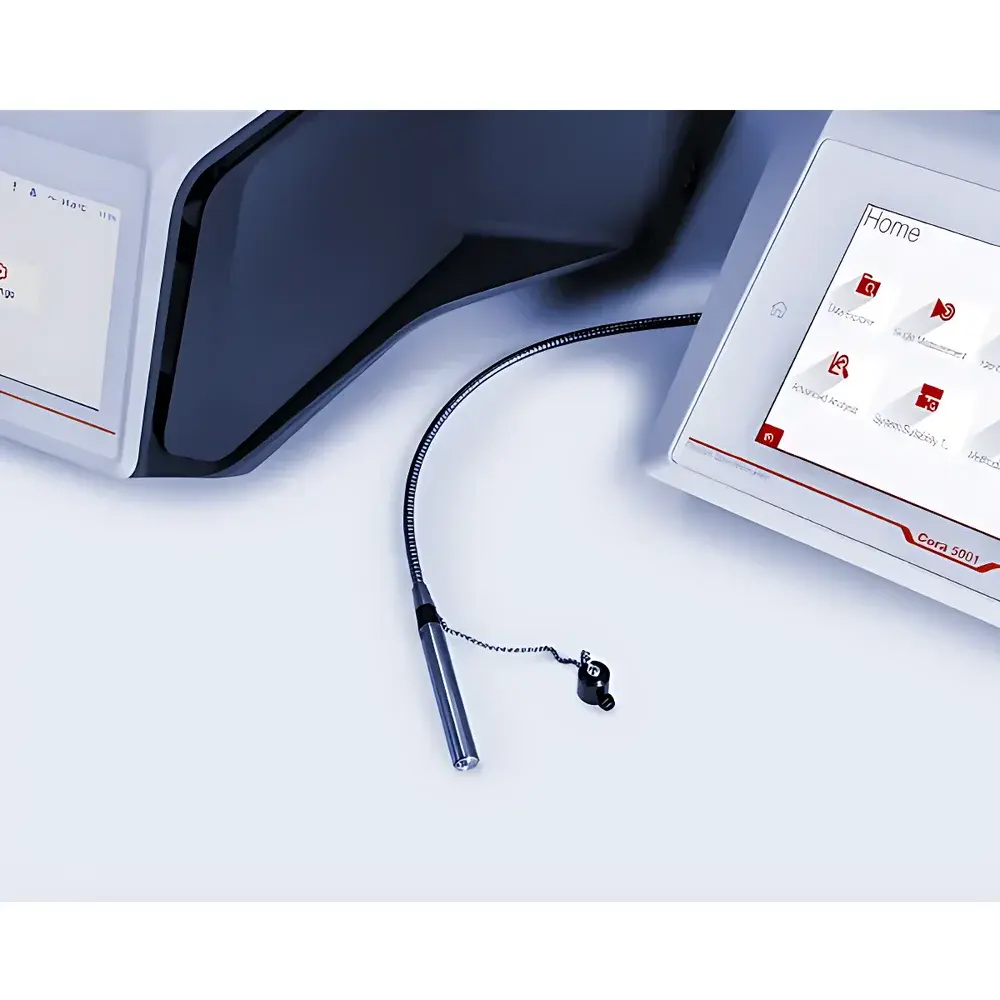
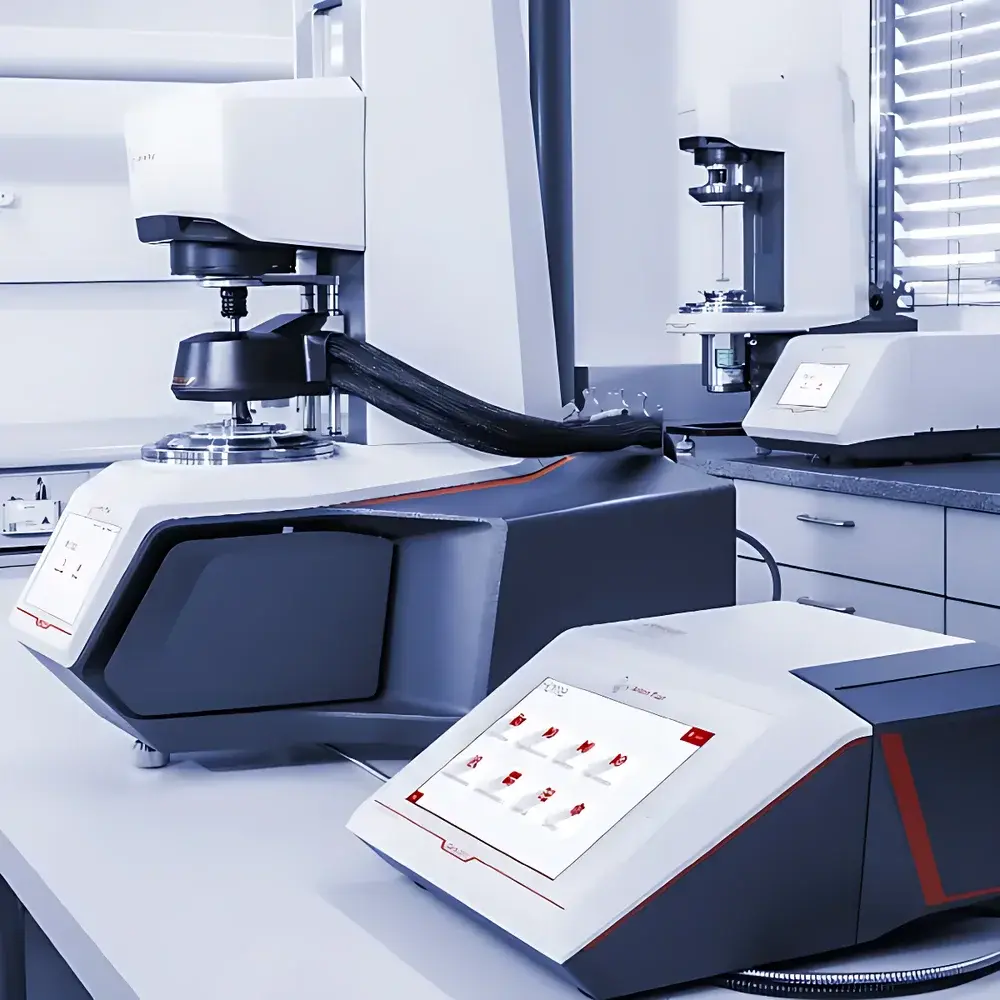
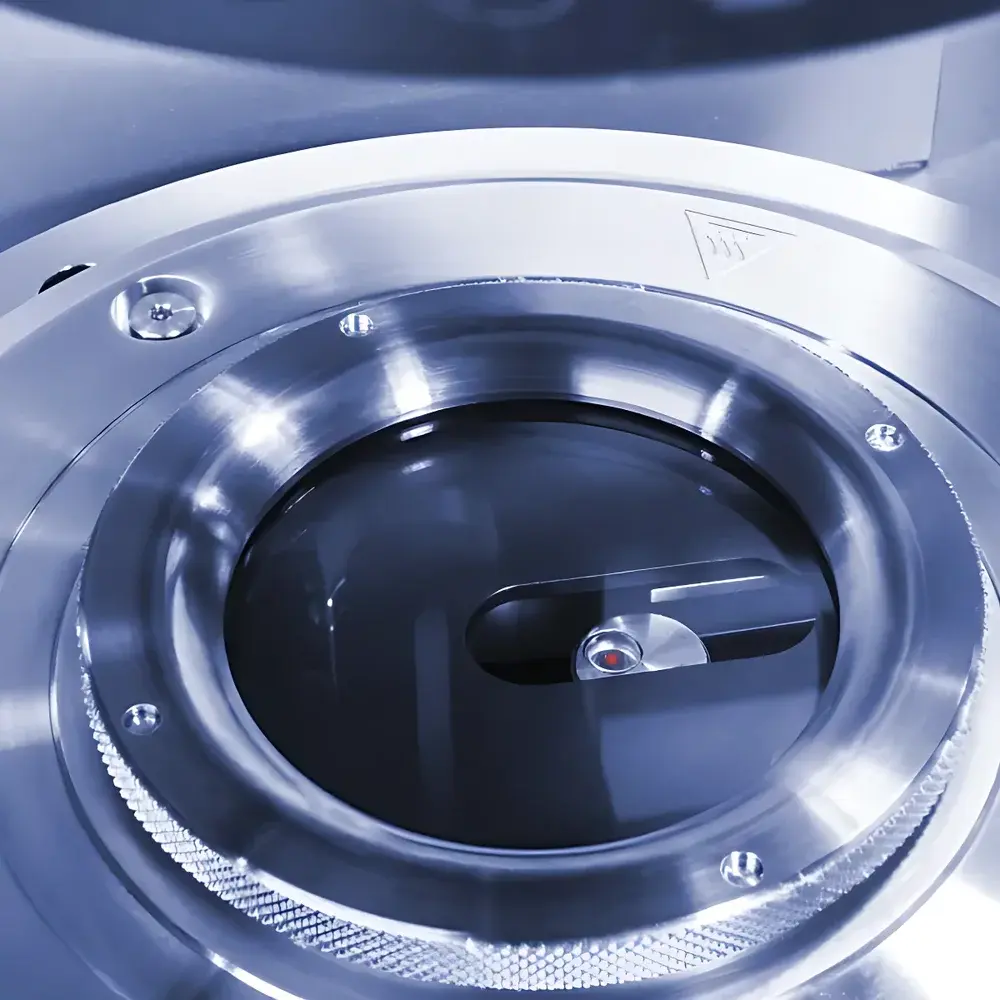
Anton Paar MCR Rheometer + Cora 5001 Raman Spectrometer Hybrid System
| Brand | Anton Paar |
|---|---|
| Origin | Austria |
| Manufacturer Type | Original Equipment Manufacturer (OEM) |
| Country of Origin | Imported |
| Model | MCR Series + Cora 5001 |
| Instrument Type | Rotational Rheometer with Integrated In Situ Raman Spectroscopy |
| Sample Type | High-Viscosity Liquids and Melts |
| Sample State | Liquid/Melt |
| Bearing System | Precision Porous Carbon Air Bearing |
| Temperature Range | 10 °C to 35 °C (non-condensing environment) |
| Frequency Range | 2 × 10⁻⁸ Hz to 200 Hz |
| Minimum Rotational Speed | 0 rpm |
| Maximum Torque | 300 mNm |
| Maximum Rotational Speed | 3000 rpm |
| Torque Resolution | 0.05 nNm (with TruStrain™ active) |
| Excitation Wavelengths | 532 nm, 785 nm, and 1064 nm (dual-wavelength configuration available) |
| Raman Spectral Range | 100–3500 cm⁻¹ (dependent on laser wavelength) |
| Spectral Resolution (ASTM E2529) | 6–17 cm⁻¹ |
| Laser Power | Adjustable up to 450 mW (sample-side) |
| Detector | 2048-pixel CCD (532/785 nm), 256-pixel InGaAs (1064 nm) |
| Data Acquisition | Real-time synchronized rheological and spectral streaming |
Overview
The Anton Paar MCR Rheometer + Cora 5001 Raman Spectrometer Hybrid System is an engineered platform for correlative in situ rheo-Raman characterization of soft matter. It integrates high-precision rotational rheometry—based on Couette flow geometry and torque-controlled or strain-controlled operation—with confocal, fiber-coupled Raman spectroscopy. This dual-modality architecture enables simultaneous acquisition of mechanical response (storage/loss moduli, viscosity, yield stress, thixotropy) and molecular fingerprinting (bond vibrations, conformational changes, crosslink density, photopolymerization kinetics) under identical thermal, shear, and environmental conditions. Unlike sequential or offline coupling approaches, this system maintains strict temporal and spatial synchronization between mechanical stimulus and spectral readout—critical for establishing causal structure–property relationships in viscoelastic materials. The platform is particularly suited for studies where macroscopic rheological transitions (e.g., gelation, vitrification, shear thinning onset) must be directly linked to molecular events such as chain alignment, crystallite formation, or photochemical bond cleavage.
Key Features
- Modular integration: MCR rheometers (MCR 303, MCR 503, MCR 503 Power) and Cora 5001 spectrometers are mechanically and software-interlocked yet fully decouplable in under 60 seconds—no tools or service engineer required.
- Air-bearing torque transduction with 0.05 nNm resolution (TruStrain™ enabled) ensures ultra-low-noise measurement down to 2 × 10⁻⁸ Hz oscillatory frequencies—essential for probing terminal relaxation and glassy dynamics.
- Dual-wavelength Raman capability (e.g., 532 nm + 785 nm) allows comparative analysis of fluorescence-sensitive and resonance-enhanced systems while minimizing sample degradation during UV-curable process monitoring.
- Real-time spectral stitching and time-resolved chemometrics: Spectra acquired at 5–600 ms integration intervals are timestamped, aligned, and exported with rheological metadata (stress, strain, frequency, temperature) in standardized .csv and .spc formats.
- Comprehensive compliance-ready software suite: RheoCompass™ supports audit trails, electronic signatures, and 21 CFR Part 11–compliant user role management; spectral processing includes baseline correction, peak deconvolution, and PCA-driven trend analysis.
- Thermally stabilized optical path: Active temperature control of the Cora 5001’s VPG spectrometer and fiber interface ensures long-term spectral reproducibility (<0.1 cm⁻¹ drift over 8 h) across ambient lab conditions (10–35 °C).
Sample Compatibility & Compliance
The system accommodates liquid, molten, and semi-solid samples—including thermosets, photocurable resins, polymer melts, adhesives, and colloidal dispersions—within standard Peltier-controlled geometries (cone-plate, parallel-plate, serrated plates). All fluid-contact components comply with ISO 17025 calibration traceability requirements. Raman fiber probes meet IEC 60825-1 Class 3B laser safety standards; optional explosion-proof enclosures are available for ATEX Zone 2 environments. Data handling adheres to GLP/GMP principles: raw spectra and rheograms are immutable upon acquisition; version-controlled method templates enforce SOP consistency across operators and shifts. Full traceability is maintained via embedded instrument logs (firmware versions, calibration dates, environmental sensor readings).
Software & Data Management
RheoCompass™ v4.x serves as the unified control and analysis hub. It orchestrates synchronized acquisition, real-time visualization of G′/G″ vs. time and Raman intensity vs. wavenumber, and automated event-triggered sampling (e.g., initiate spectral capture at tan δ = 1). Processed data exports support ASTM E1441-compliant spectral metadata embedding and HDF5-based hierarchical storage for large-scale kinetic datasets. Integration with third-party chemometric toolkits (e.g., Python scikit-learn, MATLAB PLS Toolbox) is enabled via open API. Audit trails record every parameter change, user login/logout, and file export—fully compliant with FDA 21 CFR Part 11 requirements for regulated laboratories.
Applications
- Photopolymerization kinetics: Monitor C=C bond consumption and network formation in real time under concurrent UV irradiation and controlled shear—enabling quantitative modeling of rate-limiting steps in 3D printing resins.
- Thermoset curing: Correlate evolution of storage modulus with aromatic ring breathing modes or imide formation peaks to optimize cure cycles and detect incomplete crosslinking.
- Adhesive performance mapping: Identify molecular origins of cohesive failure by tracking interfacial hydrogen bonding shifts during peel testing or creep recovery.
- Polymer melt processing: Resolve shear-induced crystallinity changes in polyolefins during extensional flow, linking SAXS-calibrated lamellar orientation to transient viscosity overshoots.
- Biopolymer assembly: Characterize pH- or ion-triggered gelation of alginate or κ-carrageenan by synchronizing sol-gel transition points with mannuronic/guluronic acid vibrational signatures.
FAQ
Can the MCR and Cora 5001 operate independently?
Yes. Both instruments retain full standalone functionality—including native software interfaces, calibration routines, and compliance documentation—without requiring the hybrid module.
Is real-time spectral-rheological synchronization hardware-locked?
No. Synchronization is achieved via IEEE 1588 Precision Time Protocol (PTP) over Ethernet, enabling sub-millisecond timestamp alignment across distributed acquisition nodes.
What sample volume is required for combined measurements?
Standard 25 mm diameter parallel-plate geometry requires 0.5–1.0 mL; micro-rheology accessories (e.g., 4 mm plate) reduce volume to ~20 µL while maintaining Raman signal-to-noise ratio.
Does the system support temperature ramping during Raman acquisition?
Yes. Peltier-controlled stages maintain ±0.1 °C stability during simultaneous heating/cooling ramps (0.1–10 K/min) with continuous spectral collection and thermal expansion compensation.
Are spectral libraries and chemometric models transferable between labs?
All spectral databases (.spc collections), preprocessing workflows, and multivariate models are portable via encrypted .aplib containers—validated for interoperability across Cora 5001 units globally.



