
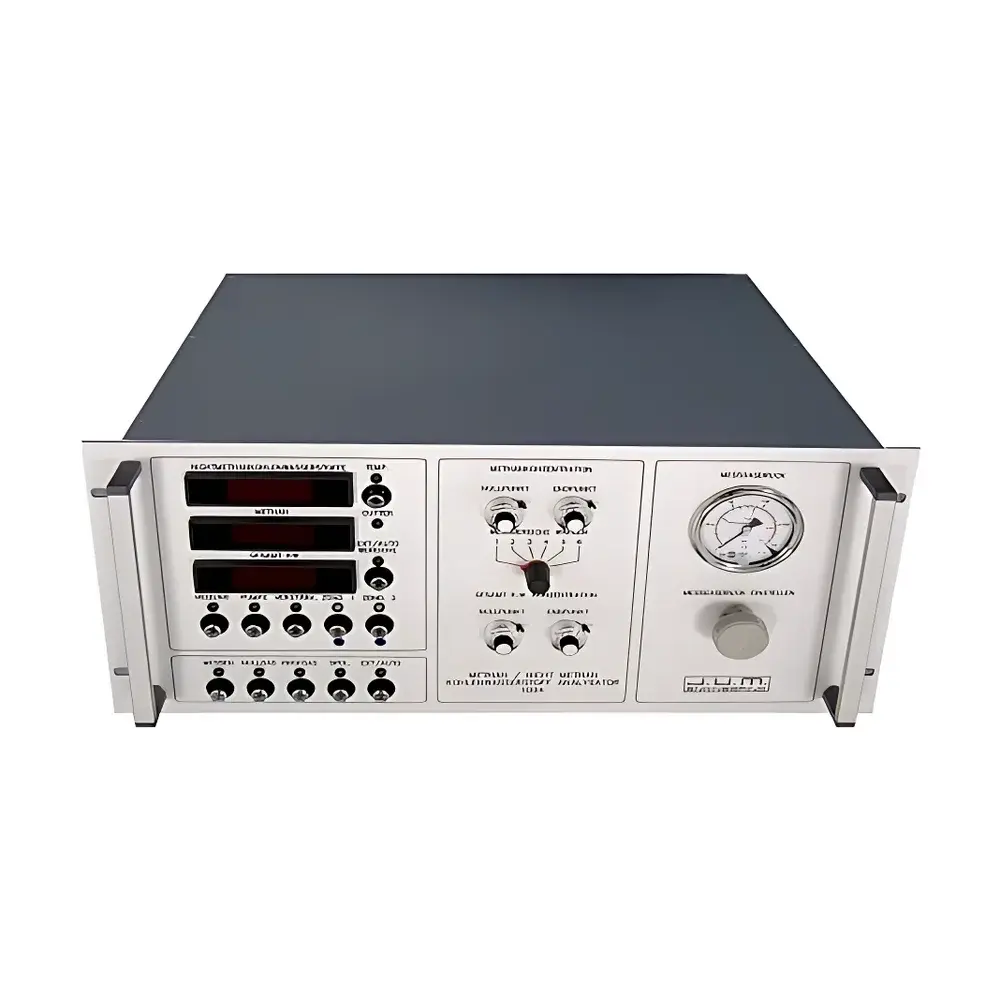
J.U.M. 109A High-Temperature Heated Non-Methane Hydrocarbons Analyzer
| Brand | J.U.M. |
|---|---|
| Origin | Germany |
| Model | 109A |
| Detection Principle | Dual Flame Ionization Detection (FID) |
| Operating Temperature | 190 °C (heated sample path, detector chambers, and filter) |
| Filter Material | Stainless Steel |
| Filter Pore Size | 2 µm |
| Filtration Mode | Compressed Air or Nitrogen Back-Pulse Cleaning |
| Sample Inlet Configuration | Integrated Heated Sample Line with Adjustable Backplate Condensation Prevention System |
| Compliance | EN 14181, EN ISO 14956, EN 12619, EN 13526, EPA Method 25A, US EPA Reference Method 503 |
| Application Scope | Continuous Emission Monitoring (CEM), Stack Gas Analysis, Ambient Air NMHC Quantification, High-Purity Gas Purity Verification |
Overview
The J.U.M. 109A High-Temperature Heated Non-Methane Hydrocarbons Analyzer is a rigorously engineered dual-flame ionization detector (FID) system designed for continuous, trace-level quantification of total hydrocarbons (THC) and methane (CH₄) in demanding industrial and regulatory environments. Unlike conventional FID analyzers, the 109A maintains the entire sample pathway—including sample inlet, filter, transfer lines, and both FID detectors—at a constant 190 °C. This fully heated architecture eliminates condensation of heavy hydrocarbons (C₆+), prevents adsorption losses on cold surfaces, and ensures high reproducibility for low-concentration NMHC measurements in stack gas, ambient air, synthesis gas, and ultra-high-purity process gases. The instrument complies with European Union reference standards EN 14181 (QAL1 certification requirements), EN ISO 14956 (ambient air measurement performance criteria), EN 12619 (stack emission monitoring specifications), and EN 13526 (hydrocarbon detection methodology), as well as U.S. EPA Method 25A and Reference Method 503 for stationary source emissions testing.
Key Features
- Dual independent FID detectors—one dedicated to total hydrocarbons (THC), the other to methane—each housed within a thermally stabilized 190 °C chamber to ensure consistent ionization efficiency and minimize drift.
- Integrated 2 µm stainless-steel heated filter with automated back-pulse cleaning using compressed air or nitrogen; eliminates need for external stack-mounted particulate probes or manual filter replacement during operation.
- Heated sample line embedded directly into the main analyzer housing, coupled with an adjustable backplate mechanism that allows fine-tuning of inlet geometry to suppress hydrocarbon condensation at the sample interface—no tools required.
- Self-contained sample pump and internal combustion air generation system; eliminates dependency on external compressed air cylinders or bottled combustion air supplies.
- Zero and span calibration system with over-range protection for calibration gases and zero air, supporting automated multi-point calibration sequences per EN 14181 QAL2 protocols.
- Real-time flame-out detection with optional automatic fuel gas shutoff valve for operational safety and regulatory compliance in hazardous area deployments.
Sample Compatibility & Compliance
The 109A is validated for use across heterogeneous gas matrices including flue gas (with moisture and particulate content up to 10 mg/m³), ambient air, natural gas streams, catalytic reactor effluents, solvent-laden exhausts, and semiconductor-grade carrier gases (e.g., N₂, Ar, He). Its heated design enables stable operation under variable dew point conditions and mitigates interference from oxygenates, aldehydes, and heavier aromatics that commonly cause signal suppression or memory effects in unheated FIDs. Regulatory alignment includes full support for EN 14181 Quality Assurance Level 1 (QAL1) certification documentation, EN 12619 functional safety requirements for CEM systems, and compatibility with GLP/GMP audit trails when integrated with compliant data acquisition software. While methane-specific calibration is not mandated under current EU or U.S. regulatory frameworks for NMHC reporting, the dual-FID configuration permits method-developed CH₄ subtraction per ASTM D6348 or ISO 8573-5 workflows.
Software & Data Management
The 109A interfaces via RS-232/RS-485 or optional Ethernet (Modbus TCP) to centralized SCADA or CEMS platforms. Firmware supports configurable analog outputs (4–20 mA) for THC and CH₄ channels with linear or logarithmic scaling, and digital alarm outputs for flame status, filter cleaning cycles, and calibration due alerts. When paired with J.U.M.’s optional WinControl CEMS software suite, the analyzer delivers full 21 CFR Part 11-compliant audit logging—including user access control, electronic signatures, calibration history with timestamped gas certificates, and change-tracking for all configuration parameters. Raw FID current signals (pA range) are digitized at 10 Hz with 16-bit resolution, enabling post-acquisition baseline correction and peak integration for transient emission events.
Applications
- Continuous emission monitoring (CEM) of non-methane hydrocarbons from thermal oxidizers, incinerators, and chemical reactors per EU IED Directive and U.S. NSPS Subpart OOOO.
- Optimization of combustion efficiency in industrial furnaces and boilers through real-time THC feedback control.
- Boundary monitoring around petrochemical facilities and solvent-handling zones to verify compliance with ambient VOC limits (e.g., TA Luft, California South Coast AQMD Rule 1171).
- Verification of carbon adsorption bed breakthrough and regeneration cycles in vapor recovery units.
- Engine exhaust characterization during development testing, including cold-start NMHC profiling per ISO 8178 and SAE J1088.
- Trace hydrocarbon contamination monitoring in semiconductor process gases (e.g., <100 ppb NMHC in 99.999% N₂), supporting ISO 8573-1 Class 1 purity verification.
- Explosive limit assessment in solvent-saturated ventilation streams using LEL-corrected NMHC concentration mapping.
FAQ
Does the 109A require external combustion air supply?
No—the analyzer incorporates an integrated air compressor and conditioning module, delivering clean, dry, oil-free combustion air at regulated pressure and flow.
Can the heated filter be cleaned without opening the analyzer housing?
Yes—automatic back-pulse cleaning is triggered at user-defined intervals using onboard compressed air or externally supplied nitrogen; no disassembly is required.
Is the 109A certified for QAL1 under EN 14181?
Yes—the instrument meets all technical and documentation requirements for QAL1 certification when installed and operated per J.U.M.’s approved installation and maintenance procedures.
What is the minimum detectable NMHC concentration?
Detection limit is application-dependent but typically ≤50 ppb C₁–C₁₀ equivalent (as propane) with 1-minute averaging, verified per EN 13526 repeatability criteria.
Can the 109A operate in explosive atmospheres?
The base unit is rated for Zone 2 / Class I Div 2; ATEX/IECEx-certified variants with intrinsic safety barriers are available upon request.
Related Products







