
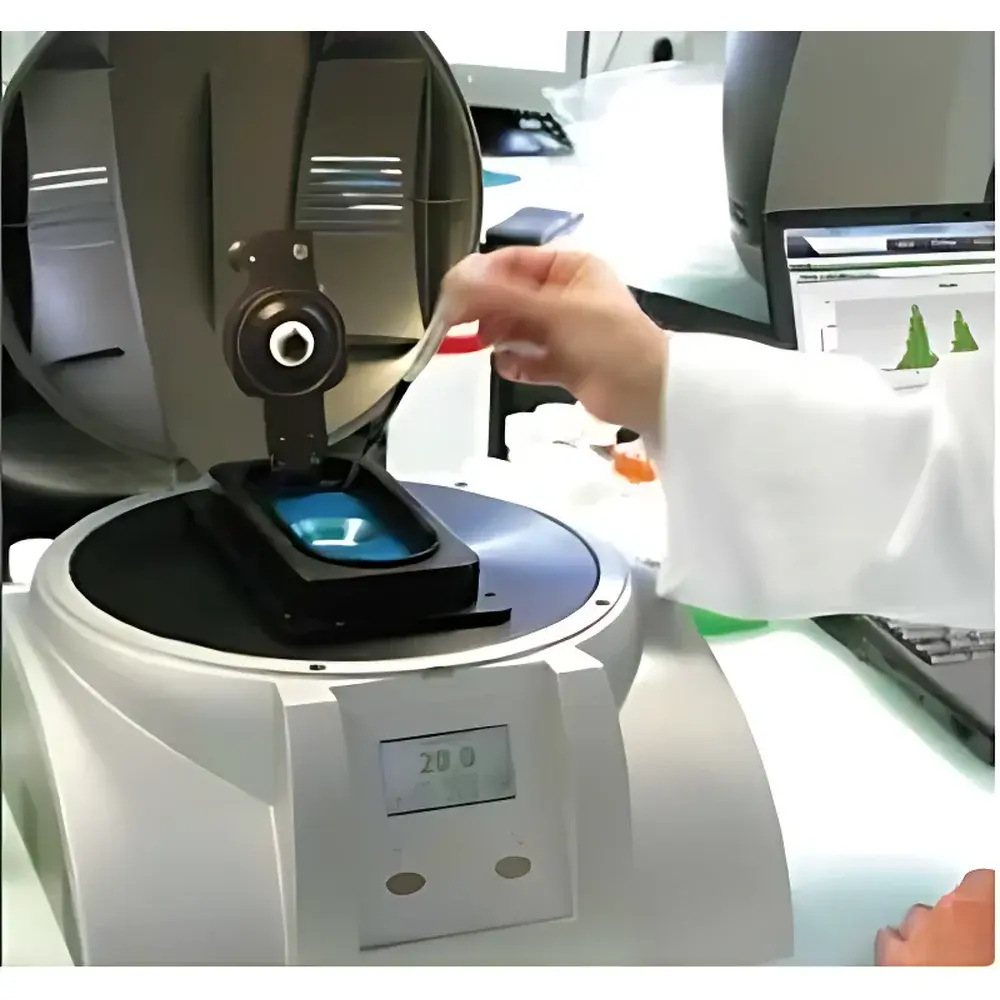
CORDOUAN VASCO Series Dynamic Light Scattering Nanoparticle Size Analyzer
| Origin | France |
|---|---|
| Manufacturer Type | Authorized Distributor |
| Origin Category | Imported |
| Model | VASCO |
| Price Range | USD 26,000–39,000 (FOB) |
| Dispersion Method | Wet Dispersion |
| Measurement Range | 0.01–3500 µm |
| Repeatability | <5% |
| Measurement Time | 30 seconds |
Overview
The CORDOUAN VASCO Series is a high-precision, benchtop dynamic light scattering (DLS) nanoparticle size analyzer engineered for rapid, non-invasive characterization of colloidal dispersions and nanoscale suspensions. Based on the physical principle of quasi-elastic (or dynamic) light scattering, the instrument measures temporal fluctuations in scattered laser intensity arising from Brownian motion of particles suspended in a liquid medium. These fluctuations are quantified via autocorrelation analysis of the detected photon signal; the decay rate of the intensity autocorrelation function is directly related to the diffusion coefficient of the particles, which—via the Stokes–Einstein equation—is inversely proportional to hydrodynamic diameter. This fundamental relationship enables accurate determination of particle size distributions in the range of 2 nm to 4000 nm across multiple VASCO configurations (VASCO1, VASCO2, VASCO3), with resolution optimized for both dilute and highly concentrated systems. Designed for routine QC/QA laboratories and R&D environments, the VASCO series delivers metrologically traceable results without requiring optical calibration standards or user intervention in optical alignment.
Key Features
- True turn-key operation: Full thermal stabilization in <5 minutes, enabling same-day deployment without warm-up delays
- Minimal sample volume requirement: As low as 50 µL per measurement, reducing reagent consumption and enabling analysis of precious or limited-availability formulations
- Robust optical architecture: Class I laser safety compliance (658 nm diode, 15–75 mW depending on model), integrated temperature-controlled cuvette chamber (10–70 °C range for VASCO2/3), and high-sensitivity photodetectors (PMT or APD)
- Universal dispersion compatibility: Validated performance in aqueous and organic media—including turbid, deeply colored, or high-absorbance samples—without pre-filtration or dilution
- Zero-maintenance optical path: Sealed, alignment-free interferometric detection system eliminates routine recalibration or optical realignment
- Ergonomic, compact footprint: Dimensions 30.4 × 33.2 × 27.9 cm; weight <12 kg; compatible with standard laboratory benches and mobile lab carts
- Regulatory-ready software architecture: Fully compliant with FDA 21 CFR Part 11 requirements, including electronic signatures, audit trails, and role-based access control
Sample Compatibility & Compliance
The VASCO analyzer accommodates a broad spectrum of sample types without modification to hardware or protocol: pharmaceutical suspensions (e.g., injectables, microemulsions), polymer latexes, agrochemical formulations (pesticides, adjuvants), cosmetic emulsions (creams, lotions), environmental water matrices (wastewater effluents, membrane filtrates), and petroleum-derived additives. It supports both low-viscosity solvents (e.g., ethanol, acetone) and high-viscosity media (e.g., glycerol/water mixtures) within its operational temperature window. All models conform to CE marking requirements under Directive 2014/30/EU (EMC) and 2014/35/EU (LVD), and meet ISO 13321:2020 (DLS methodology standard) and ISO 22412:2017 (particle size analysis by DLS). Instrument validation documentation—including IQ/OQ protocols, uncertainty budgets per GUM guidelines, and traceability to NIST-traceable reference materials—is provided with each system.
Software & Data Management
The REAN²® software suite provides a validated, Windows-native platform for acquisition, real-time correlation analysis, polydispersity index (PdI) calculation, and multimodal size distribution deconvolution using CONTIN and NNLS algorithms. Data files (.rean2) embed full metadata: instrument configuration, temperature log, laser power, correlation curve residuals, and raw photon count statistics. Export options include CSV, PDF reports with embedded digital signatures, and XML for LIMS integration. Audit trail records all user actions—including parameter edits, report generation, and data deletion—with timestamps and operator ID. Software validation package includes installation qualification (IQ), operational qualification (OQ), and performance qualification (PQ) templates aligned with GLP and GMP Annex 11 expectations.
Applications
- Pharmaceutical development: Stability assessment of liposomal drug carriers, protein aggregation kinetics, and nanoparticle batch release testing
- Materials science: Monitoring nucleation/growth dynamics in sol-gel synthesis and polymer nanoparticle formation
- Quality control: In-process verification of surfactant-stabilized dispersions in coatings and inks
- Environmental monitoring: Quantification of colloidal iron oxides or humic aggregates in treated water streams
- Food science: Characterization of casein micelles in dairy products and lipid droplet size in plant-based beverages
- Academic research: Fundamental studies of diffusion-limited aggregation, interfacial rheology, and depletion interactions
FAQ
What is the minimum detectable concentration for the VASCO system?
Detection limits vary by particle composition and refractive index contrast but typically range from 0.0003 vol% (VASCO3) to 0.01 vol% (VASCO1) for polystyrene standards in aqueous media.
Can the VASCO analyze polydisperse or multimodal samples accurately?
Yes—the REAN²® software implements regularization algorithms (CONTIN and NNLS) validated per ISO 22412 for resolving up to three distinct populations with size ratios ≥3:1.
Is temperature control mandatory for DLS measurements?
While ambient measurements are possible, precise temperature regulation (±0.1 °C) is recommended for reproducible hydrodynamic diameter determination, especially when comparing samples across time or labs.
Does the system require daily calibration with reference standards?
No—CORDOUAN’s factory-calibrated optical path and built-in reference correlation function eliminate routine calibration; only periodic verification using NIST-traceable latex standards is advised per ISO 17025.
How does the VASCO handle strongly absorbing or fluorescent samples?
The 658 nm red laser minimizes interference from UV-absorbing chromophores and autofluorescence; optional polarization filtering further suppresses background in challenging matrices.



