
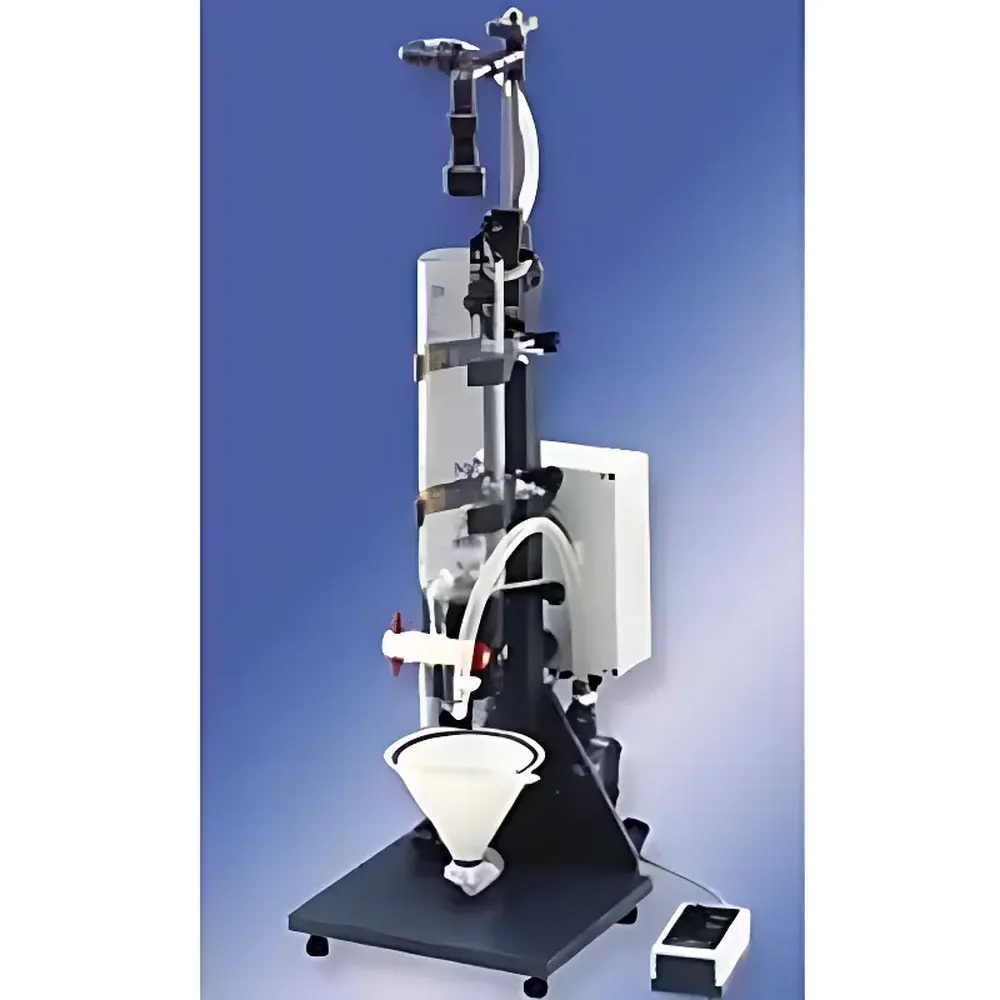
Behr BSB 4A Biological Oxygen Demand (BOD) Analyzer
| Origin | Germany |
|---|---|
| Manufacturer Type | Authorized Distributor |
| Origin Category | Imported |
| Model | Behr BSB 4A |
| Instrument Type | Laboratory Benchtop System |
| Measurement Principle | Dilution and Sealed Bottle Incubation (ISO 5851-1 / DIN EN 1899-1 compliant) |
| Wavelength | 610 ± 20 nm |
| Measurement Range | 10–5000 mg/L O₂ |
| Accuracy | ≤ ±10% |
| Repeatability | ≤ ±5% |
| Limit of Detection | 0.1 mg/L O₂ |
| Analysis Time | 20 min per sample (post-incubation measurement) |
| Batch Capacity | 15 or 30 samples simultaneously |
| Stirring Vessel Volume | 1 L (calibrated PTFE-coated stirring column) |
| Stirring Mechanism | Integrated magnetic stirrer |
| Valve System | PTFE three-way stopcock for dilution water supply and bottom degassing |
| Level Control | Semi-automatic horizontal closure with integrated rinse function |
| Weight | ~12 kg (excl. peristaltic pump) |
| Dimensions (W × D × H) | 26 × 35 × 75 cm |
Overview
The Behr BSB 4A Biological Oxygen Demand (BOD) Analyzer is a laboratory-grade, ISO 5851-1 and DIN EN 1899-1 compliant system engineered for standardized determination of biochemical oxygen demand in wastewater, surface water, and treated effluents. Unlike optical or electrochemical rapid-screening methods, the BSB 4A implements the classical dilution-and-incubation principle: samples are diluted with oxygen-saturated, nutrient-supplemented dilution water containing nitrification inhibitors (e.g., allylthiourea), sealed in BOD bottles, and incubated at 20 °C for 5 days. The BSB 4A automates the critical pre- and post-incubation handling—precise dilution water delivery, bubble-free filling, calibrated mixing, and consistent headspace management—to minimize operator variability and ensure metrological traceability. Its 610 nm photometric endpoint detection (per ASTM D5210 and ISO 5815-1 adaptations) quantifies dissolved oxygen depletion via colorimetric reaction with manganese(II) sulfate and alkaline iodide-azide reagents, yielding results fully aligned with regulatory reporting requirements under EU Water Framework Directive (WFD) Annex II and US EPA Method 405.1.
Key Features
- Integrated 1 L calibrated stirring column with PTFE-coated walls and precision刻度 (graduated scale) for reproducible sample-diluent homogenization
- PTFE three-way stopcock enabling simultaneous dilution water supply from cooled reservoirs and bottom-phase deaeration to eliminate air entrapment artifacts
- Magnetic stirring mechanism with speed-stabilized drive ensuring uniform suspension without mechanical shear or contamination risk
- Semi-automatic horizontal closure unit with programmable rinse cycle, preventing cross-contamination between batches
- Modular architecture supporting optional integration of refrigerated dilution water bath (with cooling jacket), peristaltic dosing pumps, and nitrification inhibitor metering modules
- Compact footprint (26 × 35 × 75 cm) and lightweight design (~12 kg) optimized for shared lab environments and GLP-compliant benchtop deployment
Sample Compatibility & Compliance
The BSB 4A accommodates raw sewage, activated sludge supernatants, industrial process waters, and potable water matrices requiring BOD assessment per national and international standards. It supports both standard 300 mL BOD bottles and alternative vessel formats (e.g., 60 mL micro-BOD vials) via adjustable fixture kits. All fluid-contact components—including valves, tubing, and stirring columns—are constructed from chemically inert PTFE or borosilicate glass to prevent adsorption or catalytic interference. The system is validated for compliance with DIN EN 1899-1 (Biological oxygen demand after n days — Part 1: BOD₅), ISO 5851-1 (Water quality — Determination of biochemical oxygen demand — Part 1: Dilution and seeding method), and harmonized with EU Regulation (EC) No 1272/2008 (CLP) for safe handling of reagents. Documentation packages include IQ/OQ protocols, calibration certificates traceable to NIST SRMs, and audit-ready maintenance logs.
Software & Data Management
While the BSB 4A operates as a hardware-controlled workstation without embedded firmware or touchscreen interface, it is fully compatible with LIMS-integrated data capture via RS-232 or USB-to-serial output. Raw absorbance values at 610 nm, along with user-entered dilution factors and incubation timestamps, are exported in CSV format for downstream processing in validated software platforms (e.g., LabWare LIMS, Thermo Fisher SampleManager, or custom Python-based QA/QC pipelines). All manual entries—operator ID, sample ID, reagent lot numbers—are timestamped and stored locally on connected PCs meeting FDA 21 CFR Part 11 requirements when paired with electronic signature modules. Audit trails record every parameter change, rinse event, and calibration action, satisfying GLP/GMP documentation mandates for environmental testing laboratories accredited to ISO/IEC 17025:2017.
Applications
- Regulatory BOD₅ compliance testing for municipal wastewater treatment plants (WWTPs) submitting reports to EEA or state environmental agencies
- Industrial pretreatment monitoring in food processing, pulp & paper, and pharmaceutical manufacturing facilities
- Research-scale evaluation of biodegradability kinetics for novel surfactants, polymers, or agrochemical formulations
- Validation of membrane bioreactor (MBR) and moving bed biofilm reactor (MBBR) performance under variable organic loading rates
- Teaching laboratories conducting standardized environmental chemistry experiments per AP Environmental Science and university-level limnology curricula
FAQ
Does the BSB 4A perform the full 5-day BOD incubation?
No—the BSB 4A handles only the pre-incubation preparation (dilution, mixing, degassing, sealing) and post-incubation photometric analysis. Incubation must occur externally in a certified 20 °C ± 0.5 °C BOD incubator meeting ISO 2859-1 sampling plan criteria.
Can it be used for CBOD (Carbonaceous BOD) measurements?
Yes—when paired with nitrification inhibitors such as allylthiourea (ATU) dispensed via the optional precision metering module, the system supports CBOD determination per ASTM D5210.
Is validation support available for ISO/IEC 17025 accreditation?
Yes—Behr provides full validation documentation including Design Qualification (DQ), Installation Qualification (IQ), Operational Qualification (OQ), and Performance Qualification (PQ) templates, all referencing EN ISO/IEC 17025:2017 clause 6.4.3 (Equipment verification).
What maintenance intervals are recommended?
PTFE valve seals should be inspected quarterly; magnetic stir bar alignment verified monthly; optical path cleaned before each batch using lint-free wipes and isopropanol; and dilution water reservoirs sanitized weekly per CLSI EP29-A guidelines.
How is traceability ensured for low-concentration measurements near the LOD (0.1 mg/L)?
By implementing triplicate blank correction, daily calibration against certified DO standard solutions (e.g., NIST SRM 1692), and application of weighted linear regression per ISO 8466-2, uncertainty budgets remain below 8.2% at 10 mg/L and satisfy EURACHEM QUAM guidance for environmental trace analysis.
Related Products







