
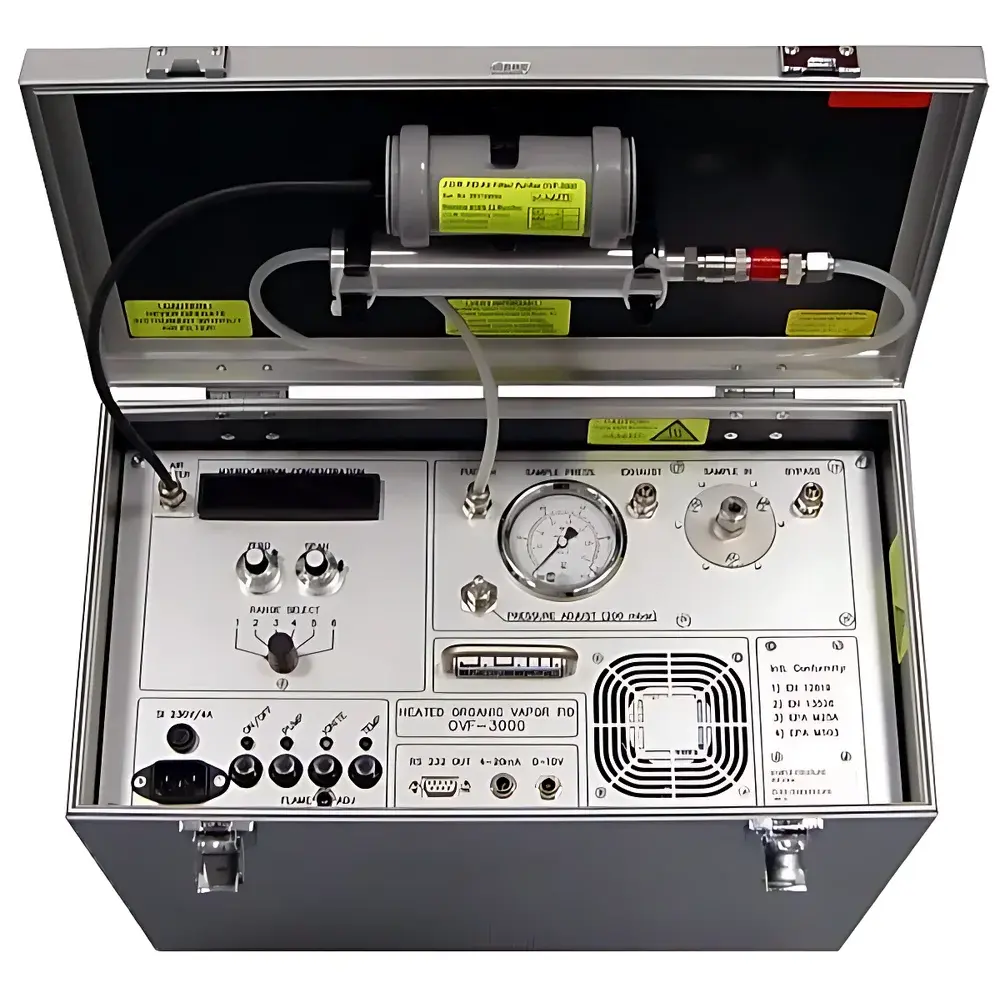
J.U.M. OVF3000 Portable Total Hydrocarbon Analyzer
| Brand | J.U.M. |
|---|---|
| Origin | Germany |
| Model | OVF3000 |
| Detection Principle | Flame Ionization Detection (FID) |
| Sensitivity | 1 ppm full-scale for CH₄ |
| Response Time | 0.2 s |
| Measurement Ranges | 0–10, 0–100, 0–1,000, 0–10,000, 0–100,000 ppm (selectable) |
| Oven Temperature | 190 °C |
| Carrier/Air Supply | Integrated zero-air generator |
| Fuel Gas | Hydrogen (stored in low-pressure metal hydride cartridge, >40 h operation per cartridge) |
| Compliance | BImSchV 2nd, 13th & 17th Ordinances, EN 12619, EN 13526, EPA Method 25A, EPA Method 503 |
Overview
The J.U.M. OVF3000 Portable Total Hydrocarbon Analyzer is a field-deployable, high-performance flame ionization detector (FID)-based instrument engineered for quantitative measurement of total hydrocarbons (THC) in gaseous matrices. Designed and manufactured in Germany, the OVF3000 operates on the well-established FID principle: sample gas is combusted in a hydrogen–air flame, generating ions proportional to the number of carbon atoms present; these ions are collected and converted into an electrical signal linearly correlated with hydrocarbon concentration. Unlike catalytic or PID-based alternatives, FID provides universal, near-equimolar response across saturated and unsaturated aliphatic and aromatic hydrocarbons—making it the reference method for regulatory-compliant THC monitoring. The analyzer features a thermally stabilized detection chamber maintained at 190 °C to prevent condensation of higher-boiling compounds and ensure consistent sensitivity across variable ambient conditions. Its compact, ruggedized chassis and integrated low-pressure metal hydride hydrogen storage enable true portability without compromising analytical integrity.
Key Features
- True portable FID architecture with integrated zero-air supply and low-pressure metal hydride hydrogen storage—enabling continuous operation exceeding 40 hours per cartridge without external gas cylinders.
- Thermally isolated, temperature-controlled combustion chamber (190 °C) optimized for stable baseline and minimal drift during extended field deployments.
- Multi-range measurement capability (0–10 ppm to 0–100,000 ppm) with automatic range switching and digital gain calibration traceable to NIST-traceable standards.
- Sub-second response time (T₉₀ ≤ 0.2 s), enabling real-time tracking of transient emissions from combustion sources, engine testing, or process upsets.
- Robust mechanical design compliant with IP54 ingress protection and MIL-STD-810G shock/vibration specifications for industrial and mobile laboratory use.
- Onboard data logging with timestamped records (≥32,000 points), USB export, and optional Bluetooth connectivity for remote configuration and diagnostics.
Sample Compatibility & Compliance
The OVF3000 accepts sample streams from ambient air, stack gas (diluted or undiluted), process vents, and laboratory exhaust lines—with inlet conditioning options including heated sampling lines (up to 200 °C), particulate filters, and moisture traps. It meets the technical requirements of major international regulatory frameworks: German TA Luft and BImSchV ordinances (2nd, 13th, and 17th), European standards EN 12619 (automated measuring systems for gaseous emissions) and EN 13526 (performance criteria for FID analyzers), and U.S. EPA Methods 25A (total gaseous organic concentration) and 503 (calibration and validation of FID systems). All firmware and calibration procedures support audit-ready documentation aligned with GLP and ISO/IEC 17025 laboratory quality management systems.
Software & Data Management
The OVF3000 is operated via an intuitive, menu-driven interface with a backlit LCD display. Configuration, calibration, and diagnostic functions are accessible through the front panel or via the optional PC-based J.U.M. AnalyzeSuite™ software. This software supports automated calibration sequence execution (span/zero checks), generation of calibration reports with uncertainty budgets, and export of raw time-series data in CSV or XML formats compatible with LIMS and environmental reporting platforms (e.g., EEA E-PRTR, U.S. EPA CDX). Audit trail functionality logs all user actions—including parameter changes, calibration events, and alarm acknowledgments—with timestamps and operator IDs, satisfying FDA 21 CFR Part 11 electronic record requirements when deployed in regulated manufacturing environments.
Applications
- Continuous emission monitoring (CEM) of total hydrocarbons from thermal oxidizers, incinerators, and catalytic cracking units.
- Real-time combustion efficiency assessment and methane slip quantification in gas turbines and reciprocating engines.
- LEL (lower explosive limit) safety monitoring during solvent recovery operations and chemical manufacturing processes.
- Trace hydrocarbon verification in ultra-high-purity gases (e.g., nitrogen, argon, helium) used in semiconductor fabrication and photolithography.
- Indoor air quality (IAQ) surveys in industrial facilities, laboratories, and remediation sites where VOC sources are suspected.
- Mobile source testing—including chassis dynamometer exhaust analysis and cold-start emissions characterization per ISO 8178 and SAE J1094 protocols.
- Carbon adsorption bed breakthrough detection and regeneration cycle optimization in vapor recovery systems.
FAQ
Does the OVF3000 require external hydrogen gas cylinders?
No—the system uses proprietary low-pressure metal hydride cartridges that safely store and release hydrogen on demand, eliminating high-pressure hazards and enabling rapid deployment.
Can the OVF3000 measure methane separately from non-methane hydrocarbons (NMHC)?
Not natively; it measures total hydrocarbons as a single parameter. For NMHC determination, a parallel methane-specific analyzer (e.g., NDIR or GC-FID) and subtraction methodology per EPA Method 25A are required.
Is the instrument suitable for humid or particulate-laden sample streams?
Yes—when equipped with optional heated sample line and coalescing filter modules, the OVF3000 maintains accuracy in ambient humidity up to 95% RH and particulate concentrations below 10 mg/m³.
What calibration standards are recommended?
Certified methane-in-air or propane-in-air standard gases traceable to NIST or BAM, with concentrations matching the intended operating range; annual verification using multi-point calibration is advised per EN 14181 QAL2 requirements.
How is data integrity ensured during power interruptions?
The internal rechargeable Li-ion battery sustains operation for ≥15 minutes during AC loss and automatically saves active measurement data and configuration settings to non-volatile memory.
Related Products







