
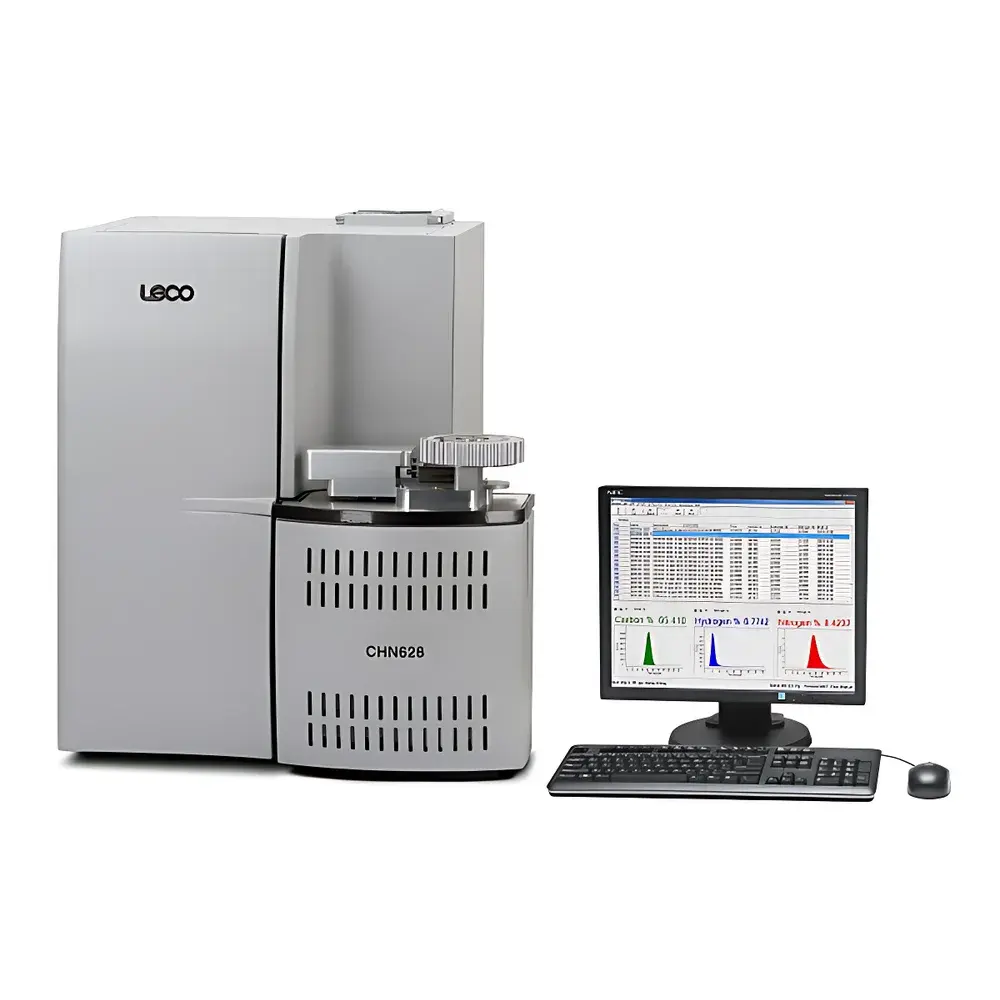
LECO FP628 Dumas Combustion Nitrogen/Protein Determinator
| Brand | LECO |
|---|---|
| Origin | USA |
| Manufacturer Type | Original Equipment Manufacturer (OEM) |
| Origin Category | Imported |
| Model | FP628 |
| Instrument Principle | Dumas Combustion Method |
| Analysis Time | 4.5 min per sample |
| Nitrogen Range | 0.04–50 mg absolute |
| Precision | ±0.02 mg or 0.5% RSD (whichever is greater) |
| Sample Mass | up to 750 mg (typical 500 mg) |
| Readability | 0.0001% w/w |
| Detector | Thermal Conductivity (TC) Cell |
| Carrier Gas | Helium (99.99%, 35 psi ±10%) |
| Combustion Gas | Oxygen (99.99%, 35 psi ±10%) |
| Assist Gas | Oil-free, dry compressed air (40 psi ±10%) |
| Furnace Temp | Primary furnace up to 950 °C, secondary furnace up to 1050 °C |
| Autosampler | 30-position (expandable to 120 via stacking) |
| Dimensions | 81 × 70 × 76 cm (H×W×D) |
| Weight | 124 kg (net), 147 kg (shipping) |
| Power | 230 V AC ±10%, 50/60 Hz, single-phase, 12 A, 4000 BTU/hr cooling requirement |
| Compliance | ASTM D515, ISO 14891, AOAC 992.15, USP <282>, FDA 21 CFR Part 11 ready (with optional audit trail module) |
Overview
The LECO FP628 Dumas Combustion Nitrogen/Protein Determinator is a fully automated, high-throughput elemental analyzer engineered for precise quantification of total nitrogen in organic matrices—enabling rapid, trace-level protein determination via the universally accepted Dumas combustion principle. Unlike Kjeldahl-based systems, the FP628 eliminates wet chemistry, hazardous reagents, and lengthy digestion steps by thermally oxidizing samples at 950 °C in a controlled oxygen-rich environment. The resulting gaseous effluent undergoes catalytic reduction, selective scrubbing, and quantitative thermal conductivity detection to isolate and measure molecular nitrogen (N2) with metrological rigor. Each analysis cycle—comprising purge, combustion, and gas-phase quantification—is completed in ≤4.5 minutes, delivering reproducible nitrogen results across diverse sample types including foodstuffs, feedstuffs, pharmaceutical excipients, soil, and botanical materials. The instrument’s architecture adheres to fundamental requirements of ISO/IEC 17025-compliant laboratories, supporting method validation, uncertainty estimation, and routine QC/QA workflows in regulated environments.
Key Features
- Integrated dual-furnace combustion system: primary furnace (950 °C) ensures complete sample oxidation; secondary furnace (up to 1050 °C) guarantees full conversion of NOx to N2 via copper- and nickel-based catalysts.
- Patented inert purge mechanism: continuous helium flush during autosampling prevents atmospheric contamination of the gas path and mixing chamber—critical for sub-milligram nitrogen accuracy.
- High-stability thermal conductivity detector (TCD): calibrated against certified N2 standards, delivering 0.0001% w/w readability and long-term baseline stability without periodic recalibration.
- Modular 30-position autosampler: motorless, gravity-driven sample introduction minimizes mechanical wear and eliminates timing-induced variability; stackable configuration supports unattended 120-sample runs.
- Multi-stage gas conditioning: heated catalytic copper column removes residual O2; nickel-based nitrogen converter reduces all nitrogen oxides to N2; magnesium perchlorate and sodium hydroxide/asbestos-free alkali traps eliminate H2O and CO2 prior to detection.
- Real-time pressure and flow monitoring: integrated sensors validate gas delivery integrity across carrier, combustion, and assist lines—ensuring method compliance and flagging deviations before data acquisition.
Sample Compatibility & Compliance
The FP628 accepts solid, semi-solid, and homogenized liquid samples encapsulated in tin or silver capsules—no pre-drying or grinding required for most matrices. It accommodates sample masses from 10 mg to 750 mg, enabling optimized sensitivity for low-nitrogen feeds (35% N). Methodologically, the system conforms to ASTM D515 (water), ISO 14891 (food and feed), AOAC Official Method 992.15 (protein in cereals), and USP (nitrogen content in pharmaceutical substances). When configured with LECO’s optional software audit trail and electronic signature modules, the platform satisfies FDA 21 CFR Part 11 requirements for data integrity, user access control, and change history retention—making it suitable for GLP and GMP-regulated laboratories.
Software & Data Management
Controlled via LECO’s Windows-based Fusion™ software, the FP628 provides full method scripting, calibration curve management, and real-time chromatogram visualization. All raw detector signals, gas pressures, furnace temperatures, and autosampler events are timestamped and stored in a relational database with SHA-256 hash verification. Users may define custom calculation protocols—including moisture-corrected (wet basis) or dry-weight-normalized protein reporting using AOAC, NRC, or client-specific conversion factors (e.g., 6.25, 5.7, or 6.38). Data export complies with ASTM E1382 and ISO/IEC 17025 Annex A.2: CSV, XML, and PDF reports include metadata on instrument status, operator ID, environmental conditions, and uncertainty estimates per ISO/IEC 17025:2017 Clause 7.6.3.
Applications
- Food & Agriculture: Routine protein labeling compliance for meat, dairy, grains, legumes, and pet food under FDA, EFSA, and Codex Alimentarius regulations.
- Pharmaceuticals: Nitrogen assay of active pharmaceutical ingredients (APIs), excipients, and biopolymer carriers per USP and EP 2.5.11.
- Environmental Testing: Total Kjeldahl nitrogen (TKN)-equivalent quantification in soils, sludges, and wastewater solids without acid digestion.
- Academic Research: High-throughput screening of nitrogen-fixing symbionts, fertilizer efficiency trials, and metabolic studies requiring precise N-balance calculations.
- Contract Laboratories: ISO/IEC 17025-accredited nitrogen testing with full traceability, inter-laboratory comparison support, and automated report generation.
FAQ
What combustion method does the FP628 use, and how does it differ from Kjeldahl?
The FP628 employs the Dumas combustion method—dry thermal oxidation at 950 °C—followed by catalytic gas-phase conversion and TCD detection. It requires no sulfuric acid, catalysts, or distillation, eliminating manual intervention, hazardous waste, and method-dependent recovery biases inherent in wet-chemistry Kjeldahl procedures.
Can the FP628 analyze wet or high-moisture samples directly?
Yes—samples are sealed in combustion capsules prior to analysis, preventing moisture loss or gain during handling. Results can be reported on as-is (wet basis) or moisture-corrected (dry basis) using integrated gravimetric or NIR moisture input.
Is the FP628 compliant with FDA 21 CFR Part 11?
Out-of-the-box, the FP628 meets technical prerequisites (audit trail logging, user authentication, electronic signatures). Full Part 11 compliance requires activation of LECO’s validated Fusion™ Audit Trail Package and adherence to site-specific SOPs for system validation and access control.
What maintenance intervals are recommended for the combustion tube and catalysts?
The quartz combustion tube is rated for ≥10,000 analyses; nickel and copper catalysts typically last 5,000–7,000 runs depending on sample matrix. LECO’s predictive diagnostics monitor catalyst depletion via signal decay trends and prompt replacement alerts.
Does the FP628 support multi-element analysis beyond nitrogen?
No—the FP628 is dedicated exclusively to total nitrogen/protein quantification. For simultaneous C/H/N/S/O analysis, LECO’s CHNS/O series (e.g., TruSpec Micro) is recommended.
Related Products






