
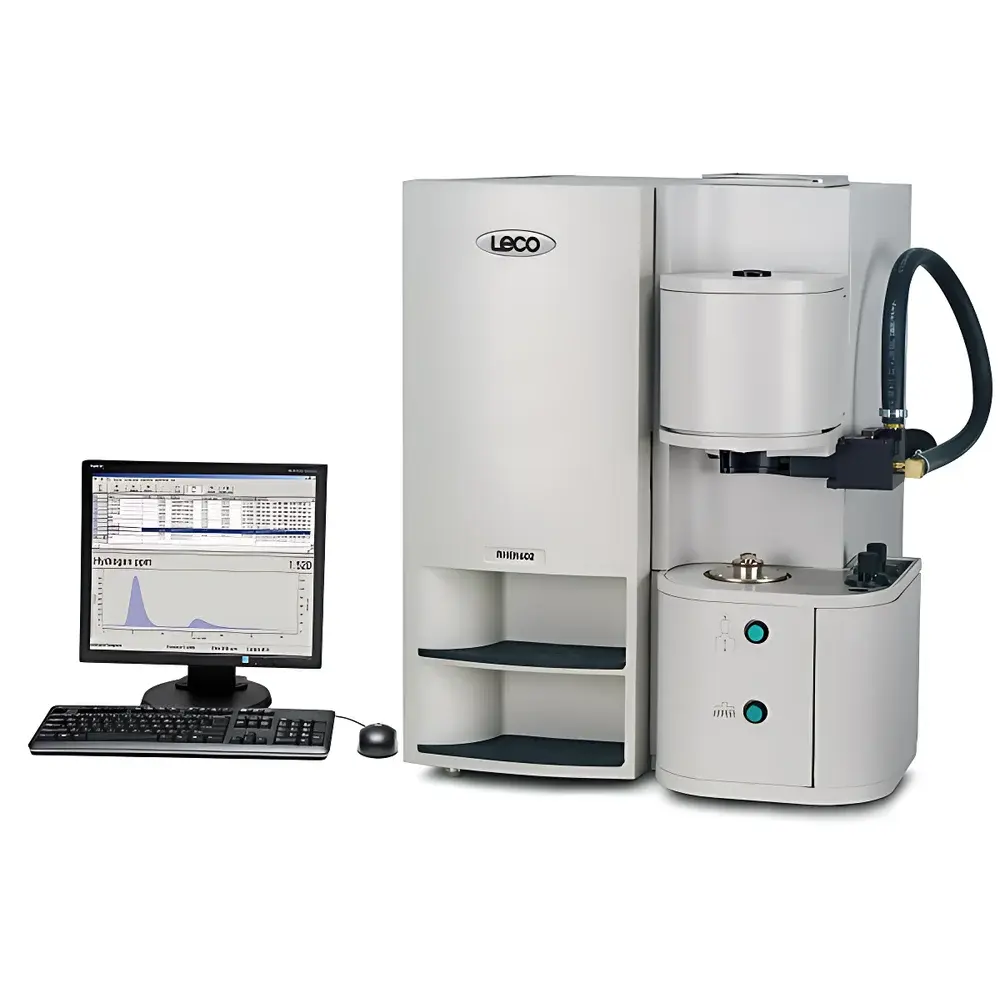
LECO RHEN602 Hydrogen Analyzer for Aluminum and Non-Ferrous Metals
| Brand | LECO |
|---|---|
| Origin | USA |
| Manufacturer | LECO Corporation |
| Type | Hydrogen Analyzer |
| Model | RHEN602 |
| Detection Range | 0.05 ppm – 500 ppm |
| Precision | < 0.02 ppm |
| Sample Capacity | Up to 6 g |
| Furnace Type | Programmable Graphite Electrode Furnace |
| Calibration Options | Certified Reference Materials (CRMs) and Standard Gases |
| Compliance | Designed for GLP/GMP environments with audit-trail-capable software |
Overview
The LECO RHEN602 Hydrogen Analyzer is a high-sensitivity, solid-state thermal conductivity-based instrument engineered for the quantitative determination of hydrogen in aluminum, aluminum alloys, refractory metals, ceramics, and other inorganic non-ferrous materials. It employs resistive graphite electrode furnace heating under controlled inert gas (typically helium or argon) purge to quantitatively evolve hydrogen trapped interstitially or as hydride phases within the sample matrix. The evolved hydrogen is carried by the carrier gas through a highly stable, temperature-regulated thermal conductivity detector (TCD), where its concentration is measured with sub-part-per-trillion sensitivity. This method conforms to established principles outlined in ASTM E1447–22 (Standard Test Method for Determination of Hydrogen in Titanium and Titanium Alloys) and ISO 11982:2013 (Metallic materials — Determination of hydrogen content — Inert gas fusion–thermal conductivity method), adapted for low-Z matrices such as aluminum where surface contamination and diffusion kinetics present unique analytical challenges.
Key Features
- Programmable graphite electrode furnace with multi-stage ramp/soak temperature profiles—enabling independent quantification of surface-adsorbed hydrogen versus bulk-dissolved (matrix) hydrogen.
- Optimized thermal design supports sample masses up to 6 g, significantly improving signal-to-noise ratio and statistical reproducibility—critical for ultra-trace hydrogen analysis (<1 ppm) in light metals.
- Dual calibration methodology: traceable certified reference materials (CRMs) for matrix-matched validation and high-purity standard gases for system linearity verification and drift monitoring.
- Embedded self-diagnostic firmware continuously monitors furnace resistance, gas flow stability, TCD baseline integrity, and detector response—reducing unscheduled downtime and accelerating troubleshooting.
- SmartLine® Remote Diagnostic Interface (optional): Enables secure, encrypted remote access by LECO Field Service Engineers for real-time performance evaluation, parameter optimization, and predictive maintenance—fully compliant with FDA 21 CFR Part 11 requirements for electronic records and signatures when enabled with audit trail configuration.
Sample Compatibility & Compliance
The RHEN602 is validated for use with solid metallic specimens—including wrought and cast aluminum alloys (e.g., 2xxx, 6xxx, 7xxx series), titanium, zirconium, niobium, and silicon carbide composites. Sample preparation follows standardized protocols per ASTM E1019 and ISO 11982, including surface cleaning (ultrasonic degreasing, acid etching where appropriate), moisture control, and consistent pelletizing (when required). Instrument architecture meets electromagnetic compatibility (EMC) requirements per IEC 61326-1 and operates within Class II safety standards. Software functionality supports 21 CFR Part 11-compliant user access controls, electronic signature workflows, and immutable audit trails for laboratory accreditation under ISO/IEC 17025:2017.
Software & Data Management
The Windows-based LECO Thermal Analysis Suite provides intuitive, role-based interface navigation with configurable dashboards. All analyses are recorded with full metadata: operator ID, sample ID, batch number, furnace program parameters, raw TCD signal traces, integration windows, calibration history, and QC flag status. Data export supports CSV, XML, and LIMS-compatible formats. Built-in statistical tools include Shewhart control charts, trend analysis across batches, and automatic outlier detection per ISO 5725 guidelines. Optional data archiving modules integrate with enterprise network storage and support automated backup to NAS or cloud repositories with AES-256 encryption.
Applications
- Quality assurance of aerospace-grade aluminum forgings and extrusions where hydrogen-induced embrittlement poses critical service-life risks.
- Process validation in vacuum arc remelting (VAR) and electroslag remelting (ESR) facilities for reactive metal producers.
- R&D studies on hydrogen trapping mechanisms in aluminum-lithium alloys and oxide-dispersion-strengthened (ODS) nickel superalloys.
- Failure analysis laboratories investigating blistering, porosity, or delayed cracking in weld zones and heat-affected zones (HAZ).
- Supplier qualification programs requiring third-party verified hydrogen specifications per AMS 2301 or EN 10204 3.1 certification.
FAQ
What is the minimum detectable hydrogen level for aluminum using the RHEN602?
The instrument achieves a method detection limit (MDL) of 0.05 ppm for 1 g aluminum samples under optimized furnace and carrier gas conditions.
Can the RHEN602 distinguish between surface and bulk hydrogen?
Yes—the programmable furnace allows sequential low-temperature desorption (surface H) followed by high-temperature fusion (bulk/matrix H), enabling speciation via differential thermal evolution profiling.
Is CRM calibration mandatory for regulatory submissions?
For ISO/IEC 17025 or GMP-regulated environments, matrix-matched CRM calibration is required to demonstrate measurement traceability and uncertainty budget compliance.
Does the system support automated sample loading?
The RHEN602 is designed for manual sample introduction; however, it is compatible with third-party robotic autosamplers via RS-232/Modbus TCP interface for high-throughput labs.
How often must the thermal conductivity detector be recalibrated?
Detector zero and span checks are recommended before each analytical session; full multi-point calibration using standard gases is performed weekly or after major maintenance events.
Related Products





