
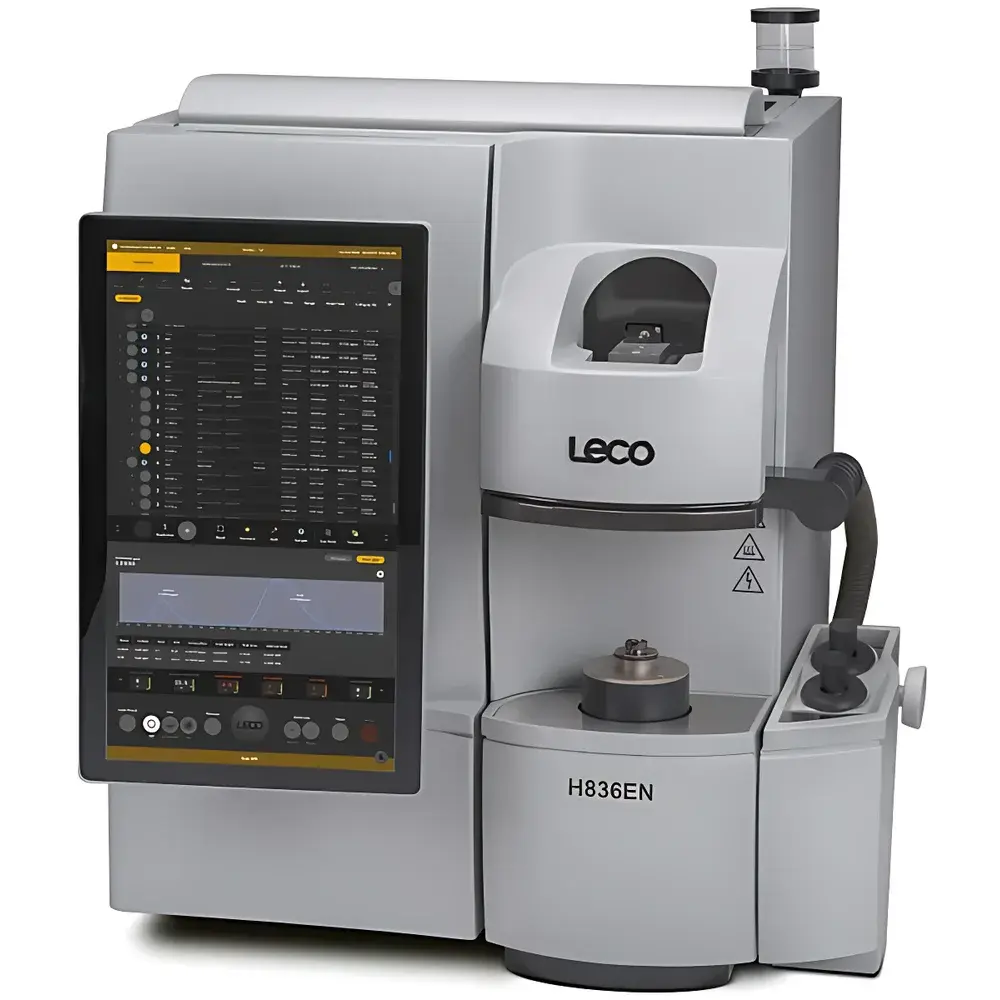
LECO H836EN Hydrogen Analyzer
| Brand | LECO |
|---|---|
| Origin | USA |
| Manufacturer Type | Original Equipment Manufacturer (OEM) |
| Product Origin | Imported |
| Model | H836EN |
| Instrument Type | Hydrogen Analyzer |
| Detection Range | 0.01–100 ppm (w/w) |
Overview
The LECO H836EN Hydrogen Analyzer is a high-precision, solid-state thermal conductivity-based instrument engineered for the quantitative determination of hydrogen in metallic and inorganic materials. Building upon the proven architecture of the RHEN602 platform, the H836EN integrates an advanced programmable electrode furnace system with real-time thermal profiling, enabling selective quantification of surface-bound hydrogen, bulk (matrix) hydrogen, and total hydrogen content. Its measurement principle relies on controlled vacuum fusion at elevated temperatures (up to 3000 °C), followed by carrier gas transport of evolved hydrogen to a high-stability thermal conductivity detector (TCD). This method conforms to standardized test practices including ASTM E1447, ISO 14284, and JIS G 1253, ensuring traceability and regulatory alignment for quality control and R&D laboratories operating under GLP or GMP frameworks.
Key Features
- Programmable electrode furnace with dual-stage heating profiles: optimized ramp rates and hold times for surface desorption (≤800 °C) and bulk diffusion (>1800 °C), supporting independent quantification of surface H, matrix H, and total H.
- Extended dynamic detection range from 0.01 ppm to 100 ppm (mass fraction), validated using certified reference materials (CRMs) traceable to NIST SRMs.
- Maximum sample capacity of 5 g—enhancing statistical reliability for low-H matrices such as aluminum alloys, titanium alloys, and refractory metals.
- Integrated self-diagnostic firmware suite with real-time fault logging, predictive maintenance alerts, and automated calibration verification routines.
- Modular furnace power control interface allowing granular adjustment of voltage, current, and thermal ramp rate—critical for reproducible analysis of thermally sensitive alloys (e.g., Al–Li, Mg–Al, Ti–6Al–4V).
- Optional SmartLine® remote diagnostics module compliant with FDA 21 CFR Part 11 requirements for secure, audit-trail-enabled technician access.
Sample Compatibility & Compliance
The H836EN accommodates diverse sample forms—including solids (ingots, chips, turnings), powders, and sintered ceramics—across ferrous and non-ferrous metallurgical systems. It is routinely deployed for hydrogen analysis in aerospace-grade aluminum-lithium alloys, nuclear-grade zirconium cladding, superalloy turbine discs, and high-purity tungsten crucibles. All analytical methods are documented per ISO/IEC 17025:2017 requirements. System validation includes linearity assessment (R² ≥ 0.9998 over full range), repeatability (RSD ≤ 2.5% at 0.1 ppm level), and recovery testing (95–102%) across certified CRMs. The instrument meets electromagnetic compatibility (EMC) standards IEC 61326-1 and safety requirements IEC 61010-1.
Software & Data Management
The embedded Windows-based Thermo-Calc™ software provides intuitive method development, multi-step temperature program definition, and automated peak integration with baseline correction algorithms. All raw signals, calibration logs, operator actions, and audit trails are timestamped and stored in encrypted SQLite databases. Data export supports CSV, XML, and ASTM E1382-compliant formats. Optional LECO Connect™ cloud portal enables centralized instrument fleet monitoring, remote method deployment, and electronic signature workflows aligned with 21 CFR Part 11 Annex 11 expectations.
Applications
- Hydrogen embrittlement risk assessment in high-strength steels and titanium airframes.
- Process validation of vacuum degassing and melt treatment in primary aluminum production.
- Quality release testing of additive manufacturing feedstock powders (e.g., Ti-6Al-4V, Inconel 718).
- Research into hydrogen trapping mechanisms in nanostructured ferritic alloys.
- Regulatory compliance testing for ASTM F2622 (hydrogen in medical-grade cobalt-chromium alloys).
- Failure analysis of hydrogen-induced cracking (HIC) in sour-service pipeline steels.
FAQ
What detection principle does the H836EN use?
It employs inert-gas fusion coupled with solid-state thermal conductivity detection—no carrier gas chromatography or mass spectrometry required.
Can the H836EN differentiate between surface and bulk hydrogen?
Yes—via programmable two-stage furnace heating profiles that isolate volatile surface species from lattice-dissolved hydrogen.
Is CRM-based calibration supported?
Yes—both solid reference materials (e.g., LECO H-100 series) and certified hydrogen-in-argon standard gases are natively supported.
Does the system comply with pharmaceutical or aerospace QA requirements?
Yes—full 21 CFR Part 11 compliance is available with optional software modules; IQ/OQ documentation packages are provided per customer request.
What is the minimum detectable hydrogen level for a 1 g aluminum sample?
0.01 ppm (w/w) at 95% confidence level, verified per ASTM E1447 Annex A1 precision statements.





