
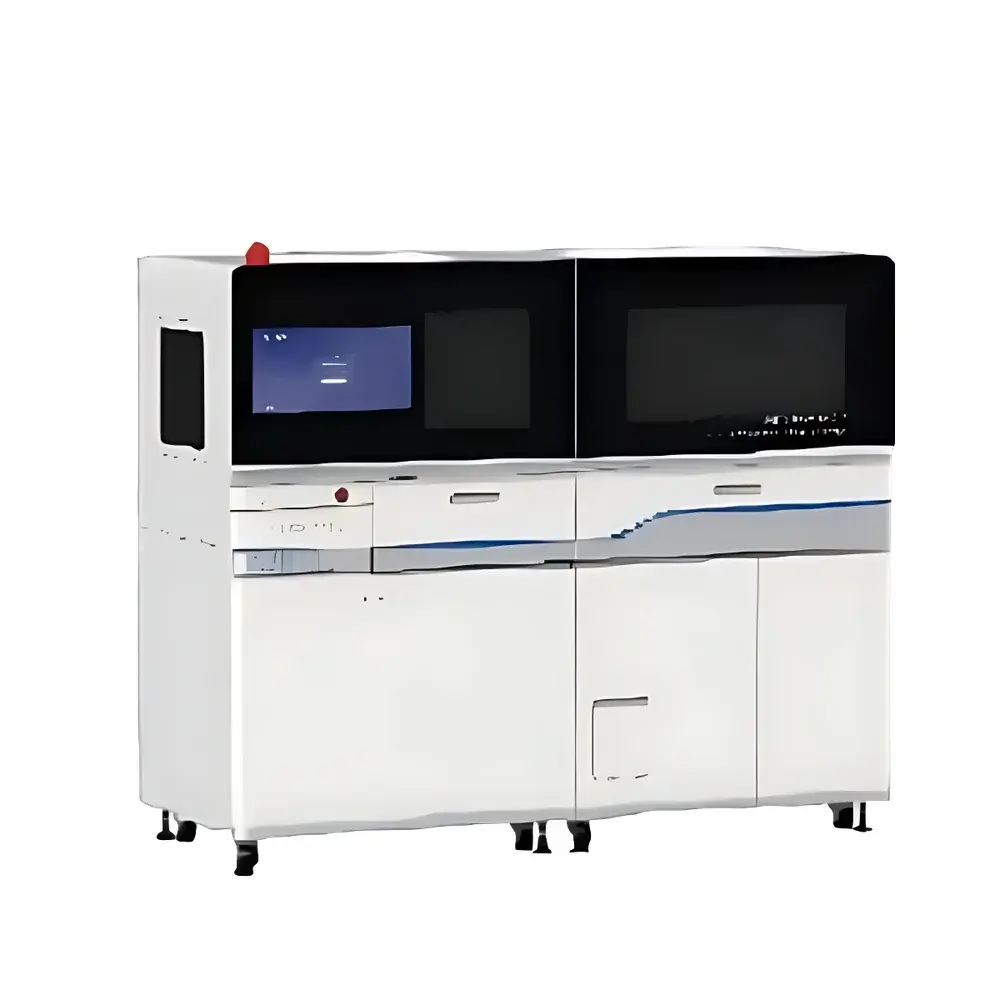
TIANLONG Aurora PANA X5 Fully Automated Nucleic Acid Purification and PCR Integration System
| Brand | TIANLONG |
|---|---|
| Origin | Shaanxi, China |
| Manufacturer Type | Direct Manufacturer |
| Product Category | Domestic |
| Model | Aurora PANA X5 |
| Automation Level | Dedicated Fully Automatic |
| Sample Throughput per Run | 96 |
| Lysis Reaction Volume | 1.7 mL |
| Pipetting Range | 5–1000 µL |
| Pipetting Accuracy | ≤2.0% (≤15 µL), ≤1.5% (15–50 µL), ≤1.0% (>50 µL) |
| Pipetting Precision (CV) | ≤3.0% (≤15 µL), ≤1.5% (15–50 µL), ≤1.2% (>50 µL) |
| Centrifuge Max Speed | 4500 RPM |
| Temperature Control Range | Ambient to 120 °C |
| Reagent Storage Compartment | Light-shielded, auto-cooled to 4–8 °C |
| Dimensions (L×W×H) | 2000 × 870 × 1780 mm |
| Touchscreen | 18-inch |
| Power Supply | AC 220 V, 50 Hz |
| Interface | USB 2.0, RJ45 Ethernet |
Overview
The TIANLONG Aurora PANA X5 is a fully integrated, walk-away nucleic acid purification and real-time PCR workflow automation system engineered for high-throughput molecular diagnostics laboratories. Built upon Couette-flow-based magnetic bead separation and thermally regulated liquid handling principles, the Aurora PANA X5 executes end-to-end processing—from primary sample tube loading to quantitative PCR amplification and result reporting—within a single instrument footprint. Its architecture adheres to ISO 15189 and CLIA-aligned laboratory workflow design principles, supporting unidirectional sample flow, physical segregation of pre- and post-amplification zones, and hardware-enforced contamination control. The system is validated for use with clinical specimen types including nasopharyngeal swabs, saliva, plasma, and whole blood, and is compatible with CE-IVD–marked and FDA EUA–authorized extraction and amplification chemistries.
Key Features
- Integrated 96-sample capacity platform combining automated tube uncapping/capping, barcode scanning (360° omnidirectional recognition), magnetic-bead-based nucleic acid isolation, qPCR master mix preparation, and thermal cycling—all within one enclosure.
- Dual independent pipetting modules with eight individually addressable channels, each equipped with liquid-level sensing, air-gap aspiration, clog detection, and multi-dispense functionality across a 5–1000 µL range.
- Modular physical zoning: four functionally isolated compartments (reagent storage, sample loading, nucleic acid extraction, and amplification analysis) maintained under controlled negative pressure, HEPA-filtered exhaust, and directional laminar airflow.
- Comprehensive contamination mitigation suite: UV-C irradiation (254 nm) between runs, disposable waste containment cartridges, droplet capture traps, and automated surface decontamination protocols compliant with ISO 13485 environmental monitoring requirements.
- Embedded thermal control subsystem: reagent cooling (4–8 °C), lysis heating (up to 120 °C), and qPCR block with precise ramping (±0.25 °C uniformity) and real-time fluorescence detection.
- Self-diagnostic firmware with real-time fault logging, error-resilient operation (e.g., barcode misread recovery without process interruption), and audit-trail generation meeting FDA 21 CFR Part 11 data integrity criteria.
Sample Compatibility & Compliance
The Aurora PANA X5 supports standard 0.2 mL and 1.5 mL tubes, as well as 96-well deep-well and PCR plates conforming to ANSI/SLAS dimensional specifications. It is validated for use with silica-magnetic bead and guanidinium-thiocyanate-based extraction chemistries, and interfaces seamlessly with commercial TaqMan and SYBR Green qPCR assays. System validation documentation includes analytical sensitivity (LoD), reproducibility (inter-run CV < 2.5%), and carryover testing per CLSI EP17-A2 guidelines. Instrument software complies with IEC 62304 Class B medical device software requirements and supports GLP/GMP audit modes with electronic signature enforcement and immutable event logs.
Software & Data Management
The embedded Linux-based operating system features a 18-inch capacitive touchscreen interface with role-based access control (administrator, technician, operator). Method templates are stored in encrypted SQLite databases with version-controlled revision history. All run data—including raw fluorescence curves, cycle threshold (Ct) values, extraction yield metrics, and hardware event timestamps—are exported in CSV and PDF formats compliant with LIS/HIS integration via ASTM E1384 or HL7 v2.5.2 messaging. Audit trails record user actions, parameter changes, and instrument state transitions with cryptographic hashing to ensure non-repudiation and traceability for regulatory inspections.
Applications
- Clinical virology screening: SARS-CoV-2, influenza A/B, RSV, and multiplex respiratory pathogen panels.
- Transplant monitoring: Quantitative detection of BK virus, CMV, and EBV in urine and plasma.
- Oncology liquid biopsy support: Isolation and pre-analytical preparation of circulating tumor DNA from plasma prior to NGS library construction.
- Public health surveillance: High-volume batch processing in centralized reference labs with minimal hands-on time and full chain-of-custody tracking.
- Research core facilities: Standardized nucleic acid workflow deployment across multiple investigator projects with method lock-down and cross-platform interoperability.
FAQ
Does the Aurora PANA X5 require external computers or network infrastructure to operate?
No—it operates as a standalone unit with embedded computing, local storage, and touchscreen HMI. Network connectivity (RJ45) is optional for LIS integration or remote monitoring.
Can third-party reagents be used without compromising validation status?
Yes, provided they meet magnetic bead coupling efficiency, elution volume compatibility, and inhibitor removal performance thresholds documented in the system’s reagent qualification protocol.
How is carryover contamination monitored and verified during routine operation?
Automated carryover validation runs are scheduled weekly using no-template controls (NTCs); results are logged and flagged if Ct values exceed predefined thresholds per CLSI EP17-A2 Annex D.
Is the system compatible with ISO/IEC 17025-accredited laboratory quality management systems?
Yes—the instrument’s calibration schedule, maintenance records, and performance verification reports align with ISO/IEC 17025:2017 clause 6.4.6 (equipment management) and clause 7.7 (result reporting).
What level of technical support and service coverage is available internationally?
TIANLONG provides on-site installation qualification (IQ), operational qualification (OQ), and preventive maintenance contracts through authorized regional service partners, with SLAs aligned to ISO 13485-certified service delivery frameworks.





