
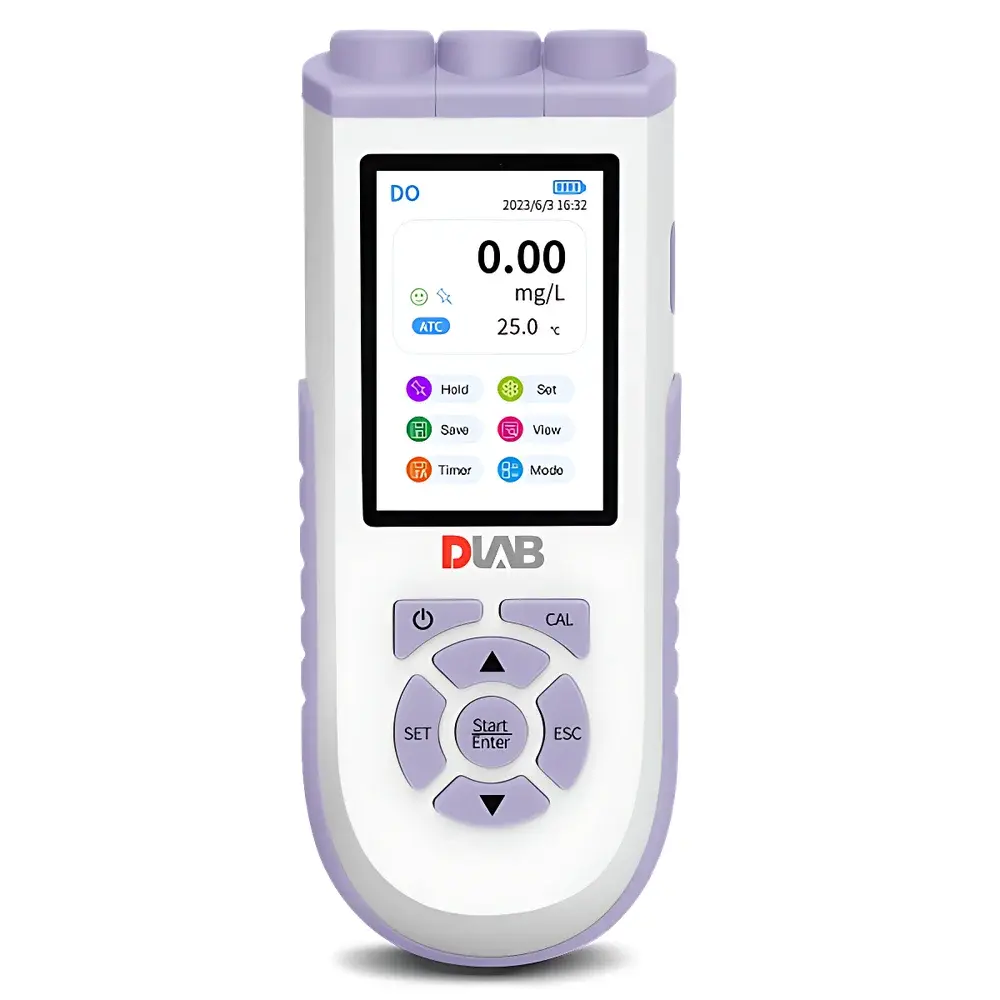
DLAB DDOPRO10 Portable Optical Dissolved Oxygen Meter (Single-Parameter)
| Brand | DLAB |
|---|---|
| Origin | Beijing, China |
| Manufacturer Type | Manufacturer |
| Product Origin | Domestic (China) |
| Model | DDOPRO10 |
| Price | Upon Request |
| Display | 3.5-inch TFT color LCD |
| Measurement Principle | Fluorescence quenching (optical, non-consumptive) |
| DO Range | 0.00–20.00 mg/L |
| DO Accuracy | ±0.20 mg/L |
| DO Saturation Range | 0.0–200.0 % |
| Atmospheric Pressure Compensation | Automatic, 0–200.0 kPa |
| Temperature Compensation | Automatic, 0.0–50.0 °C (32.0–122.0 °F) |
| Salinity Compensation | Manual, 0–45 ppt |
| Temperature Range | −10.0–135.0 °C (14.0–275.0 °F) |
| Temp Accuracy | ±0.2 °C |
| Response Time | <15 s |
| Electrode Housing | POM (polyoxymethylene) |
| Protection Rating | IP57 |
| Power Supply | Built-in rechargeable Li-ion battery (DH10-LI01) |
| Charging Interface | USB Type-C |
| Standard Kit Includes | DDOPRO10 meter, DODO01-3M optical DO probe (3 m cable), carrying case (33 × 27.2 × 8.2 cm), charging cable, user manual |
Overview
The DLAB DDOPRO10 is a handheld, single-parameter optical dissolved oxygen (DO) meter engineered for field-deployable and laboratory-grade water quality assessment. Unlike traditional electrochemical Clark-type sensors, the DDOPRO10 employs fluorescence quenching technology—measuring the phase shift or intensity decay of ruthenium-based luminescent dye excited by blue LED light upon exposure to molecular oxygen. This optical principle eliminates oxygen consumption at the sensing surface, ensuring zero drift during continuous monitoring and eliminating the need for membrane replacement, electrolyte refilling, or extended polarization periods. The instrument is calibrated per ISO 5814:2012 (Water quality — Determination of dissolved oxygen — Electrochemical probe method) and supports traceable measurements compliant with EPA Method 360.1 and ASTM D888-22 (Standard Test Methods for Dissolved Oxygen in Water). Its ruggedized design—including POM (polyoxymethylene) housing and IP57 ingress protection—ensures operational reliability in humid, dusty, or splash-prone environments typical of wastewater treatment plants, aquaculture facilities, environmental monitoring stations, and river basin surveys.
Key Features
- Optical fluorescence-based DO sensing: No oxygen consumption, no membrane degradation, no electrolyte maintenance
- 3.5-inch high-resolution TFT color display with intuitive UI navigation and real-time graphical trend logging
- Automatic temperature and atmospheric pressure compensation algorithms aligned with Henry’s law correction models
- Manual salinity compensation (0–45 ppt) enabling accurate DO reporting across freshwater, brackish, and coastal marine matrices
- Rapid response time (<15 seconds to 95% of final value) supporting dynamic profiling in flowing streams or aeration basins
- POM-bodied DODO01-3M optical probe with integrated temperature sensor and 3-meter abrasion-resistant cable
- Rechargeable lithium-ion battery (DH10-LI01) with USB Type-C charging port and >20-hour continuous operation
- IP57-rated enclosure certified for dust resistance and immersion up to 1 m for 30 minutes
Sample Compatibility & Compliance
The DDOPRO10 is validated for aqueous samples across pH 4–12 and conductivity ≤20 mS/cm. It exhibits minimal cross-sensitivity to common interferents including CO₂, H₂S, Cl₂, and NOₓ—unlike amperometric sensors vulnerable to redox-active species. Calibration is performed using either air-saturation (at known barometric pressure and temperature) or zero-oxygen solution (sodium sulfite method per ISO 5814 Annex B). All measurement data adhere to GLP documentation requirements, with timestamped readings stored internally and exportable via USB. The device supports audit-ready operation under ISO/IEC 17025-accredited laboratories and satisfies functional prerequisites for US EPA Region 10 field protocols and EU WFD (Water Framework Directive) monitoring programs.
Software & Data Management
While the DDOPRO10 operates as a standalone instrument, its internal memory logs up to 2,000 timestamped DO/temperature/pressure/saturation records with automatic metadata tagging (date, time, operator ID placeholder, calibration status). Data export is facilitated through direct USB connection to Windows/macOS systems without proprietary drivers—readable as CSV files compatible with LIMS, Excel, or statistical analysis platforms (e.g., R, Python pandas). Firmware updates are delivered via downloadable .bin files and installed through the onboard menu—ensuring long-term regulatory adaptability. No cloud connectivity or remote telemetry is embedded, preserving data sovereignty and aligning with ITAR- and GDPR-sensitive deployment contexts.
Applications
- Wastewater treatment process control: Aeration basin optimization, effluent compliance verification (e.g., NPDES permits)
- Aquaculture and hatchery management: Real-time DO monitoring in recirculating aquaculture systems (RAS) and pond dynamics
- Environmental field surveys: Stream health assessment, lake stratification profiling, and wetland restoration monitoring
- Drinking water distribution: Residual oxygen verification post-chlorination and storage tank integrity checks
- Educational laboratories: Undergraduate environmental chemistry and limnology experiments requiring robust, low-maintenance instrumentation
- Industrial cooling water systems: Corrosion risk assessment via dissolved oxygen mapping in closed-loop circuits
FAQ
Does the DDOPRO10 require membrane replacement or electrolyte refilling?
No. As an optical sensor, it contains no consumable membranes or liquid electrolytes—eliminating routine maintenance associated with polarographic DO probes.
Can the instrument compensate for altitude-related barometric pressure changes?
Yes. The built-in pressure sensor automatically compensates across 0–200.0 kPa, enabling accurate DO reporting from sea level to high-elevation sites (e.g., Andean reservoirs or Tibetan plateau monitoring stations).
Is the DODO01-3M probe suitable for submerged long-term deployment?
It is rated IP68 when used with optional submersible mounting hardware (not included), but standard use assumes intermittent immersion; continuous submersion beyond 72 hours requires validation against biofouling accumulation per ISO 10523 guidelines.
How often should calibration be performed in routine field use?
Field calibration is recommended before each sampling session or every 8 hours of continuous operation—verified against NIST-traceable air-saturated water standards or certified zero-O₂ solutions.
Does the device support GLP-compliant data traceability?
Yes. Each stored reading includes date/time stamp, probe serial number, calibration timestamp, and operator ID field—meeting minimum ALCOA+ (Attributable, Legible, Contemporaneous, Original, Accurate, Complete, Consistent, Enduring, Available) data integrity criteria for regulated environments.




