
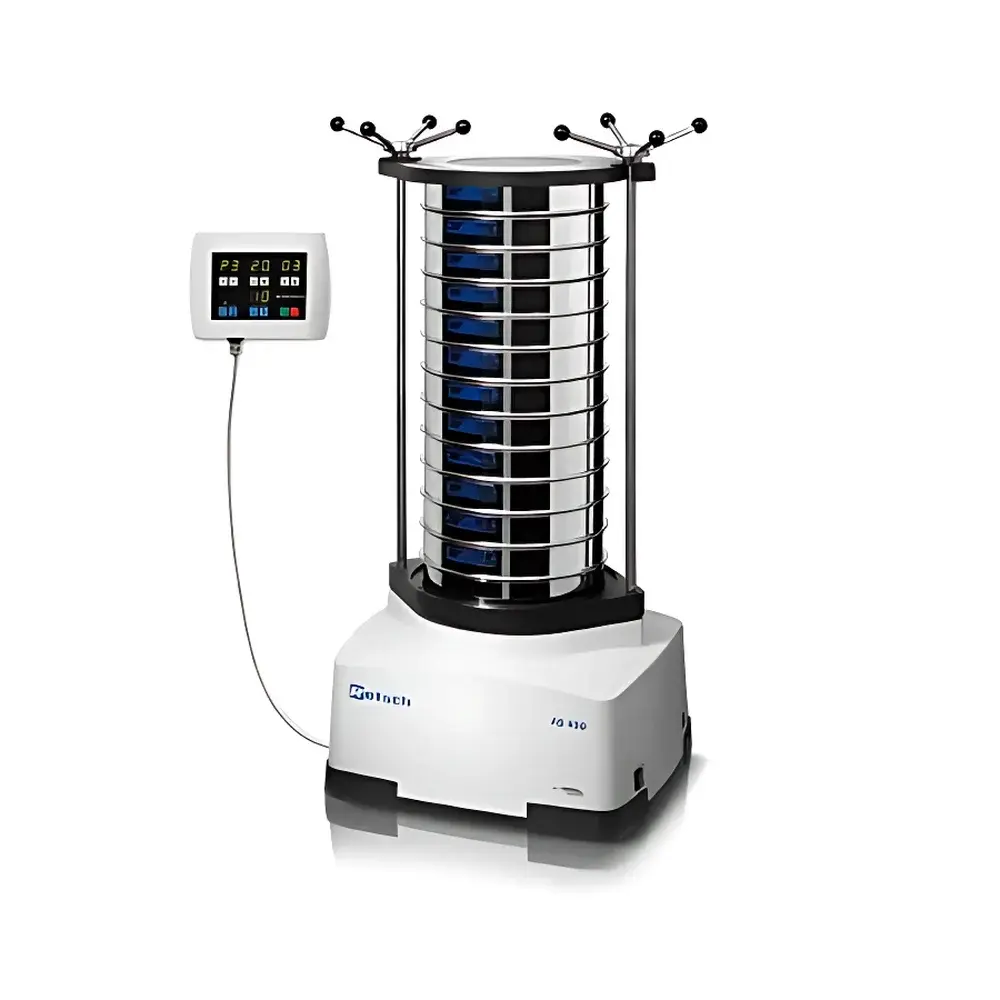
Retsch AS450 Control Electromagnetic 3D Shaker Sieve Analyzer
| Brand | Retsch |
|---|---|
| Origin | Germany |
| Model | AS450 Control |
| Principle | Electromagnetic 3D vibratory sieving |
| Measurement Range | 25 µm – 125 mm |
| Max. Sample Load | 25 kg |
| Max. Sieve Stack Levels | 13 (min. 3) |
| Amplitude Range | 0.2 – >2.2 mm |
| Acceleration | 1–7.1 g |
| Sieving Time | 1–99 min (digital display) |
| Intermittent Mode Interval | 10–99 s |
| Stored SOPs | 9 |
| Sieve Diameter Compatibility | 400 mm / 450 mm |
| Max. Sieve Tower Height | 963 mm |
| Net Weight | ~220 kg |
| Power Supply | Single-phase, CE-compliant |
Overview
The Retsch AS450 Control is a high-precision electromagnetic 3D shaker sieve analyzer engineered for reproducible, standardized particle size distribution analysis across research, quality control, and production environments. Unlike conventional eccentric or rotary sievers, the AS450 employs a patented electromagnetic drive system combined with Retsch’s proprietary CET (Controlled Excitation Technology) to generate a true three-dimensional抛动 (tossing) motion—characterized by simultaneous vertical lift, horizontal oscillation, and rotational dispersion. This kinematic profile ensures uniform sample distribution across the full active area of each sieve, minimizing segregation effects and maximizing sieving efficiency—even for challenging materials such as agglomerated powders, fibrous particles, or abrasive granules. Designed explicitly for 400 mm and 450 mm diameter analytical sieves, the instrument complies with ISO 2591-1, ISO 9276-1, and ASTM E11 standards for test sieve specifications and sieving methodology. Its robust cast-iron frame and vibration-damped base guarantee operational stability under maximum load conditions (up to 25 kg), while the fully digital control interface enables traceable, audit-ready parameter logging.
Key Features
- Electromagnetic 3D drive system delivering precise, maintenance-free excitation without mechanical wear or belt slippage
- CET technology enabling amplitude stabilization (0.2–>2.2 mm) and acceleration control (1–7.1 g) independent of sample mass or stack configuration
- Digital parameter adjustment for sieving time (1–99 min), amplitude, and intermittent pause intervals (10–99 s)
- Onboard memory for up to 9 user-defined SOPs—including dry and wet sieving protocols—with timestamped execution history
- Detachable, ergonomically angled control panel with intuitive keypad and high-contrast LCD display
- Integrated RS232 serial interface supporting bidirectional communication with optional EasySieve software for automated data capture, statistical reporting, and GLP-compliant audit trails
- Modular clamping system (“Standard” and “Comfort” variants) compatible with both dry and wet sieving setups, including liquid-tight seals and drainage trays
- CE-marked, single-phase power supply with built-in overcurrent and thermal protection; designed for continuous operation in ISO/IEC 17025-accredited laboratories
Sample Compatibility & Compliance
The AS450 Control accommodates a broad spectrum of particulate materials—including free-flowing powders, cohesive granules, suspended solids, and friable aggregates—across a validated size range from 25 µm to 125 mm. It supports wet sieving with integrated fluid management accessories (e.g., spray nozzles, overflow troughs, and corrosion-resistant stainless-steel sieve frames), making it suitable for applications involving cementitious slurries, mineral suspensions, or recycled construction aggregates. All operational parameters meet requirements for ISO 9001-certified measurement equipment, and when paired with EasySieve software, the system satisfies FDA 21 CFR Part 11 criteria for electronic records and signatures—including user authentication, change tracking, and immutable result archiving. Routine verification adheres to ISO/IEC 17025 clause 6.4.10 (verification of equipment performance), with amplitude and timing accuracy verified annually using NIST-traceable calibrators.
Software & Data Management
Optional EasySieve software transforms the AS450 Control into a networked analytical workstation. Via RS232 connection, it enables remote initiation, real-time monitoring of amplitude, acceleration, and elapsed time, and automatic export of sieve residue weights per fraction into CSV or PDF formats. The software enforces role-based access control, generates GMP-compliant batch reports with operator ID, date/time stamps, and instrument calibration status, and supports trend analysis across multiple sieving campaigns. All raw data files are stored with embedded metadata (e.g., sieve mesh numbers, material ID, environmental temperature/humidity if logged externally), facilitating seamless integration into LIMS or ELN platforms. Audit logs record every parameter modification, start/stop event, and firmware update—ensuring full compliance with GLP and pharmaceutical validation protocols.
Applications
The AS450 Control serves critical functions in regulated and non-regulated sectors alike. In chemical and polymer manufacturing, it verifies filler dispersion homogeneity and catalyst particle integrity prior to extrusion. In geotechnical and metallurgical labs, it characterizes crushed ore gradation, slag particle morphology, and soil texture classification per ASTM D422 and ISO 14688. Environmental laboratories apply it to classify recycled concrete aggregates, municipal solid waste fractions, and fly ash fineness for pozzolanic activity assessment. Ceramic and glass producers rely on its repeatability for raw material grading—especially feldspar, silica sand, and alumina powders—where narrow PSD windows directly impact sintering behavior and final density. Additionally, the instrument is widely adopted in R&D settings for formulation screening, process optimization, and failure analysis of powder handling systems.
FAQ
What sieve diameters does the AS450 Control support?
It is optimized exclusively for 400 mm and 450 mm analytical sieves conforming to ISO 3310-1 and ASTM E11 specifications.
Can the AS450 perform wet sieving without modification?
Yes—wet sieving is supported natively via optional liquid-handling kits, including splash guards, drain trays, and pressurized spray manifolds.
Is calibration documentation provided with the instrument?
Each unit ships with a factory calibration certificate referencing traceable standards; annual verification kits and certified reference materials are available separately.
How many sieve levels can be stacked simultaneously?
Up to 13 sieve levels may be used in a single run; minimum configuration requires 3 tiers to ensure mechanical stability and kinetic coupling.
Does the AS450 Control comply with FDA 21 CFR Part 11?
When operated with EasySieve software and configured with appropriate IT controls (e.g., password policies, electronic signatures), it meets all technical and procedural requirements for Part 11 compliance.



