
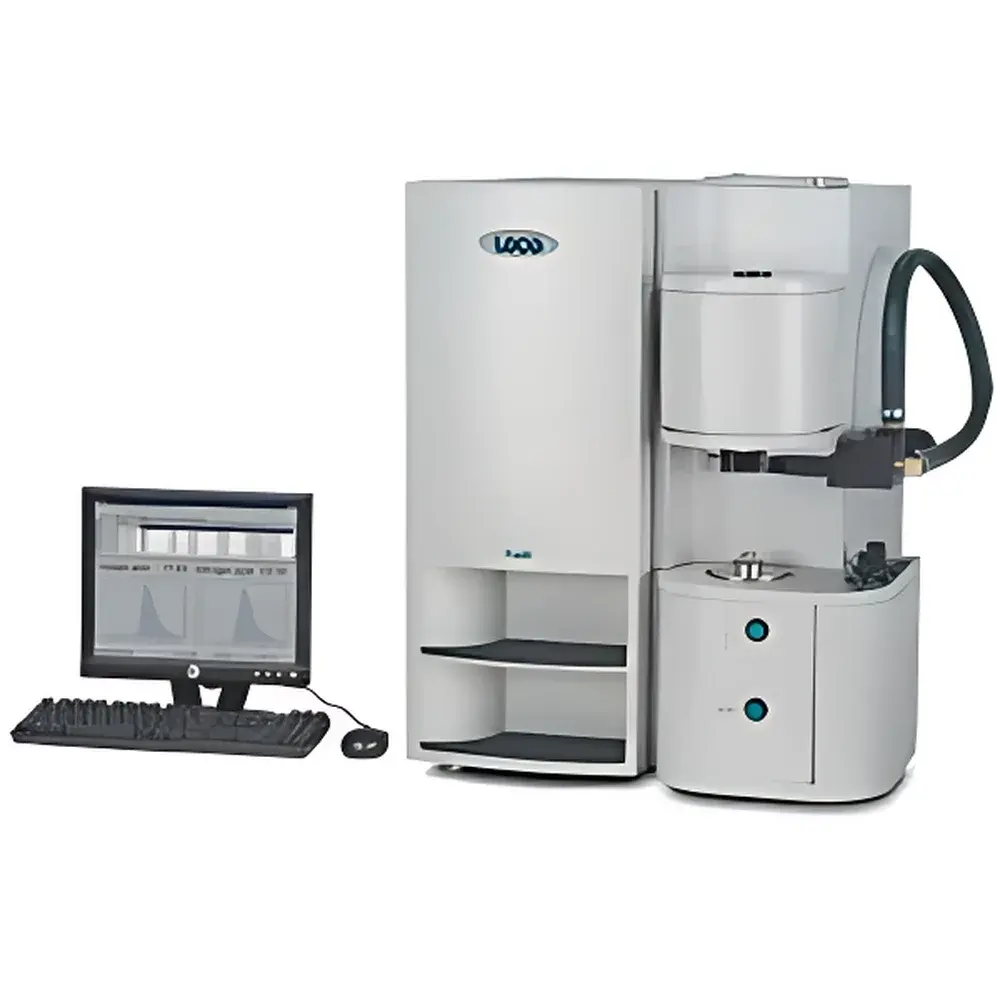
LECO TC-500 Oxygen and Nitrogen Determinator
| Brand | LECO |
|---|---|
| Origin | USA |
| Manufacturer Type | Original Equipment Manufacturer (OEM) |
| Product Origin | Imported |
| Model | TC-500 |
| Instrument Type | Oxygen and Nitrogen Analyzer |
Overview
The LECO TC-500 Oxygen and Nitrogen Determinator is a high-performance, dual-element combustion-based elemental analyzer engineered for precise quantification of total oxygen and nitrogen in solid inorganic materials—including ferrous and non-ferrous metals, refractory alloys, ceramics, and advanced composites. Utilizing high-temperature inert gas fusion (helium or argon), the TC-500 thermally decomposes samples in a graphite crucible at temperatures exceeding 3,000 °C, releasing bound oxygen as carbon monoxide (CO) and nitrogen as molecular N₂. These evolved gases are then separated and quantified via infrared (IR) absorption spectroscopy for oxygen and thermal conductivity detection (TCD) for nitrogen—enabling simultaneous, independent measurement with high specificity and minimal interferences. Designed for routine production control and quality assurance laboratories, the TC-500 delivers robust repeatability, low detection limits, and compliance-ready operation across metallurgical, aerospace, and nuclear-grade material certification workflows.
Key Features
- Simultaneous oxygen and nitrogen determination in a single analysis cycle, reducing turnaround time and cross-contamination risk.
- High-temperature graphite furnace with programmable thermal ramping and inert gas purge control to ensure complete sample decomposition and reproducible gas release kinetics.
- Dual-detector architecture: Solid-state infrared cell optimized for CO detection (oxygen channel) and micro-flow thermal conductivity detector (nitrogen channel), each calibrated traceably to NIST-certified standards.
- Automated crucible handling and ash removal system minimizes operator intervention and enhances long-term analytical stability.
- Rugged industrial enclosure rated IP54, compliant with CE, UL, and FCC electromagnetic compatibility requirements for integration into regulated manufacturing environments.
- Integrated leak-check and pressure-monitoring routines ensure gas-path integrity prior to every analysis—critical for low-level detection reliability.
Sample Compatibility & Compliance
The TC-500 accepts solid samples up to 1.0 g (typical mass range: 0.1–0.5 g), including castings, powders, chips, and sintered compacts. Sample preparation requires no acid digestion or chemical pretreatment; direct solid introduction eliminates reagent-related blanks and contamination pathways. The instrument meets ASTM E1019 (Standard Test Methods for Determination of Carbon, Sulfur, Nitrogen, and Oxygen in Steel, Iron, Nickel, and Cobalt Alloys), ISO 14284 (Steel and Iron — Sampling and Preparation of Samples for Determination of Chemical Composition), and USP (Elemental Impurities – Procedures) for oxygen/nitrogen validation protocols. Data acquisition and audit trails conform to FDA 21 CFR Part 11 requirements when operated with LECO’s optional Secure Software Package, supporting GLP/GMP-compliant documentation and electronic signature workflows.
Software & Data Management
Controlled via LECO’s proprietary OmniStar™ software platform (Windows-based), the TC-500 provides real-time gas chromatogram visualization, automated peak integration, and multi-point calibration curve management. All raw detector signals, furnace temperature profiles, gas flow rates, and pressure logs are timestamped and stored in an encrypted SQLite database. Export options include CSV, XML, and PDF reports compliant with laboratory information management systems (LIMS). Audit trail functionality records user actions, method changes, calibration events, and result modifications with immutable timestamps—enabling full traceability for internal audits and regulatory inspections. Optional network connectivity supports remote diagnostics and centralized instrument fleet monitoring.
Applications
- Quality control of stainless steels, titanium alloys, and superalloys where interstitial oxygen and nitrogen directly impact ductility, weldability, and creep resistance.
- Refinery catalyst support materials (e.g., alumina, zirconia) where residual nitrogen affects surface area and catalytic activity.
- Nuclear-grade zirconium and hafnium cladding materials, where oxygen content must be maintained below 1,200 ppm to prevent hydride formation.
- Research and development of metal-matrix composites and additive manufacturing feedstocks, requiring tight specification of interstitial impurities.
- Third-party certification labs performing ISO/IEC 17025-accredited testing for aerospace OEMs and defense contractors.
FAQ
What sample forms are compatible with the TC-500?
Solid metallic samples (chips, turnings, pellets), powders, and sintered ceramics—no liquid or volatile organic matrices.
Is helium the only carrier gas option?
No; argon may be used for nitrogen analysis, but helium is required for optimal oxygen detection due to its superior thermal conductivity and IR transparency.
How often does the IR cell require recalibration?
Typically every 6–12 months under normal use; verified daily via certified reference materials (CRMs) such as NIST SRM 1263a (low-alloy steel) and LECO’s internal O/N check standards.
Can the TC-500 be integrated into an existing LIMS?
Yes—via ASTM E1382-compliant ASCII or HL7 messaging, or direct database query using ODBC drivers provided with OmniStar™ software.
Does the system support GLP-compliant electronic signatures?
Yes, when equipped with Secure Software Package v3.2+, which enforces role-based access control, biometric or token-based authentication, and 21 CFR Part 11–compliant audit logging.




