
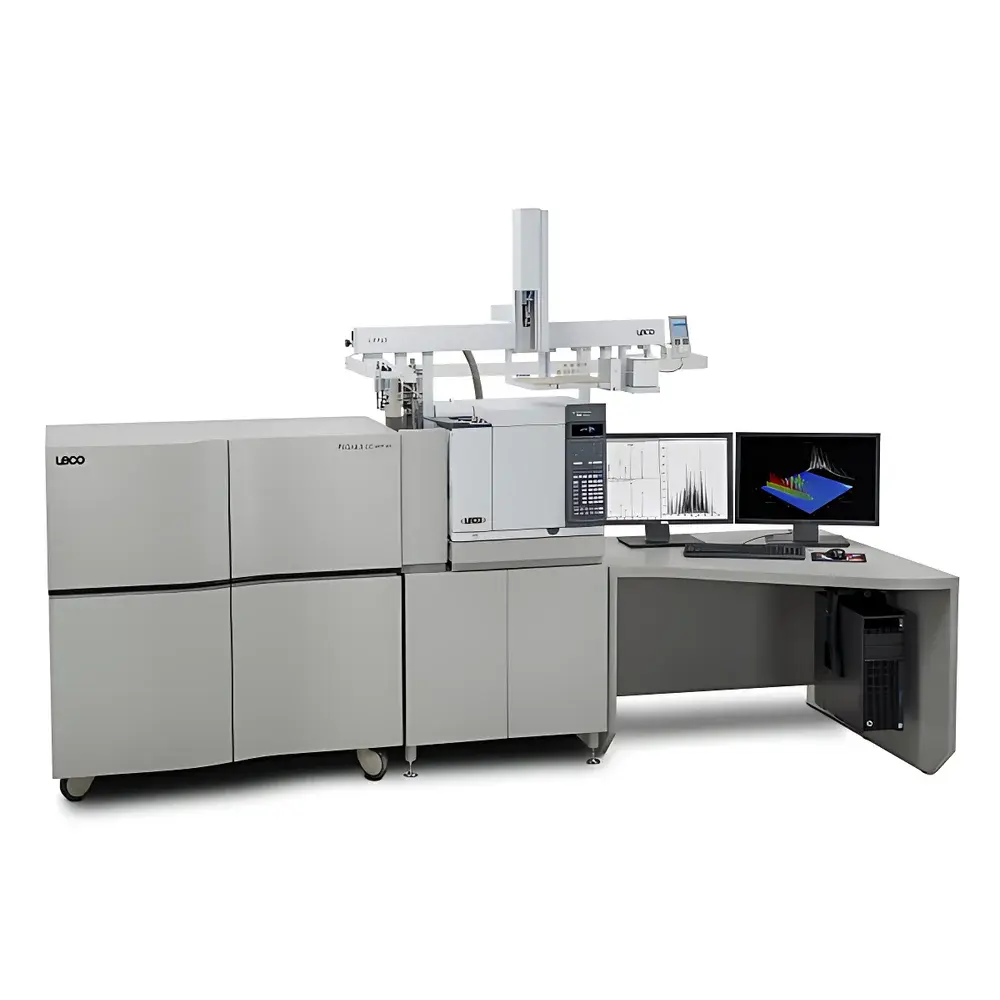
LECO Pegasus GC-HRT 4D+ Comprehensive Two-Dimensional Gas Chromatography High-Resolution Time-of-Flight Mass Spectrometer
| Brand | LECO |
|---|---|
| Origin | USA |
| Manufacturer | LECO Corporation |
| Model | Pegasus GC-HRT 4D+ |
| Instrument Type | Time-of-Flight Mass Spectrometer (TOF-MS) |
| Chromatography Type | Comprehensive Two-Dimensional Gas Chromatography (GC×GC) |
| Mass Range | 15–1500 Da |
| Resolution | 25,000 / 50,000 (FWHM at m/z 200) |
| Sensitivity | 0.1 pg OFN (octafluoronaphthalene), S/N > 150 (UR model) |
| Acquisition Rate | 200 spectra/s |
| Ionization Modes | Electron Impact (EI) and Chemical Ionization (CI) |
Overview
The LECO Pegasus GC-HRT 4D+ is an integrated analytical platform engineered for ultra-high-fidelity characterization of chemically complex matrices. It combines comprehensive two-dimensional gas chromatography (GC×GC) with a high-resolution, high-speed time-of-flight mass spectrometer (HR-TOF-MS), delivering orthogonal separation power and sub-ppm mass accuracy in a single acquisition. Unlike conventional one-dimensional GC-MS systems, GC×GC employs two serially coupled capillary columns with distinct stationary phases and retention mechanisms—modulated via cryogenic or consumable-free thermal modulation—to achieve effective peak capacities exceeding 10,000. This results in dramatically enhanced peak capacity, reduced co-elution, and improved signal-to-noise ratios. The Pegasus GC-HRT 4D+ utilizes LECO’s proprietary multi-reflecting TOF analyzer, enabling simultaneous acquisition of full-spectrum data at 200 Hz while maintaining resolution up to 50,000 (FWHM) and mass accuracy better than 1 ppm RMS across the entire mass range (15–1500 Da). Its EFP (Encoded Frequent Pushing) ion acceleration technology ensures near-100% duty cycle without sacrificing sensitivity—critical for capturing narrow GC×GC peaks (<200 ms width) with sufficient data points per peak for robust deconvolution and quantitation.
Key Features
- Integrated GC×GC hardware support—including dual-mode modulation options: cryogenic quad-jet modulator (industry-standard for broad volatility coverage and high modulation efficiency) and consumable-free thermal modulator (reducing operational cost and complexity)
- High-resolution TOF-MS with real-time acquisition at 200 spectra/second, resolving power up to 50,000 FWHM, and mass accuracy <1 ppm RMS
- EFP ion optics architecture delivering >95% duty cycle and 10× higher sensitivity vs. prior-generation GC-HRT 4D
- Dual ionization capability: fully switchable EI and CI sources for complementary fragmentation patterns and soft ionization of labile compounds
- Dynamic range exceeding five orders of magnitude, enabling reliable quantitation from trace-level contaminants to major components in a single run
- Automated peak detection (Automated Peak Find™) with customizable SNR and peak width thresholds—even detecting sub-baseline features
- HR-Deconvolution™ algorithm for accurate spectral unmixing of co-eluting analytes separated by as little as 0.01 s in retention time
- Four-dimensional identification confidence: 1st-D retention time, 2nd-D retention time, spectral library match score, and exact mass of fragment ions
Sample Compatibility & Compliance
The Pegasus GC-HRT 4D+ is validated for analysis of volatile and semi-volatile organic compounds across diverse sample classes—including petrochemicals, environmental persistent organic pollutants (POPs), dioxins/furans, PCBs, food volatiles, tobacco smoke condensate, traditional Chinese medicine essential oils, and biological metabolites. Its GC×GC separation resolves structural isomers and homologous series that remain inseparable by 1D-GC, while HR-TOF-MS enables confident formula assignment (e.g., CxHyOzNw) and elemental composition verification. The system complies with key regulatory frameworks including ASTM D7504 (petroleum hydrocarbons), EPA Method 8270/1613/1668C (halogenated organics), ISO 17993 (environmental analysis), and supports GLP/GMP workflows through audit-trail-enabled ChromaTOF-HRT software. Data integrity meets FDA 21 CFR Part 11 requirements when deployed with appropriate IT controls.
Software & Data Management
ChromaTOF-HRT 5.2 serves as the unified control, acquisition, processing, and reporting engine. It provides synchronized GC×GC oven and modulator timing control, real-time spectral visualization, and automated calibration. Advanced data processing includes mass defect plot generation, Van Krevelen diagrams, RDBE vs. carbon number plots, and unsupervised compound classification. The SAT (Spectral Analysis Tools) module facilitates rapid pattern recognition in untargeted workflows. All processing steps—including peak detection, deconvolution, library search (NIST, Wiley, custom libraries), and quantitative integration—are fully scriptable and reproducible. Reports are customizable via drag-and-drop templates; peak tables export directly to Excel, CSV, or mzXML formats. Raw data files (.tdf) are vendor-neutral and compatible with third-party open-source tools (e.g., MS-DIAL, XCMS Online).
Applications
- Petroleum & refinery: detailed hydrocarbon group-type analysis (HTA), biomarker profiling, sulfur speciation
- Environmental monitoring: non-target screening of emerging contaminants, congener-specific dioxin analysis, microplastic leachate profiling
- Food & flavor science: authenticity verification, off-flavor compound identification, Maillard reaction product mapping
- Clinical & nutritional metabolomics: serum/urine volatile metabolite fingerprinting, gut microbiome-derived SCFA profiling
- Pharmaceutical impurity profiling: genotoxic alkyl halide detection, residual solvent screening
- Natural products chemistry: essential oil chemotyping, terpene and sesquiterpene isomer differentiation
FAQ
What distinguishes GC×GC from conventional 1D-GC in terms of peak capacity and resolution?
GC×GC achieves effective peak capacities 5–10× greater than 1D-GC by orthogonally separating compounds first by volatility (1st dimension) and then by polarity (2nd dimension), significantly reducing co-elution and enhancing detectability of trace analytes.
How does the 200 spectra/s acquisition rate impact data quality in GC×GC-TOF-MS?
At typical GC×GC peak widths of 100–200 ms, ≥10 data points per peak are required for accurate apex determination and deconvolution—200 Hz acquisition ensures ≥20 points per peak, preserving chromatographic fidelity and enabling robust HR-Deconvolution™.
Can the system perform both targeted and untargeted analysis in a single run?
Yes—ChromaTOF-HRT supports hybrid workflows: automated target analyte finding (TAF) alongside full-spectrum non-target screening, with shared calibration, retention indexing, and database matching infrastructure.
Is the system compliant with FDA 21 CFR Part 11 for regulated laboratories?
When configured with role-based user access, electronic signatures, and audit-trail logging enabled in ChromaTOF-HRT, the platform satisfies core technical requirements for Part 11 compliance; formal validation remains the responsibility of the end-user laboratory.
What column configurations are supported for GC×GC method development?
The system accommodates standard GC×GC setups (e.g., DB-5/DB-17, BPX-50/BPX-70) and integrates the GC×GC Column Calculator tool within ChromaTOF to predict modulation parameters, peak width, and optimal temperature programs based on column dimensions and phase chemistries.





