
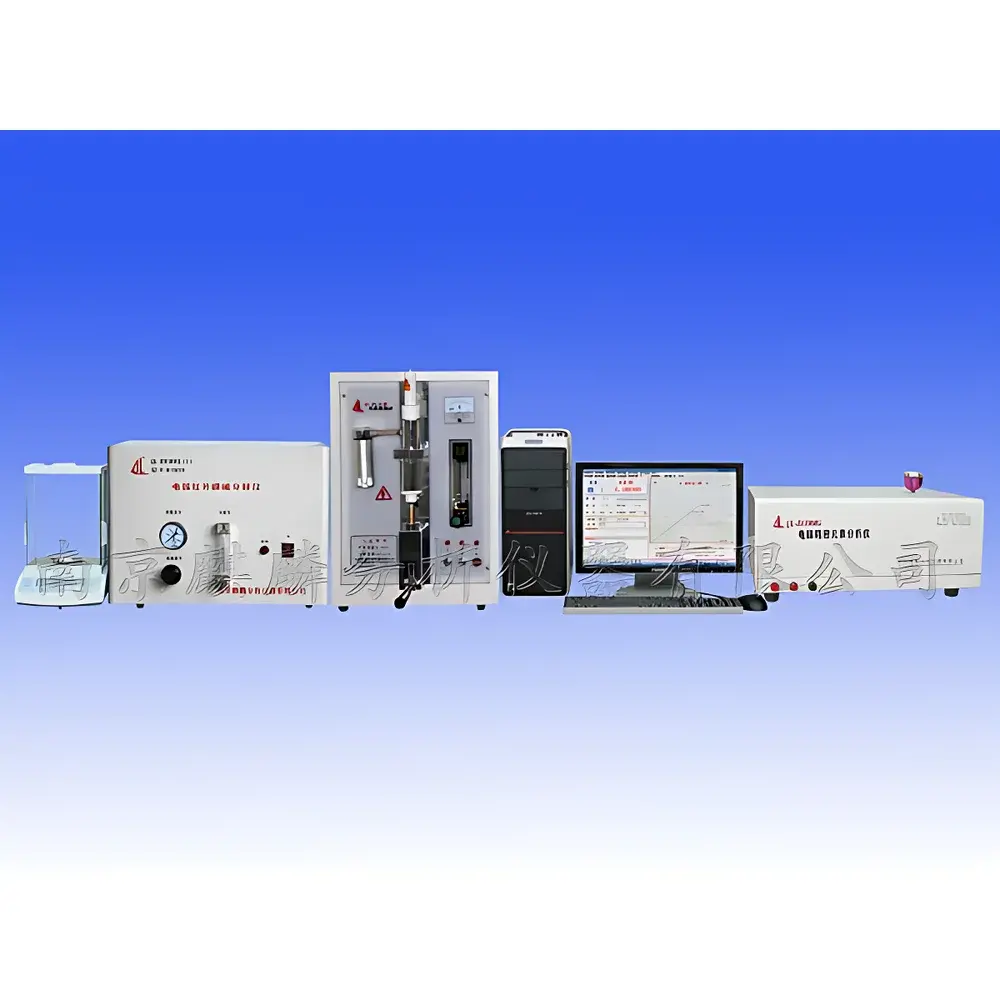
QL-S3000C Black Metal Elemental Analyzer
| Origin | Jiangsu, China |
|---|---|
| Manufacturer Type | Authorized Distributor |
| Origin Category | Domestic (PRC) |
| Model | S3000C |
| Price | USD 8,100 (FOB Jiangsu) |
| Measurement Principle | IR Absorption (C/S) + Photometric Colorimetry (Multi-element) |
| Wavelength Range | 400–800 nm (Motorized Grating, Digital Step Control, Resolution <1 nm) |
| Sample Form | Solid metallic alloys (ferrous & non-ferrous), pre-digested solutions |
| Analysis Time | ~5 min per sample (C+S+up to 12 additional elements) |
| Calibration Curves | 99 user-storable regression-based calibration curves |
| Compliance | Meets GB/T 223.3–5:1988 and GB/T 223.68–69:1997 requirements for ferrous metallurgical analysis |
| Data Output | CSV, Excel, PDF via Windows-compatible PC interface |
| Sample Introduction | Off-line acid digestion (HCl/HNO₃/HF mixtures), followed by automated photometric measurement |
| Weight Integration | Optional RS-232/USB connection to analytical balance (0.1 mg resolution) |
| Optical System | Patented motor-driven holographic grating monochromator with zero-point auto-calibration |
| Reagent Delivery | Electrodeless titration dosing system with anti-clogging valve design |
| Software Platform | QL-Analyze v4.2 (Windows 10/11), supports CFR 21 Part 11 user authentication and electronic signature modules |
Overview
The QL-S3000C Black Metal Elemental Analyzer is a dual-mode benchtop instrument engineered for high-throughput quantitative elemental analysis of ferrous and non-ferrous metallic materials. It integrates infrared absorption spectroscopy for carbon and sulfur determination with computer-controlled photometric colorimetry for simultaneous multi-element analysis—including Mn, P, Si, Cr, Ni, Mo, Mg, Cu, Al, V, W, Ti, and rare earths—within a single operational workflow. Designed specifically for quality control laboratories in steel mills, foundries, and metal recycling facilities, the system operates on the principle of measuring characteristic absorbance at defined wavelengths following controlled acid dissolution of solid samples. Carbon and sulfur are combusted in a high-frequency induction furnace and quantified via IR detection cells with dual-detector compensation; all other elements are determined through standardized wet-chemical colorimetric reactions in solution phase, using a motorized diffraction grating monochromator to select optimal analytical wavelengths between 400 nm and 800 nm.
Key Features
- Dual analytical architecture: IR absorption for C/S + programmable photometry for up to 12 additional metallic elements per sample
- Motorized holographic grating monochromator with digital wavelength positioning (step resolution <1 nm), enabling precise, repeatable spectral selection without manual calibration
- Off-line sample digestion protocol eliminates internal tubing and valves—reducing maintenance frequency and extending system lifetime
- Electrodeless reagent dosing system with patented anti-clogging valve design for stable sulfur titration and long-term reliability
- Integrated weight acquisition: compatible with standard analytical balances via RS-232 or USB; supports both automatic mass import and manual entry
- 99-user-expandable calibration curve library using polynomial regression algorithms; curves persist across software sessions and power cycles
- Self-calibrating optical path: automatic zero and full-scale correction using cold-light source and imported photodetectors
- Windows-based QL-Analyze v4.2 software with configurable data export (CSV, XLSX, PDF), customizable report templates, and optional 21 CFR Part 11 compliance modules
Sample Compatibility & Compliance
The QL-S3000C is validated for use with solid metallic samples requiring prior acid digestion—primarily carbon steels, alloy steels, cast irons, stainless steels, and non-ferrous alloys such as copper-nickel and aluminum-magnesium systems. Sample preparation follows ASTM E350–22 and ISO 11572:2020 guidelines for dissolution of metallic matrices. Analytical performance meets or exceeds the precision and accuracy requirements specified in Chinese national standards GB/T 223.3–5:1988 (for Mn, P, Si) and GB/T 223.68–69:1997 (for C and S). While not certified to ISO/IEC 17025, the instrument’s documented repeatability (RSD ≤ 0.8% for mid-range concentrations), linearity (r² ≥ 0.9995 over working ranges), and inter-laboratory correlation data support its deployment in GLP- and GMP-aligned environments where method validation is performed internally.
Software & Data Management
QL-Analyze v4.2 provides a full-featured Windows-native interface supporting multi-user login, role-based access control, and electronic signature workflows compliant with FDA 21 CFR Part 11 when configured with audit trail logging and secure password policies. All measurement events—including wavelength selection, reagent volume delivery, absorbance readings, calibration updates, and final concentration calculations—are timestamped and attributable. Data files are stored in encrypted local databases with optional network backup; exports support laboratory information management system (LIMS) integration via ODBC drivers. The software includes built-in statistical tools for QC charting (X-bar/R, Levey-Jennings), trend analysis, and batch reporting aligned with ISO 10012 requirements for measurement process control.
Applications
This analyzer serves as a primary tool for incoming raw material verification, melt-process monitoring, and finished-product certification in metallurgical production. Typical use cases include rapid verification of alloy grade compliance (e.g., AISI 304 vs. 316 stainless steel), detection of tramp elements affecting weldability or corrosion resistance (e.g., Sn, As, Pb in copper alloys), and routine surveillance of slag-forming elements (P, S, Ca) in continuous casting operations. Its ability to quantify low-level magnesium (0.010–0.100%) and rare earths (0.01–0.100%) makes it suitable for specialty steel R&D, while the sub-ppm sulfur detection limit supports stringent automotive and aerospace specification testing (e.g., SAE J431, AMS 2301).
FAQ
What sample preparation is required before analysis?
Solid metal samples must be drilled, milled, or cut into chips and digested using standardized HCl/HNO₃/HF mixtures under reflux conditions. Digestion time and acid ratios vary by matrix; reference methods are provided in the operator manual.
Can the instrument analyze non-metallic materials such as ceramics or slags?
Yes—provided the sample is fully dissolved into an aqueous matrix compatible with the colorimetric chemistry and does not interfere with IR cell optics or cause precipitation during measurement.
Is third-party calibration verification supported?
The system accepts NIST-traceable CRM solutions (e.g., NIST SRM 1251 series for steel) for daily verification; calibration verification reports can be generated and exported directly from QL-Analyze.
What maintenance intervals are recommended?
IR cell purge gas filters require replacement every 6 months; optical grating alignment is factory-set and requires no field adjustment; reagent lines should be flushed weekly with deionized water if used daily.
Does the software support LIMS connectivity?
Yes—via configurable ODBC interface with schema mapping tools; HL7 and ASTM E1384 message formats are supported upon request.





