
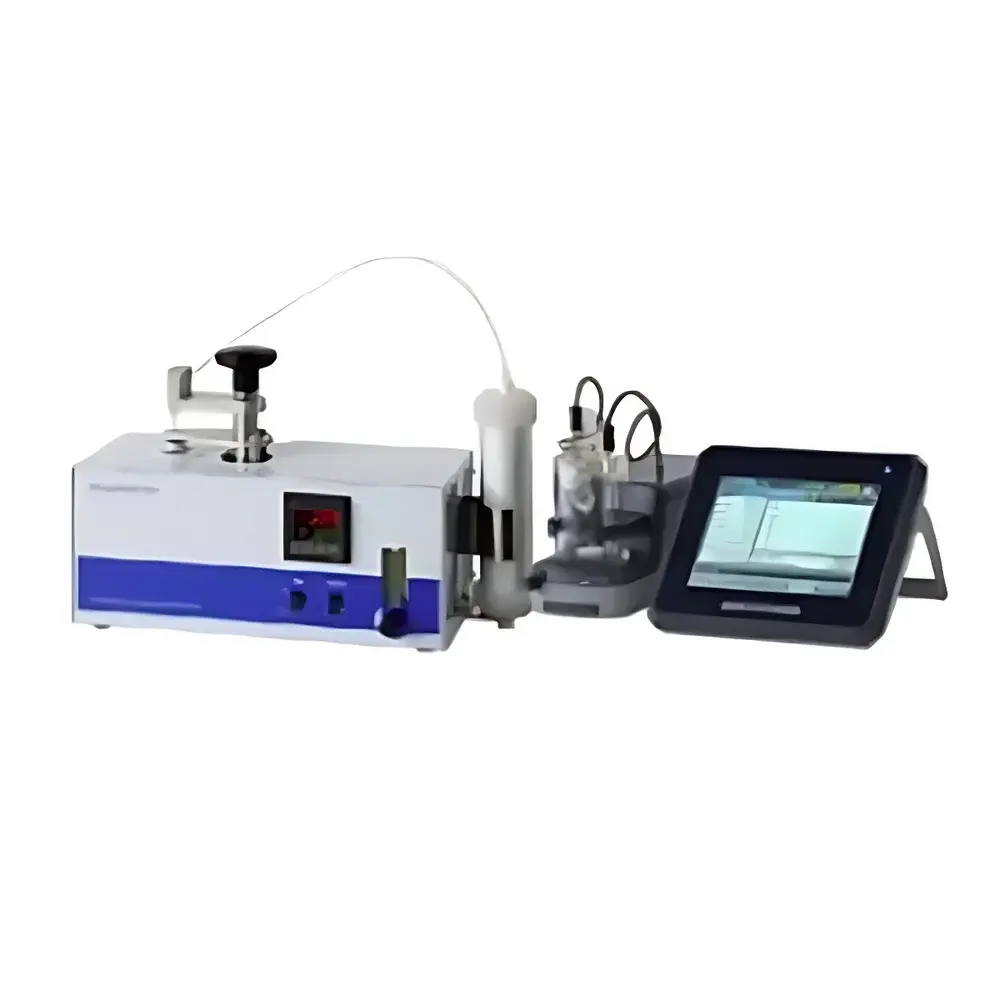
Nittoseiko Analytech CA-310PH Coulometric Karl Fischer Moisture Analyzer
| Brand | Nittoseiko Analytech |
|---|---|
| Origin | Japan |
| Instrument Type | Coulometric Karl Fischer Moisture Analyzer |
| Model | CA-310PH |
| Titration Method | Fully Automatic Coulometric Titration |
| Measurement Resolution | ±0.1 μA |
| Water Content Range | 5 μg to 999.9999 mg |
| Accuracy | < 0.3% RSD (for samples > 1 mg H₂O) |
| Minimum Dispensing Volume | 1/2000 of burette volume |
| Titration Control Precision | 0.1 μL |
| Electrolysis Current | Up to 516 mA |
| Average Titration Speed | 2.2 mg H₂O/min (2.64 mg H₂O/min in High-Speed Mode) |
| Detection Sensitivity | 0.1 μg H₂O |
| Blank Correction | Automatic, Real-Time Display |
| Sample Heating Control | Stepwise Temperature Control (Patent No. 3284783) |
| Display | 8.4-inch Full-Color TFT Touchscreen LCD |
| Data Storage Capacity | 9999 test records |
| GLP/GMP Compliance | Yes (Audit Trail, Electronic Signatures, User Access Levels) |
| Interface | 4× USB, 1× LAN, RS-232 for Balance Integration |
| Operating Environment | 15–40 °C, ≤85% RH (non-condensing) |
| Power Supply | AC 230–240 V, 310 VA, 50/60 Hz |
Overview
The Nittoseiko Analytech CA-310PH is a high-precision coulometric Karl Fischer moisture analyzer engineered for trace-level water quantification in pharmaceuticals, active pharmaceutical ingredients (APIs), excipients, and other hygroscopic or thermally sensitive materials. It operates on the fundamental electrochemical principle of coulometric Karl Fischer titration—where iodine is generated *in situ* via controlled electrolysis of iodide ions in the anolyte solution, reacting stoichiometrically with water (1 mol I₂ ≡ 1 mol H₂O). This method eliminates volumetric reagent delivery errors and enables sub-microgram detection limits without manual calibration drift. Designed specifically for regulated laboratory environments, the CA-310PH supports full data integrity per FDA 21 CFR Part 11, EU Annex 11, and ISO/IEC 17025 requirements, including electronic signatures, audit trails, and role-based user access control.
Key Features
- Four-channel expandability (optional): A single master console can simultaneously control up to four independent coulometric cells, enabling parallel analysis of reference standards, blanks, and multiple sample batches—enhancing throughput and statistical robustness.
- Stepwise temperature-controlled vaporization (Patent No. 3284783): Integrated with Mitsubishi Chemical VA-series vaporizers (e.g., VA-300, VA-236S), the system dynamically adjusts heating profiles based on real-time evaporation kinetics—minimizing thermal degradation while maximizing water recovery from low-volatility or matrix-bound samples.
- Intelligent endpoint detection: Continuous polarization potential monitoring ensures precise endpoint identification, even for challenging matrices such as ketones, aldehydes, and low-hydroxyl acids—supported by dual-electrode options (membrane-free for routine AQUAMICRON®-based workflows; membrane-type for expanded analyte compatibility).
- Automated SOP execution: Pre-programmed standard operating procedures guide operators through sample weighing, injection, titration, and reporting—reducing human error and ensuring inter-operator consistency across GMP-compliant QC labs.
- High-resolution electrochemical control: 0.1 μL titrant resolution and ±0.1 μA current measurement enable reproducible quantification down to 5 μg absolute water mass under optimized environmental conditions (controlled humidity <30% RH, stable temperature).
- Full-system connectivity: Four USB ports support external storage, firmware updates, and report export; LAN interface enables remote monitoring, LIMS integration, and centralized instrument management via secure network protocols.
Sample Compatibility & Compliance
The CA-310PH accommodates solid powders, granules, liquids, and semi-solids—including hygroscopic APIs, lyophilized formulations, and polymer-based excipients. Its coulometric architecture avoids solvent interference issues common in volumetric KF systems, making it suitable for samples incompatible with methanol-based reagents. The system meets critical regulatory expectations for analytical instrumentation: automatic blank correction with continuous background tracking, timestamped audit logs for all user actions, and configurable electronic signature workflows compliant with GLP and GMP documentation standards. All data files are stored in non-proprietary formats (CSV, PDF) and retain full metadata—including operator ID, method version, environmental parameters, and raw current-time curves—for seamless inspection during regulatory audits.
Software & Data Management
Embedded firmware provides intuitive touchscreen navigation with multilingual support (English, Japanese, Chinese). The system stores up to 9999 complete test records locally, each containing raw current traces, titration curves, calculated water content (% w/w or ppm), statistical summaries (mean, SD, RSD), and user-defined annotations. Data export is supported via USB mass storage or network transfer; reports comply with ISO 17025 clause 7.8.2 for result reporting integrity. Built-in diagnostic tools include electrode activation routines, system self-tests, and context-sensitive troubleshooting menus—reducing downtime and supporting first-time-right operation in high-throughput QC settings.
Applications
- Pharmaceutical quality control: Release testing of APIs per USP , EP 2.5.12, and JP 2.05, especially for low-moisture specifications (<0.1% w/w).
- Stability studies: Monitoring moisture ingress in blister-packed tablets or desiccated vials over accelerated and long-term storage conditions.
- Raw material qualification: Verification of moisture content in lactose monohydrate, microcrystalline cellulose, and other functional excipients prior to formulation.
- Biologics and peptide characterization: Quantifying residual water in freeze-dried monoclonal antibodies and vaccine intermediates where water activity directly impacts structural stability.
- Contract manufacturing organizations (CMOs): Supporting method validation (ICH Q2(R2)) with documented precision, accuracy, linearity, and robustness evidence across multi-site operations.
FAQ
What distinguishes coulometric KF from volumetric KF in pharmaceutical testing?
Coulometric KF generates iodine electrochemically at the anode, eliminating reagent standardization and pipetting variability—critical for achieving <0.3% RSD at sub-milligram water levels required for API release.
Can the CA-310PH analyze samples containing acetone or acetaldehyde?
Yes—when equipped with the optional membrane-type generator electrode, the system suppresses side reactions and enables accurate determination in ketone- and aldehyde-rich matrices per ASTM D6304 guidelines.
How does the stepwise temperature control improve accuracy for difficult samples?
It prevents localized overheating and decomposition by adapting heating rate to real-time water release kinetics—ensuring complete volatilization without charring or oxidation artifacts.
Is electronic record retention compliant with FDA 21 CFR Part 11?
Yes—the system implements role-based authentication, immutable audit trails, electronic signatures with biometric or token-based verification, and encrypted data backups meeting Part 11 Subpart B requirements.
What vaporizers are compatible with the CA-310PH?
All Mitsubishi Chemical VA-series vaporizers (VA-300, VA-200, VA-210, VA-230, VA-236S, VA-121, VA-122) and VG-200, all featuring integrated stepwise temperature control and direct digital communication with the analyzer.





