
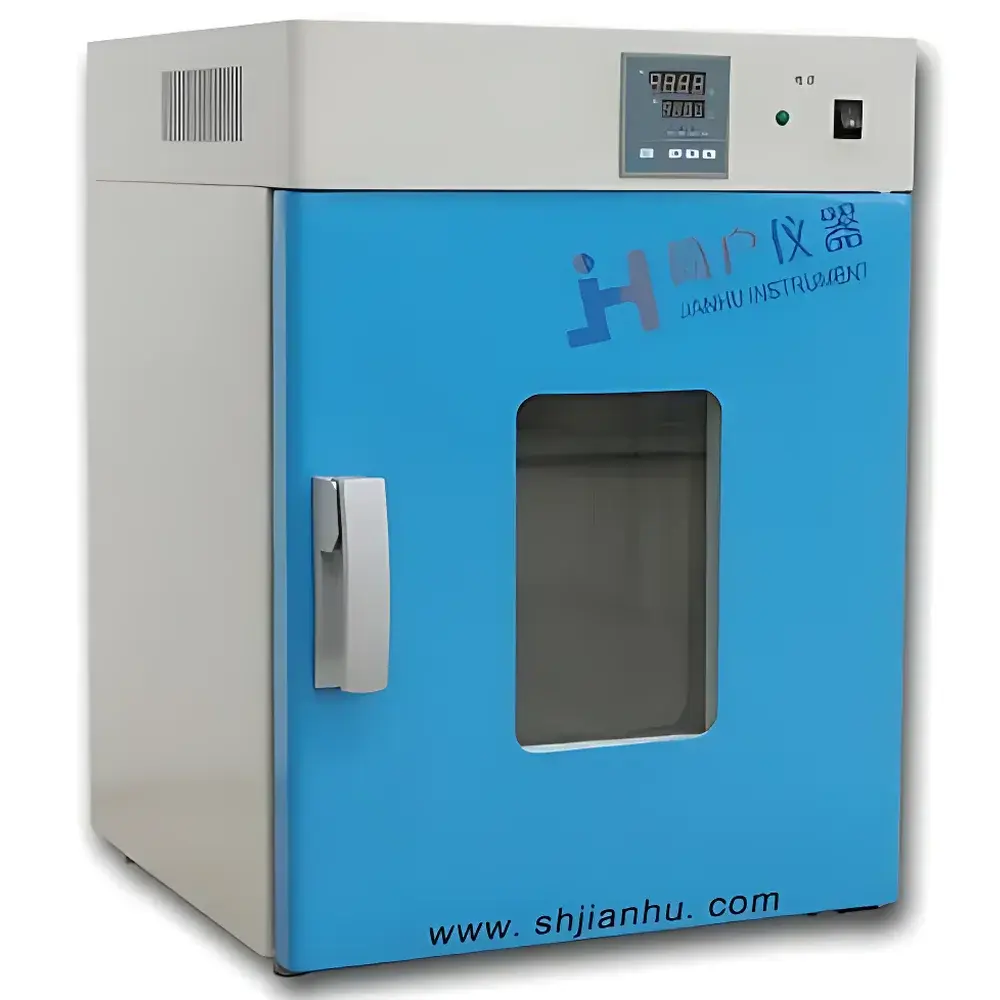
Jianhu JHT Series High-Temperature Forced-Air Circulation Drying Oven
| Brand | Jianhu |
|---|---|
| Origin | Jiangsu, China |
| Manufacturer Type | Authorized Distributor |
| Country of Origin | China |
| Model | JHT |
| Price Range | USD 280–700 (FOB) |
| Instrument Type | High-Temperature Drying Oven |
| Temperature Range | 100°C to 400°C |
| Temperature Uniformity | ±1°C |
| External Dimensions (mm) | 540×660×615 |
| Internal Chamber Dimensions (mm) | 350×350×400 |
| Construction | Cold-rolled A3 carbon steel (1.0–1.5 mm thickness) for inner and outer walls |
| Insulation | High-efficiency aluminum silicate fiber blanket |
| Heating System | Stainless steel tubular heating elements mounted in side ducts or base |
| Air Circulation | Forced convection via industrial-grade Tenglong motor-driven centrifugal blower |
| Air Inlet/Outlet | Adjustable 60 mm inlet |
| Temperature Sensor | Stainless steel sheathed PT100 platinum resistance thermometer |
| Controller | Intelligent digital temperature controller with auto-hold function, ±2°C accuracy |
| Safety Features | APT/AD16 audible-visual alarm for over-temperature and timer completion |
| Electrical Supply | 380 VAC, 50 Hz, 3-phase 4-wire |
| Electrical Components | Chint (Zhejiang Zhengtai) brand circuit breakers, contactors, and relays |
| Compliance | Designed per GB/T 5170.2–2017 (Electrical Equipment for Environmental Testing — Temperature Test Equipment), compatible with ISO/IEC 17025 laboratory environmental conditioning requirements |
Overview
The Jianhu JHT Series High-Temperature Forced-Air Circulation Drying Oven is an engineered thermal processing system designed for precise, repeatable, and uniform heat treatment in laboratory, R&D, and light industrial settings. Operating on the principle of forced convection, the oven circulates heated air via a high-reliability centrifugal blower, ensuring rapid thermal equilibration and minimal spatial temperature deviation across the working chamber. With a maximum operating temperature of 400°C and certified uniformity of ±1°C under steady-state conditions, it meets critical requirements for material aging, moisture removal, pre-baking of components, curing of coatings, and thermal stability testing of polymers, ceramics, and electronic assemblies. Its structural architecture—featuring dual-layer cold-rolled carbon steel walls, high-density aluminum silicate fiber insulation, and strategically positioned stainless steel tubular heaters—delivers robust thermal containment and long-term dimensional stability under cyclic thermal loading.
Key Features
- Three standard chamber configurations (350×350×400 mm, 450×450×450 mm, 600×600×600 mm) support scalable throughput without compromising temperature homogeneity.
- Intelligent digital temperature controller with programmable ramp-soak profiles, real-time PID tuning, and adjustable overshoot suppression to minimize thermal inertia effects.
- Stainless steel-sheathed PT100 sensor provides traceable, NIST-compatible measurement with Class B tolerance (IEC 60751), installed at optimal chamber depth to avoid boundary layer interference.
- Modular air management system: 60 mm diameter inlet with manual damper for volumetric flow regulation; 60–120 mm exhaust port configurable for external ducting to comply with local ventilation codes (e.g., OSHA 1910.142, EN 14175).
- Structural reinforcement: Heavy-duty 6# or 12# channel steel base frame with embedded rail guides for seamless integration with trolleys or conveyor-linked workflows.
- Full electrical safety compliance: Isolation transformer-ready input, Chint-certified contactors and overload protection, and grounded 3-phase 4-wire distribution per IEC 60204-1.
Sample Compatibility & Compliance
The JHT oven accommodates non-volatile, non-explosive solid samples including metal specimens, ceramic green bodies, printed circuit board assemblies, pharmaceutical excipients, and polymer films. It is unsuitable for solvents, flammable liquids, reactive powders, or pressurized containers. Internally, the chamber surface finish—smooth, non-porous cold-rolled steel—facilitates cleaning validation and prevents particulate shedding during GMP-relevant processes. The design adheres to GB/T 5170.2–2017 for temperature uniformity verification and supports audit-ready documentation for ISO/IEC 17025-accredited laboratories. Optional calibration certificates (traceable to CNAS-accredited providers) and IQ/OQ protocols are available upon request for regulated environments requiring FDA 21 CFR Part 11–compliant validation.
Software & Data Management
While the base model operates via standalone digital controller, optional RS485 Modbus RTU interface enables integration into centralized lab monitoring systems (e.g., LabVantage, Thermo Fisher SampleManager). Logged data—including setpoint, actual chamber temperature, cycle time, and alarm events—is timestamped and exportable as CSV for trend analysis. For GLP/GMP applications, third-party software packages support electronic signature capture, user-level access control, and 21 CFR Part 11–compliant audit trails when paired with validated OPC UA gateways.
Applications
- Accelerated aging tests per ASTM D5870 and ISO 188 for elastomers and thermoplastics.
- Drying of gravimetric samples prior to elemental analysis (e.g., ASTM E1218 for moisture content in soils).
- Curing of epoxy encapsulants and conformal coatings on PCBs (IPC-CC-830B compliant process windows).
- Pre-baking of semiconductor wafers and MEMS devices to eliminate adsorbed moisture before vacuum deposition.
- Thermal desorption of catalyst supports and activated carbon substrates prior to BET surface area analysis.
- Conditioning of reference standards for thermal expansion coefficient calibration (ASTM E228).
FAQ
What is the recommended procedure for initial oven conditioning?
Before first use or after prolonged storage, operate at 80–100°C for two hours to drive off residual moisture from insulation and internal surfaces—this improves dielectric integrity and extends heater service life.
Can the oven be used for sterilization?
No. This unit is not validated for microbial lethality and lacks the temperature uniformity, recording, and validation infrastructure required for ISO 17665 or EN 554 sterilization cycles.
Is external venting mandatory?
Venting is strongly advised when processing materials that emit volatile decomposition products (e.g., binders, resins) to maintain indoor air quality and comply with local occupational exposure limits (e.g., ACGIH TLVs).
How often should temperature uniformity be verified?
Per ISO/IEC 17025 Clause 6.4.10, quarterly verification using a calibrated multi-point probe array (≥9 points) is recommended for accredited labs; annual verification suffices for routine QC applications.
What maintenance is required for the blower motor?
The Tenglong motor requires no scheduled lubrication; however, biannual inspection of belt tension (if belt-driven variant) and cleaning of inlet filters prevent airflow degradation and thermal drift.



