
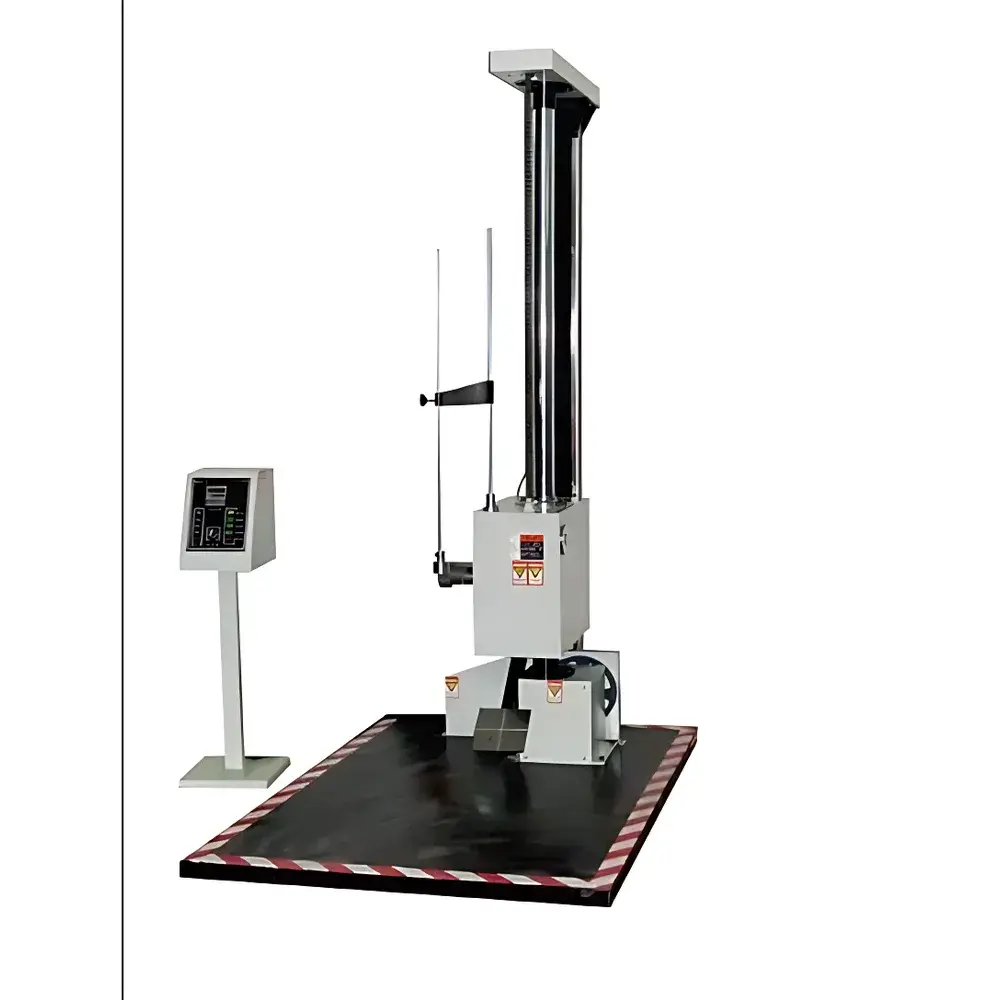
Jianhu JH-8006 Zero-Drop Impact Testing Machine
| Brand | Jianhu |
|---|---|
| Origin | Shanghai, China |
| Model | JH-8006 |
| Max. Specimen Weight | 300 kg |
| Drop Height Range | 0–2000 mm |
| Max. Specimen Dimensions | 1000 × 1000 × 800 mm |
| Test Orientations | Face, Edge, Corner |
| Power Supply | 380 V / 50 Hz |
| Drive System | Motor-driven with Pneumatic Acceleration & Electromagnetic Release |
| Impact Plate Material | Solid 45# Steel Plate |
| Height Display | Digital LCD with Programmable Setpoint |
| Height Indication | Calibrated Scale Bar |
| Guiding Mechanism | Imported Taiwan Linear Slides + Bronze Bushings |
| Drop Arm Frame | Welded Square Tubular 45# Steel Structure |
| Acceleration Mechanism | Pneumatic Assist |
| Release Mechanism | Electromagnetic Trigger |
| Safety Protection | Dual Inductive Sensors (Upper/Lower Limit) |
| Damping System | High-Efficiency Shock Absorbers |
| Net Weight | ~1500 kg |
| Rated Power | 5 kW |
| Compliance Standard | GB/T 1019–2008 |
Overview
The Jianhu JH-8006 Zero-Drop Impact Testing Machine is an industrial-grade physical testing system engineered for controlled, repeatable drop impact evaluation of large-format packaging units and heavy-duty cargo containers. Unlike conventional free-fall testers, this machine employs a precisely synchronized electromagnetic release and pneumatic acceleration mechanism to eliminate residual upward inertia in the support frame — enabling true zero-initial-velocity drop initiation at any height between 0 mm and 2000 mm. The core principle relies on rapid decoupling of the specimen from its E-shaped cradle (fabricated from structural 45# steel), followed by unimpeded gravitational acceleration onto a rigid, vibration-damped impact surface. This architecture ensures high reproducibility across face, edge, and corner impact configurations per ISO 2233, ASTM D5276, and GB/T 1019–2008 requirements. Designed specifically for packages exceeding standard laboratory-scale dimensions, the JH-8006 accommodates specimens up to 1000 mm × 1000 mm × 800 mm and supports loads up to 300 kg — making it suitable for evaluating palletized shipments, industrial enclosures, and transport-grade electronics housings.
Key Features
- True zero-velocity drop initiation via electromagnetic cradle release, eliminating pre-drop acceleration artifacts
- Programmable digital height control (0–2000 mm) with LCD interface and automatic stop-at-setpoint functionality
- Hybrid actuation system: motor-driven vertical positioning combined with pneumatic assist for consistent acceleration profile
- Robust E-frame cradle constructed from welded square-section 45# steel tubing, rated for 300 kg static load
- Impact base featuring solid 45# steel plate mounted on high-efficiency hydraulic shock absorbers to minimize energy reflection and ensure stable rebound damping
- Dual inductive safety sensors at upper and lower mechanical limits, compliant with IEC 61508 functional safety principles
- Guidance system utilizing imported Taiwan linear motion slides and bronze bushings for low-friction, wear-resistant vertical travel
- Calibrated scale bar for manual height verification alongside digital readout, supporting GLP traceability protocols
Sample Compatibility & Compliance
The JH-8006 is validated for testing rigid and semi-rigid packaging systems including corrugated fiberboard boxes, wooden crates, plastic totes, and composite shipping containers. Its open-frame design permits rapid reconfiguration for face-down, edge-down, or corner-first impact orientations without tooling changes. All mechanical components conform to GB/T 1019–2008 “Packaging – Basic Tests for Transport Packages”, and the system’s measurement repeatability aligns with ISO/IEC 17025 requirements for accredited testing laboratories. While not certified to UL or ISTA standards out-of-the-box, the machine’s programmable height resolution (±1 mm), documented release timing (<5 ms jitter), and calibrated impact surface meet the foundational performance criteria referenced in ISTA 3A, 3E, and 3H test protocols. Optional calibration certificates traceable to CNAS-accredited metrology labs are available upon request.
Software & Data Management
The JH-8006 operates via an embedded microcontroller-based control unit with no external PC dependency. All operational parameters — including target drop height, test count, orientation mode, and pass/fail status — are stored locally in non-volatile memory with timestamping. The system supports basic audit trail generation: each test record includes date/time stamp, height setting, actual measured drop distance (via encoder feedback), and operator ID input field. For integration into enterprise quality management systems (QMS), optional RS-232 or Modbus RTU communication modules enable transfer of test logs to LIMS or MES platforms. Data export complies with FDA 21 CFR Part 11 requirements when paired with validated electronic signature add-ons and role-based access controls.
Applications
- Validation of distribution packaging integrity for automotive components shipped on Euro-pallets
- Pre-shipment qualification of medical device cabinets and diagnostic equipment housings (per ISO 11607-2)
- Design verification of e-commerce fulfillment cartons subjected to multi-drop logistics scenarios
- Supplier qualification testing for military-grade ammunition containers under MIL-STD-810H Method 516.8
- Root-cause analysis of package failure modes using sequential edge/corner drop sequences
- Internal R&D testing of novel cushioning materials under standardized impact energy inputs
FAQ
What does “zero-drop” mean in technical terms?
Zero-drop refers to the elimination of initial upward velocity or mechanical preload in the cradle prior to release — ensuring the specimen begins its descent with zero relative velocity and purely gravitational acceleration from the programmed height.
Can the machine perform sequential multi-drop tests without manual repositioning?
Yes — the E-cradle allows rapid orientation switching between face, edge, and corner configurations using indexed mechanical stops; full sequence programming requires external PLC integration.
Is third-party calibration support available?
Yes — Jianhu partners with CNAS-accredited metrology providers to deliver annual calibration services with uncertainty budgets and traceable certificates.
Does the system comply with EU Machinery Directive 2006/42/EC?
The base configuration meets essential health and safety requirements; CE marking requires site-specific risk assessment and integration of additional guarding per end-user facility layout.
What maintenance intervals are recommended for the pneumatic and electromagnetic subsystems?
Compressed air filters should be replaced quarterly; electromagnetic coil resistance and release timing should be verified semiannually; linear slide lubrication is required every 500 operational cycles.



