
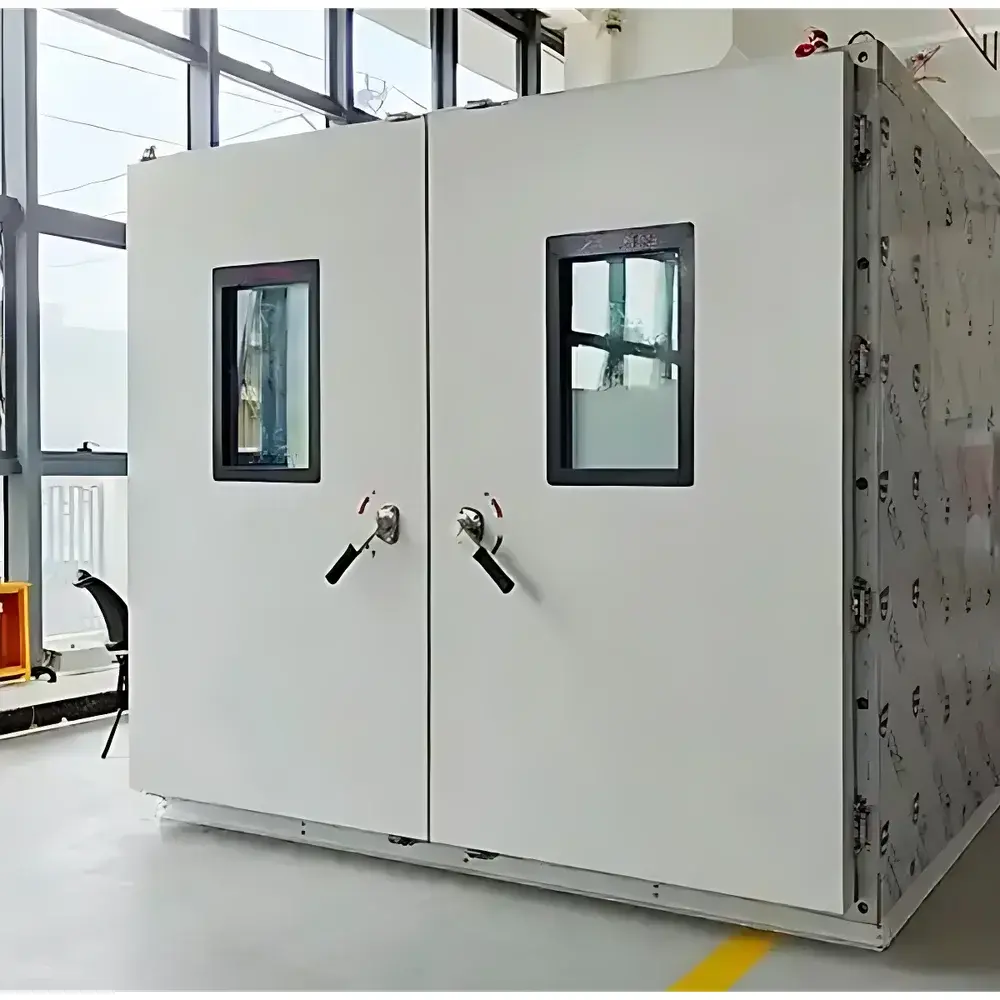
Jianhu NH-2025 Nylon Hygroscopic Conditioning Chamber for Automotive Components
| Brand | Jianhu |
|---|---|
| Origin | Shanghai, China |
| Manufacturer Type | Authorized Distributor & OEM Integrator |
| Product Category | Domestic Environmental Test Equipment |
| Model | NH-2025 |
| Price Range | USD 1,250 – 12,500 (FOB Shanghai) |
| Humidity Control Range | 50–95% RH |
| Temperature Range | 10–120°C |
| Temperature Uniformity | ±0.5°C |
| Humidity Accuracy | ±2% RH |
| Available Chamber Volumes | 5–50 m³ |
| Compliance | ISO 17025-aligned validation support, GB/T 2423.34 (IEC 60068-2-38), ASTM D5229/D618 |
Overview
The Jianhu NH-2025 Nylon Hygroscopic Conditioning Chamber is an industrial-grade environmental test system engineered specifically for the pre-conditioning of semi-crystalline polyamide components—primarily PA6 and PA66—used in automotive powertrain, interior, and under-hood applications. Unlike generic humidity chambers, the NH-2025 implements a dual-loop PID-controlled hygrothermal environment calibrated to replicate real-world moisture diffusion kinetics in nylon. It accelerates equilibrium moisture absorption under precisely regulated temperature and relative humidity profiles, enabling manufacturers to stabilize dimensional integrity and mechanical properties prior to final assembly or functional testing. This process mitigates post-installation warpage, embrittlement, or loss of tensile strength caused by uncontrolled ambient exposure during logistics or field operation. The chamber operates on the principle of controlled vapor saturation within a thermally insulated enclosure, with integrated steam injection, desiccant-assisted dehumidification, and high-stability air circulation optimized for uniform moisture distribution across heterogeneous part geometries.
Key Features
- High-fidelity hygrothermal control: Dual-sensor feedback loops maintain ±2% RH accuracy and ±0.5°C temperature stability over full operating range (10–120°C), validated per ISO/IEC 17025 traceable protocols.
- Scalable chamber architecture: Modular design supports volumes from 5 m³ (bench-scale R&D validation) to 50 m³ (full-batch production conditioning), with reinforced stainless-steel construction and low-thermal-conductivity insulation.
- Automotive-grade process repeatability: Each unit undergoes 72-hour continuous load testing at maximum operational setpoints prior to shipment, simulating extended shift-based production cycles.
- Material-specific profile library: Pre-loaded conditioning protocols for PA6, PA66, PA46, and glass-filled variants—including time-temperature-moisture (TTM) curves aligned with SAE J2527 and ISO 11357 standards.
- Robust mechanical integration: Heavy-duty casters, reinforced door gaskets, and vibration-dampened internal racks accommodate stacked trays of engine brackets, cable ties, and structural interior carriers without micro-movement-induced condensation artifacts.
Sample Compatibility & Compliance
The NH-2025 accommodates geometrically complex nylon parts—including injection-molded housings, thin-walled ducts, and multi-material assemblies—with no requirement for part encapsulation or secondary fixturing. Its airflow pattern minimizes boundary-layer stagnation, ensuring consistent moisture ingress even in recessed features or under ribbed surfaces. The system supports compliance workflows for IATF 16949-certified production facilities: calibration records, deviation logs, and maintenance histories are structured to meet audit requirements for traceability. Optional IQ/OQ documentation packages align with FDA 21 CFR Part 11 electronic record controls when integrated with validated LIMS environments. Chamber performance conforms to GB/T 2423.34 (equivalent to IEC 60068-2-38 for damp heat cyclic testing) and provides documented correlation to ASTM D5229 (moisture absorption in plastics) and ASTM D618 (conditioning of plastics for testing).
Software & Data Management
The embedded control interface runs on a real-time Linux OS with deterministic scheduling, eliminating latency in sensor polling or actuator response. All process parameters—including chamber setpoints, actual RH/temperature trajectories, steam valve duty cycle, and elapsed soak time—are logged at 1-second intervals and exported via USB or Ethernet to CSV or XML formats. Optional cloud gateway enables secure TLS 1.3 transmission to enterprise MES platforms (e.g., Siemens Opcenter, Rockwell FactoryTalk). Audit trails include user authentication, parameter change timestamps, and firmware revision metadata—fully compliant with GLP/GMP data integrity expectations. Remote diagnostics allow authorized service engineers to monitor system health metrics (compressor current, heater resistance drift, humidity sensor aging coefficients) without physical access.
Applications
- Predictive stabilization of nylon fasteners and clips prior to automated assembly, reducing torque scatter and thread stripping in high-volume lines.
- Pre-conditioning of PA66 engine intake manifolds to eliminate post-molding dimensional drift during thermal cycling validation per GMW14872.
- Moisture equilibration of automotive wiring harness retainers to ensure consistent clip retention force across seasonal humidity variations.
- Accelerated aging studies correlating hygrothermal history with long-term creep modulus degradation in instrument panel substrates.
- Supporting PPAP submissions by generating statistically valid moisture-content vs. mechanical-property datasets required by Tier-1 OEMs.
FAQ
What nylon grades are validated for use with the NH-2025?
PA6, PA66, PA46, and 15–30% glass-filled variants are fully supported. Custom profiles can be developed for PA12 or bio-based polyamides upon material datasheet submission.
Does the chamber support automated start/stop based on part batch ID?
Yes—via optional RS-485 or Modbus TCP integration with PLC-driven part tracking systems; chamber initiates conditioning only after barcode-scanned confirmation of material lot and specification version.
How is temperature uniformity verified across large-volume configurations?
Each 50 m³ unit ships with a 9-point NIST-traceable temperature mapping report conducted under ISO 14644-3 Class 5 cleanroom-equivalent conditions, including worst-case loading scenarios.
Can the system be validated for GMP-regulated medical device nylon components?
Yes—optional 21 CFR Part 11-compliant software package includes electronic signatures, role-based access control, and immutable audit trail generation meeting Annex 11 requirements.
What is the typical lead time for custom chamber configurations?
Standard models ship within 6–8 weeks; custom volume or interface integrations require 12–14 weeks from PO acceptance and final technical sign-off.



