
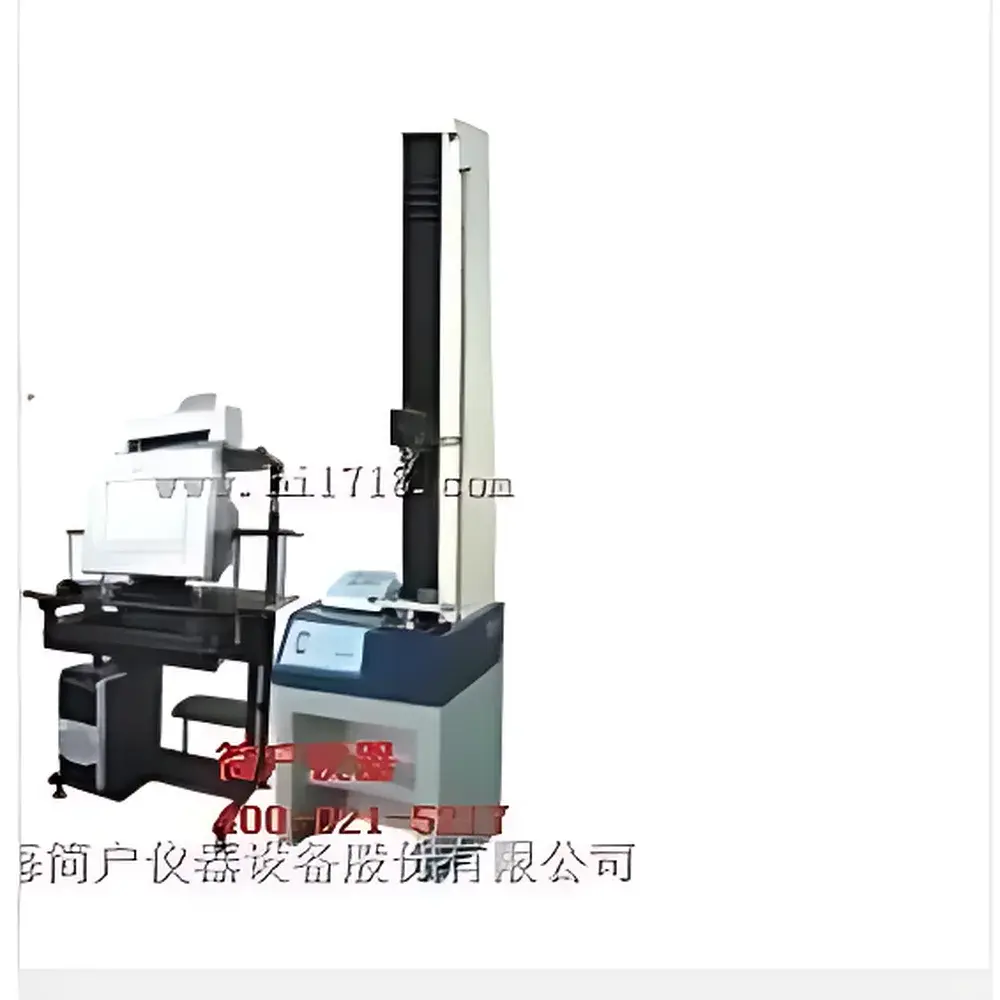
Jianhu JH-60T Intelligent Fully Automatic Universal Testing Machine
| Brand | Jianhu |
|---|---|
| Model | JH-60T |
| Type | Electromechanical Universal Testing Machine |
| Load Capacity | 5 kN |
| Force Sensor Standard | 2 kg (20 N), optionally upgradable with additional sensors |
| Force Accuracy Class | 0.2 |
| Force Measurement Range | 0.4–100% FS |
| Force Resolution | ±1/300,000 of full scale, unsegmented throughout range |
| Deformation Measurement Range | 0.2–100% FS |
| Deformation Error | < ±0.2% of reading |
| Deformation Resolution | ±1/300,000 of maximum deformation |
| Displacement Accuracy | ±0.2% of reading |
| Displacement Resolution | 0.02 µm |
| Crosshead Speed Range | 0.001–200 mm/min |
| Speed Control Accuracy | ±0.2% of set value |
| Strain Rate Range | 0.001–2% FS/min |
| Strain Rate Control Accuracy | ±0.2% of set value |
| Effective Test Width | 370 mm or 210 mm (configurable) |
| Max Tensile Travel | 700 mm or 1200 mm (configurable) |
| Max Compression Stroke | 700 mm |
| Control System | Full PC-based closed-loop control |
| Power Supply | 220 V, 50 Hz |
| Rated Power | 0.4 kW |
| Machine Weight | 160 kg |
| Dimensions (W×D×H) | 800 × 410 × 1600 mm |
| Compliance | GB/T 228.1, ISO 6892-1, ASTM E8/E21, JIS Z2241, DIN 50125 |
Overview
The Jianhu JH-60T Intelligent Fully Automatic Universal Testing Machine is an electromechanical static testing system engineered for precision mechanical property evaluation of metallic, polymeric, composite, ceramic, and elastomeric materials under tension, compression, bending, shear, and peel configurations. It operates on a dual-column portal frame architecture with high-rigidity load train components, integrated high-resolution servo-motor-driven crosshead actuation, and real-time closed-loop control of force, displacement, and strain rate. The system complies with fundamental metrological requirements defined in ISO 7500-1 (static calibration of force-proving instruments) and ISO 5893 (tensile/compression testing machines), ensuring traceable measurement integrity across its full operational envelope.
Key Features
- High-fidelity force measurement using a factory-calibrated 20 N (2 kgf) load cell, compliant with ISO 376 Class 0.2 accuracy; optional multi-sensor configuration enables seamless switching between low-force (e.g., thin films, biomedical specimens) and mid-range (e.g., structural composites) test regimes without recalibration.
- Unsegmented force resolution of ±1/300,000 FS eliminates range-switching artifacts and supports consistent data acquisition from sub-newton to 5 kN loads — critical for capturing nonlinear viscoelastic transitions and yield onset in heterogeneous materials.
- Sub-micron displacement resolution (0.02 µm) coupled with ±0.2% linearity ensures accurate determination of modulus, elongation at break, and plastic deformation thresholds per ASTM D638 or ISO 527-2.
- Programmable crosshead velocity from 0.001 to 200 mm/min with ±0.2% speed fidelity accommodates quasi-static tensile tests (e.g., ASTM E8) and controlled-rate creep protocols (e.g., ISO 899-1).
- Triple-layer safety architecture: hardware-based limit switches (mechanical + optical), software-defined travel boundaries, and real-time current/voltage monitoring prevent overtravel, overload, and thermal runaway during extended unattended operation.
- Modular mechanical design supports interchangeable fixtures — including wedge-action grips, pneumatic clamps, bend supports, and environmental chamber adapters — enabling rapid reconfiguration for diverse ISO/ASTM test methods.
Sample Compatibility & Compliance
The JH-60T accommodates specimens ranging from micro-scale filaments (diameter ≥ 0.1 mm) to macro-scale bars (up to 370 mm wide × 1200 mm gage length). Its standardized test space geometry aligns with specimen dimensions specified in GB/T 228.1–2021, ISO 6892-1:2019, ASTM E8/E21, JIS Z2241, and DIN 50125. All force, displacement, and strain measurements are traceable to national standards via documented sensor calibration certificates (NIST-traceable where applicable). The system supports GLP-compliant audit trails when configured with time-stamped user logins, parameter change history, and electronic signature options — fulfilling foundational requirements for regulated environments governed by FDA 21 CFR Part 11 and ISO/IEC 17025.
Software & Data Management
The Windows-native test platform (compatible with Windows 10/11 x64) provides synchronized real-time visualization of up to six concurrent channels: load vs. displacement, stress vs. strain, load vs. time, displacement vs. time, and custom-derived metrics (e.g., secant modulus, energy absorption). All raw data streams are saved in ASCII CSV format with metadata headers (test ID, operator, date/time stamp, calibration IDs, environmental conditions). Automated report generation supports customizable templates aligned with internal QA formats or regulatory submission requirements (e.g., ASTM-certified summary sheets). Batch testing mode allows sequential execution of preloaded test sequences with auto-reset positioning, eliminating manual intervention between specimens. Dynamic axis scaling, curve overlay comparison, peak-hold annotation, and post-test modulus calculation are embedded without third-party plug-ins.
Applications
- Mechanical characterization of thermoplastics and thermosets per ISO 527 and ASTM D638, including tensile strength, yield point, elongation, and Poisson’s ratio derivation.
- Compression testing of foams, ceramics, and concrete cores per ASTM C365 and ISO 844.
- Bending stiffness and flexural modulus evaluation of laminates and printed circuit boards per ASTM D790 and ISO 178.
- Adhesion strength assessment of coated metals and polymer-laminated substrates via T-peel and 180° peel tests (ASTM D1876, ISO 8510-2).
- Quality control validation in automotive component manufacturing (e.g., seatbelt webbing, airbag fabrics) and medical device production (e.g., suture tensile strength, catheter kink resistance).
- Research-grade material behavior modeling — particularly for rate-dependent phenomena such as strain hardening, necking evolution, and ductile-to-brittle transition analysis.
FAQ
What standards does the JH-60T support out-of-the-box?
The system includes built-in test method templates for GB/T 228.1, ISO 6892-1, ASTM E8, ASTM D638, ISO 527-2, and JIS Z2241. Custom method definitions can be created using the scriptable test sequence editor.
Can the system integrate with external environmental chambers?
Yes — the controller features analog I/O ports (±10 V, 16-bit) and RS-485 Modbus RTU interface for synchronized temperature/humidity chamber control and data streaming.
Is the software compliant with FDA 21 CFR Part 11?
The optional Audit Trail & Electronic Signature module provides role-based access control, immutable event logging, and digital signature capture — meeting baseline technical controls for Part 11 compliance.
What maintenance is required for long-term accuracy?
Annual verification against certified reference standards (e.g., deadweight force calibrators, displacement gauge blocks) is recommended. Load cell drift compensation routines are accessible via service menu with password-protected access.
Does the machine support multi-axis or biaxial testing?
The JH-60T is a uniaxial testing platform. Biaxial capability requires integration with third-party add-on systems (e.g., biaxial tensile stages); Jianhu offers mechanical interface documentation for such integrations.



