
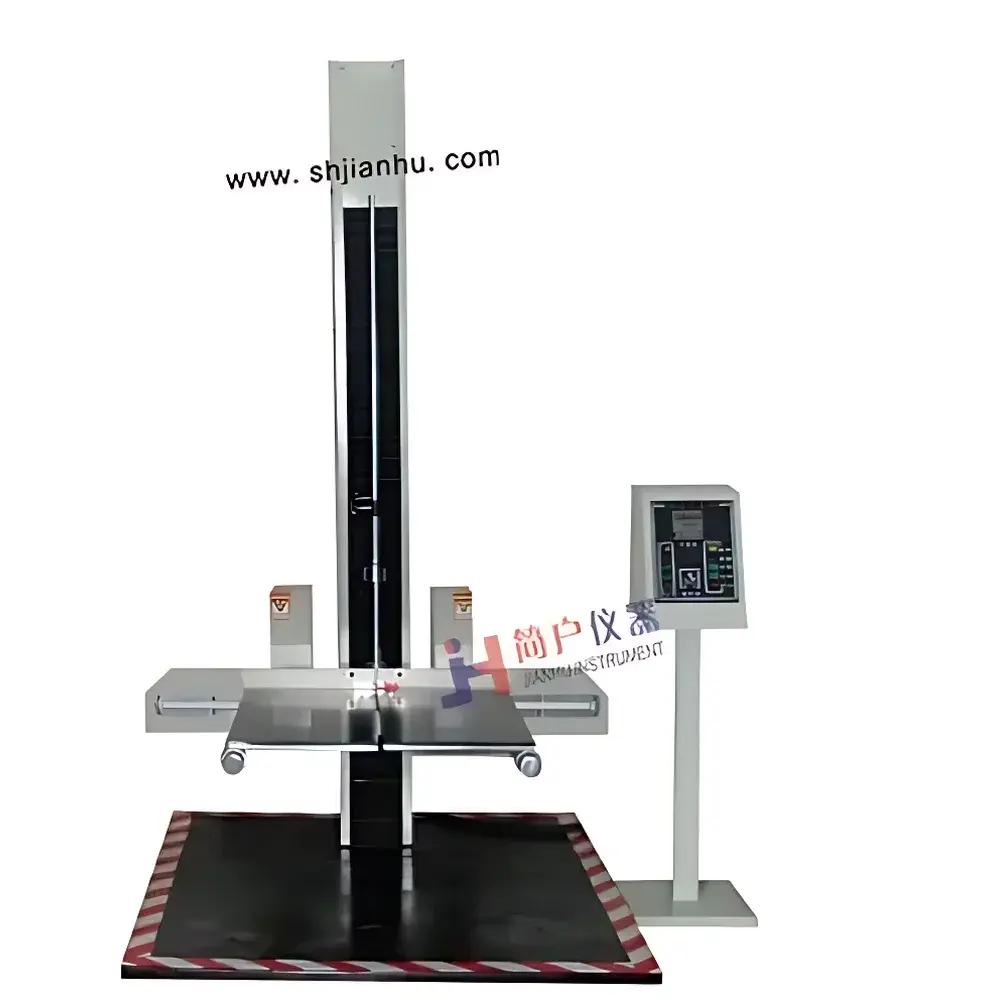
Jianhu JH Single-Arm Drop Test Machine
| Brand | Jianhu |
|---|---|
| Origin | Shanghai, China |
| Model | JH |
| Drop Height Range | 300–1500 mm |
| Max. Test Weight | 80 kg |
| Max. Test Dimension | 800 × 1000 × 1000 mm |
| Base Plate Size | 1700 × 1200 × 14 mm |
| Frame Height Accuracy | ±5 mm |
| Levelness Tolerance of Drop Surface | <1° |
| Height Sensing | High-Resolution Rotary Encoder (Japan SP) |
| Main Motor | 1.85 kW (Yasba, Taiwan) |
| Reset Motor | Kosen, Taiwan |
| Control Instrument | Proprietary Digital Height Controller |
| Structural Column | Precision-Ground & Chrome-Plated Steel |
| Electrical Components | Omron (Japan) |
| Drive Chain | ST, Taiwan |
| Timing Belt | Rongfeng, Taiwan |
| Gearmotor | Hangsu, China |
| Power Supply | 380 V AC, 3 kW |
| Compliance | Designed to support ISO 2248, ASTM D5276, ISTA 1A/2A/3A test protocols |
Overview
The Jianhu JH Single-Arm Drop Test Machine is an electromechanically actuated impact testing system engineered for standardized evaluation of packaging integrity and product structural resilience under free-fall conditions. It operates on the principle of controlled gravitational acceleration, enabling repeatable release of test specimens from preset heights onto a rigid, level impact surface—typically a steel or concrete base plate meeting ISO 2248 requirements for hardness and flatness. This apparatus replicates real-world handling hazards including accidental drops during logistics, warehouse staging, retail stocking, and end-user handling. Unlike dual-arm or guided-drop configurations, the single-arm design provides unobstructed access to all six faces (top, bottom, four sides) and eight corners of cuboidal packages, facilitating comprehensive orientation-specific impact assessment per ISTA and ASTM guidelines.
Key Features
- Adjustable drop height range from 300 mm to 1500 mm, calibrated with ±5 mm positional repeatability using a high-resolution rotary encoder (SP, Japan)
- Robust structural column fabricated from precision-ground, chrome-plated steel—resistant to corrosion, deformation, and wear over extended service life
- Dual-motor drive system: main lifting motor (1.85 kW, Yasba, Taiwan) ensures stable vertical transport; dedicated reset motor (Kosen, Taiwan) enables rapid cycle recovery
- Integrated digital height controller developed in-house, offering intuitive parameter input, real-time position feedback, and programmable test sequences
- Levelness-controlled impact surface (<1° deviation) with 1700 × 1200 × 14 mm hardened steel base plate, conforming to ASTM D5276 flatness specifications
- Full electrical safety architecture compliant with IEC 61000-6-2/6-4 immunity and emission standards; key components sourced from Omron (relays, contactors, sensors)
- Modular mechanical drivetrain featuring ST (Taiwan) heavy-duty roller chain and Rongfeng (Taiwan) HTD timing belt for low-backlash, high-torque transmission
Sample Compatibility & Compliance
The JH machine accommodates packaged units up to 80 kg mass and 800 × 1000 × 1000 mm external dimensions—suitable for consumer electronics, medical device kits, industrial components, and e-commerce parcels. Its open-frame configuration permits unrestricted placement and orientation of test samples prior to release. The system supports full-spectrum drop testing per international transport simulation standards: corner drops (3 orientations), edge drops (6 orientations), and face drops (3 orientations), as defined in ISO 2248 and ISTA 3A. When operated with documented procedures and calibrated instrumentation, test records generated on this platform are admissible in GLP-aligned quality audits and regulatory submissions requiring evidence of package robustness (e.g., FDA 21 CFR Part 11–compliant data traceability when paired with validated software).
Software & Data Management
While the base JH model features standalone operation via its proprietary digital control panel, optional RS-485 or Ethernet interface enables integration with laboratory information management systems (LIMS) or custom QA databases. Height setpoints, drop count, and timestamped cycle logs can be exported for traceability. For regulated environments, third-party validation packages—including IQ/OQ documentation templates, calibration certificates for encoder and load cells (optional), and electronic audit trail configuration—are available upon request to meet GMP/GLP and ISO/IEC 17025 requirements.
Applications
- Evaluation of corrugated box compression strength and cushioning performance under simulated distribution shocks
- Verification of smartphone, tablet, and wearable device housing durability following MIL-STD-810G Method 516.6 drop criteria
- Validation of sterile barrier integrity for Class II medical device packaging per ISO 11607-1
- Pre-shipment qualification of automotive ECUs, sensors, and infotainment modules subjected to vibration + drop combined stress profiles
- Root-cause analysis of field failure modes by correlating lab-induced damage (crack propagation, solder joint fracture, display delamination) with specific impact vectors
FAQ
What standards does the JH Single-Arm Drop Tester comply with?
It supports test execution aligned with ISO 2248, ASTM D5276, ISTA 1A, 2A, and 3A. Full compliance requires adherence to procedural controls, operator training, and periodic verification of height accuracy and surface flatness.
Can the machine perform sequential drop tests across multiple orientations without manual repositioning?
No—each orientation (face, edge, corner) requires manual sample repositioning and height recalibration. Automated multi-axis positioning is not supported in the standard configuration.
Is the base plate included with the system?
Yes—the 1700 × 1200 × 14 mm hardened steel base plate is supplied as integral equipment and installed at commissioning.
What maintenance intervals are recommended for long-term reliability?
Lubrication of chain and gearmotor every 500 operational hours; encoder calibration verification annually; visual inspection of column plating and structural welds per ISO 9001 internal audit schedule.
Does the system support weight-based drop energy calculation?
Not natively—the control unit displays height only. Drop energy (in joules) must be calculated externally using E = m·g·h, where m is specimen mass (kg), g = 9.80665 m/s², and h is nominal drop height (m).



