
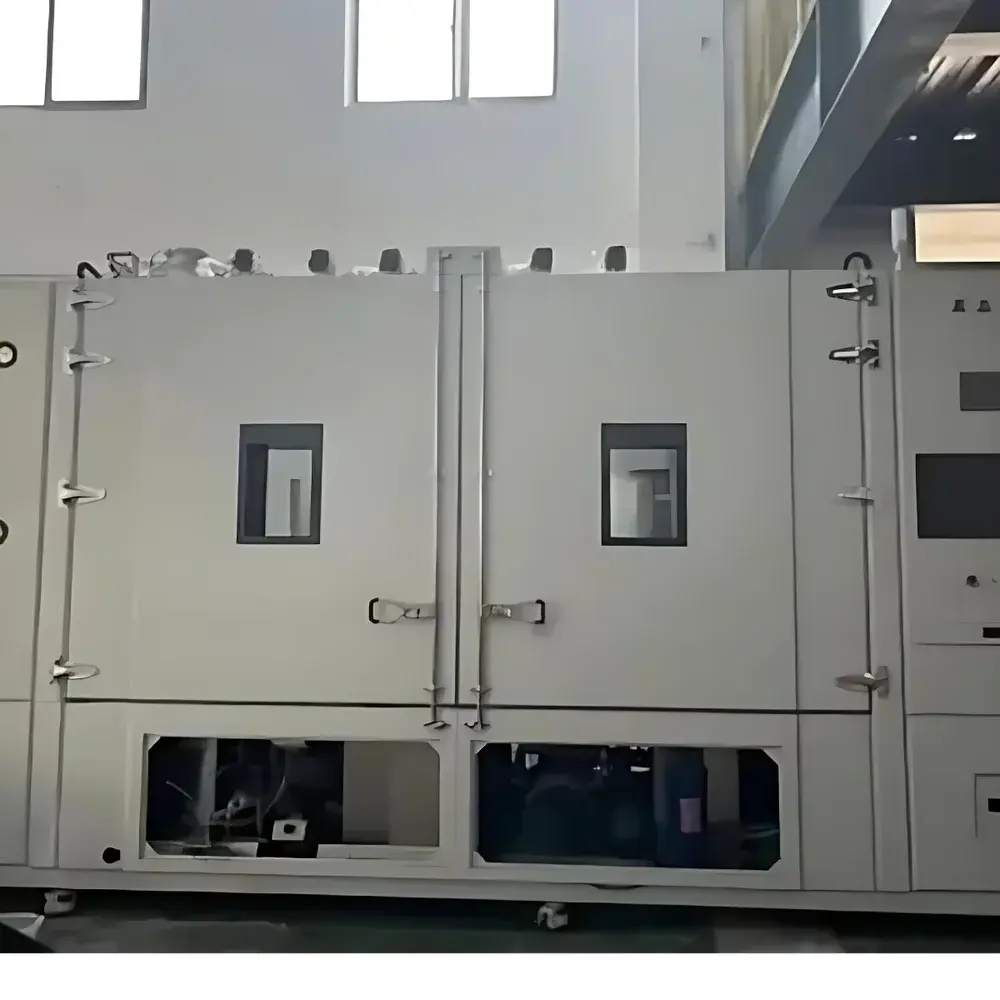
JH-Explosion-Proof Battery Charge/Discharge Environmental Test Chamber with Triple-Zone Temperature Control
| Brand | JH Instruments |
|---|---|
| Origin | Shanghai, China |
| Manufacturer Type | Authorized Distributor |
| Country of Origin | China |
| Model | JH-Battery-Explosion-Proof-CD-TripleZone |
| Price Range | USD 980 – 9,800 |
Overview
The JH-Explosion-Proof Battery Charge/Discharge Environmental Test Chamber with Triple-Zone Temperature Control is an integrated reliability validation platform engineered for rigorous electrochemical and thermal performance assessment of lithium-ion and next-generation energy storage cells. Designed in strict accordance with IEC 62133, UN 38.3, and GB/T 31467.3 safety testing requirements, this chamber combines simultaneous multi-zone thermal conditioning (−40 °C to +150 °C) with programmable bidirectional DC power cycling (up to 1000 A, ±5 V typical range) within a certified Class II explosion-proof enclosure (ATEX Zone 2 / IECEx Zone 2 compliant). Its core architecture implements forced-air convection with independent PID-controlled thermal zones—upper, middle, and lower compartments—enabling differential thermal stress application across cell modules or pack-level assemblies. This configuration supports realistic simulation of thermal gradients encountered during vehicle-level battery operation, including fast-charging-induced localized heating and cold-soak recovery dynamics.
Key Features
- Triple independent thermal zones with ±0.5 °C uniformity and ±0.3 °C stability over 24 h at setpoint
- Integrated 4-quadrant DC power supply with real-time current/voltage regulation (0–1000 A, 0–5 V; optional up to 2000 A)
- Explosion-proof housing rated to IP54 ingress protection and certified for flammable gas environments (IEC 60079-0, -1, -7)
- Real-time synchronized acquisition of voltage, current, surface temperature (via 16-channel thermocouple inputs), and chamber ambient parameters
- Modular design supporting parallel testing of up to 12 individual 18650/21700 cells or 3–6 prismatic modules per zone
- Emergency venting system with flame-arresting mesh and pressure-relief diaphragm activated at ≥2 bar internal overpressure
Sample Compatibility & Compliance
The chamber accommodates cylindrical (18650, 21700, 4680), prismatic, and pouch-format cells (up to 300 mm × 200 mm × 20 mm), as well as small-scale battery modules (≤10 kg). All electrical interfaces comply with UL 2580 and ISO 12405-4 mechanical mounting standards. Thermal control algorithms adhere to ASTM D7211 (thermal shock profile definition) and ISO 16750-4 (environmental conditions for road vehicles). Data logging meets FDA 21 CFR Part 11 requirements for audit trail, electronic signature, and data integrity—validated through third-party calibration against NIST-traceable references. The system is routinely deployed in GLP-compliant laboratories supporting UN 38.3 T.3 (vibration), T.4 (shock), and T.5 (external short circuit) preconditioning protocols.
Software & Data Management
Control and analysis are executed via JH-TestSuite v4.2—a Windows-based application supporting script-driven test sequencing (Python API available), real-time waveform overlay, and automated pass/fail evaluation against user-defined thresholds. Raw data is stored in HDF5 format with embedded metadata (test ID, operator, timestamp, firmware version, calibration expiry). Export options include CSV, MATLAB .mat, and PDF report templates aligned with AIAG CQI-19 and VDA Volume 5 requirements. Audit logs record all parameter modifications, user logins, and emergency events with SHA-256 hashing. Remote monitoring is enabled via TLS-secured WebSocket interface compatible with enterprise LIMS integration.
Applications
- Accelerated life cycle testing under combined thermal and electrical stress (e.g., 1C charge @ 45 °C → 0.5C discharge @ −20 °C)
- Thermal runaway propagation studies using calibrated hot-wire triggers and IR thermal imaging synchronization
- Cell-to-cell consistency validation for battery management system (BMS) algorithm training
- Pre-certification testing for OEM battery pack qualification (e.g., VW TL 82462, GM GP-12)
- Electrolyte decomposition onset detection via in-situ gas chromatography coupling (optional port)
- Low-temperature pulse power capability mapping for arctic EV deployment scenarios
FAQ
What safety certifications does the chamber hold for hazardous area operation?
It carries IECEx and ATEX certification for Zone 2 (gas group IIA–IIIC, T4 temperature class), verified by SGS and issued under IEC 60079-0:2017 and IEC 60079-1:2014.
Can the triple-zone thermal control be operated independently for gradient testing?
Yes—each zone has dedicated compressors, heaters, and PID controllers, enabling programmable thermal differentials up to 120 K between upper and lower zones.
Is the system compatible with external battery cyclers such as Keysight or Bitrode?
Yes—standard Ethernet (TCP/IP) and CAN bus interfaces support bidirectional communication with third-party cycler hardware using Modbus TCP or CANopen protocols.
How is data integrity ensured during long-duration tests (e.g., 1000-cycle validation)?
All measurements undergo cyclic redundancy check (CRC-32), automatic file segmentation every 24 h, and dual-storage redundancy (SSD + network-attached storage with RAID 1 mirroring).
Does the chamber support automated failure response protocols?
Yes—configurable logic triggers can initiate immediate power cutoff, nitrogen purge activation, door interlock engagement, and remote SMS/email alerts upon detection of voltage reversal, thermal runaway precursor signals (>2 °C/s rise rate), or chamber overpressure.



