
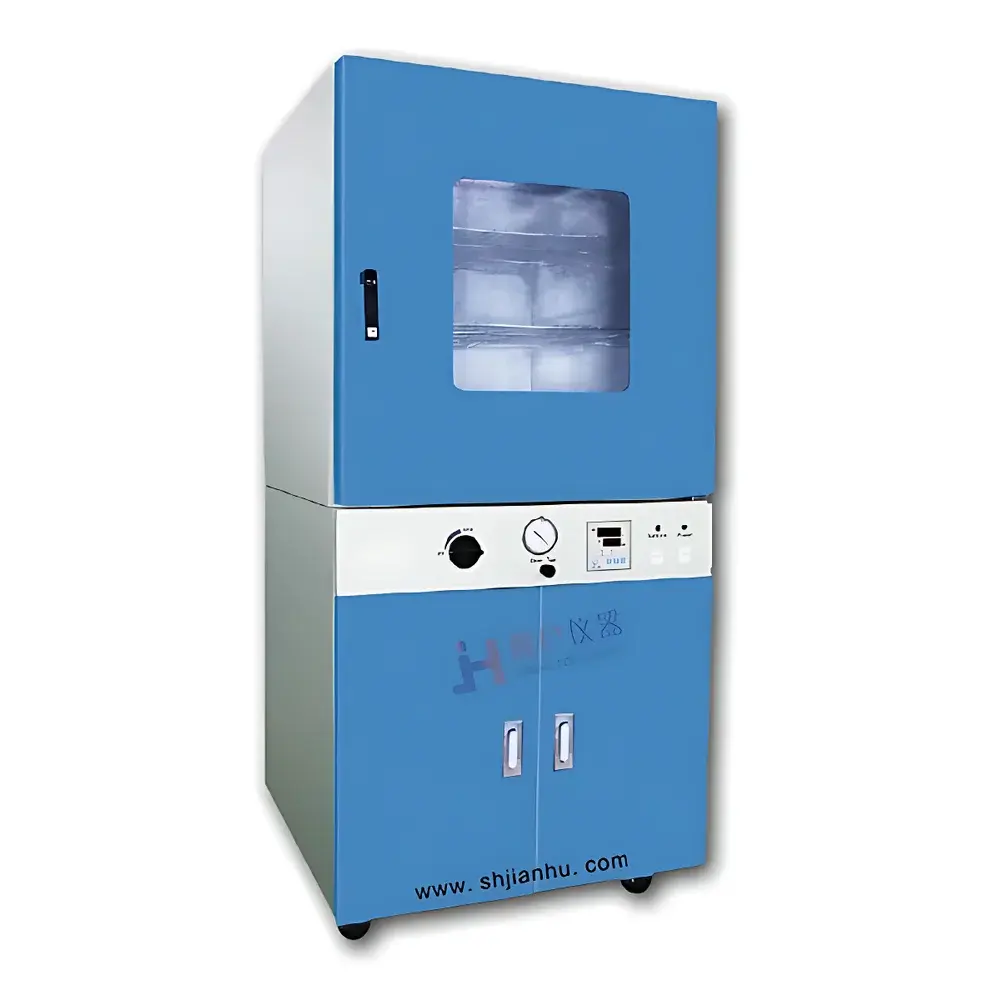
Jianhu JH-6090 Forced-Air Drying Oven
| Brand | Jianhu |
|---|---|
| Origin | Chongqing, China |
| Model | JH-6090 |
| Instrument Type | Forced-Air Drying Oven |
| Temperature Range | RT+10°C to 200°C |
| Temperature Uniformity | ±1°C (at 100°C) |
| Temperature Fluctuation | ±0.1°C (short-term stability) |
| Internal Chamber Dimensions | 450 × 450 × 450 mm (W×D×H) |
| External Dimensions | 610 × 680 × 1460 mm (W×D×H) |
| Chamber Material | Mirror-Finish Stainless Steel (SUS304) |
| Door Configuration | Double-Door with Dual-Layer Heat-Resistant Glass Window |
| Sealing | High-Performance Silicone Gasket |
| Heating System | Embedded Coiled Tubular Electric Heaters |
| Air Circulation | Centrifugal Low-Noise Blower, Forced Convection |
| Controller | Digital Microprocessor-Based PID Temperature Controller with Timer Function |
| Safety Features | Independent Over-Temperature Protection Circuit |
Overview
The Jianhu JH-6090 Forced-Air Drying Oven is an industrial-grade laboratory drying system engineered for precision thermal processing of non-volatile, heat-stable samples under atmospheric conditions. It operates on the principle of forced convection—using a centrifugal blower to circulate heated air uniformly throughout the chamber—thereby minimizing thermal gradients and ensuring reproducible drying, curing, sterilization, or moisture-loss testing outcomes. Designed for routine quality control, material pre-conditioning, and sample preparation in pharmaceutical, chemical, food, and academic laboratories, the JH-6090 complies with fundamental thermal stability requirements outlined in ISO 17025-accredited environments and supports GLP-aligned documentation practices through its programmable controller and alarm logging capability.
Key Features
- Microprocessor-based PID temperature controller with adjustable timer function (0–9999 minutes), enabling unattended operation and process repeatability.
- Mirror-finish SUS304 stainless steel interior chamber with rounded corners and smooth welds—resistant to corrosion, easy to clean, and compliant with hygiene-sensitive applications.
- Embedded coiled tubular heating elements fully enclosed within metal sheaths—reducing surface oxidation and extending service life compared to exposed wire heaters.
- Dual-door structure with double-layer heat-resistant glass observation window and high-integrity silicone gasket sealing—ensuring visual monitoring without compromising thermal efficiency or safety.
- Forced-air circulation system utilizing a low-noise centrifugal blower mounted at the rear wall—optimized for laminar airflow distribution and uniform temperature maintenance across the full working volume.
- Independent over-temperature cut-off circuit with audible/visual alarm—meeting essential functional safety criteria per IEC 61010-1 for laboratory electrical equipment.
Sample Compatibility & Compliance
The JH-6090 accommodates standard laboratory glassware, ceramic crucibles, metal trays, and polymer containers up to 450 mm in width, depth, and height. Its chamber geometry allows flexible placement of multiple sample racks, with adjustable shelf spacing to accommodate varying sample heights. While not rated for vacuum or inert-atmosphere operation, it is suitable for drying powders, granules, filter papers, coated substrates, and pre-weighed specimens prior to gravimetric analysis. The unit conforms to general-purpose laboratory oven standards referenced in ASTM E145 (Standard Specification for Gravity-Convection and Forced-Ventilation Ovens) and aligns with baseline thermal performance expectations for Class II ovens per ISO 8573-1 (air purity classification not applicable, but internal airflow design minimizes particulate recirculation). No CE marking or UL certification is provided; users are advised to verify local regulatory acceptance prior to installation.
Software & Data Management
The JH-6090 features a standalone digital controller without external PC connectivity or data export functionality. All operational parameters—including setpoint, real-time chamber temperature, elapsed time, and alarm status—are displayed on a high-contrast LED screen. The PID algorithm enables stable temperature regulation with minimal overshoot and rapid recovery after door opening. Though no audit trail or electronic record-keeping is built-in, the device supports manual logbook documentation compatible with FDA 21 CFR Part 11–aligned workflows when paired with external calibrated thermometers and timestamped entry protocols. Optional analog output (4–20 mA) for temperature signal transmission may be available upon request for integration into centralized building management systems.
Applications
- Moisture content determination via loss-on-drying (LOD) per USP , Ph. Eur. 2.2.32, and AOAC 950.46 methodologies.
- Pre-drying of filters, membranes, and absorbent media prior to gravimetric particulate analysis.
- Curing of coatings, adhesives, and polymer films under controlled thermal exposure.
- Stabilization of reference standards and calibration weights in humidity-controlled storage prep areas.
- Baking of glassware and metal tools for residue-free sterilization in analytical labs.
- Conditioning of hygroscopic materials (e.g., silica gel, molecular sieves) before use in gas purification systems.
FAQ
What is the maximum operating temperature of the JH-6090?
The rated maximum temperature is 200°C. Although Jianhu offers higher-temperature variants (up to 500°C), the JH-6090 model is specifically designed and validated for continuous operation up to 200°C.
Is this oven suitable for drying moisture-sensitive or oxygen-sensitive samples?
No. The JH-6090 operates under ambient atmospheric conditions and lacks inert gas purging or vacuum capability. For such applications, a nitrogen-purged or vacuum drying oven is recommended.
Can the temperature uniformity be verified and documented?
Yes. Users may perform temperature mapping using NIST-traceable calibrated thermocouples placed at nine predefined locations (per ASTM E145 Annex A3) to generate a validation report supporting ISO/IEC 17025 compliance.
Does the unit include calibration documentation?
Factory calibration certificate is not included by default but can be supplied as an optional add-on service with traceability to national standards.
What maintenance is required for long-term reliability?
Routine cleaning of the chamber interior and blower intake filter every 3–6 months is recommended. Annual verification of temperature sensor accuracy and heater continuity is advised for regulated environments.



