
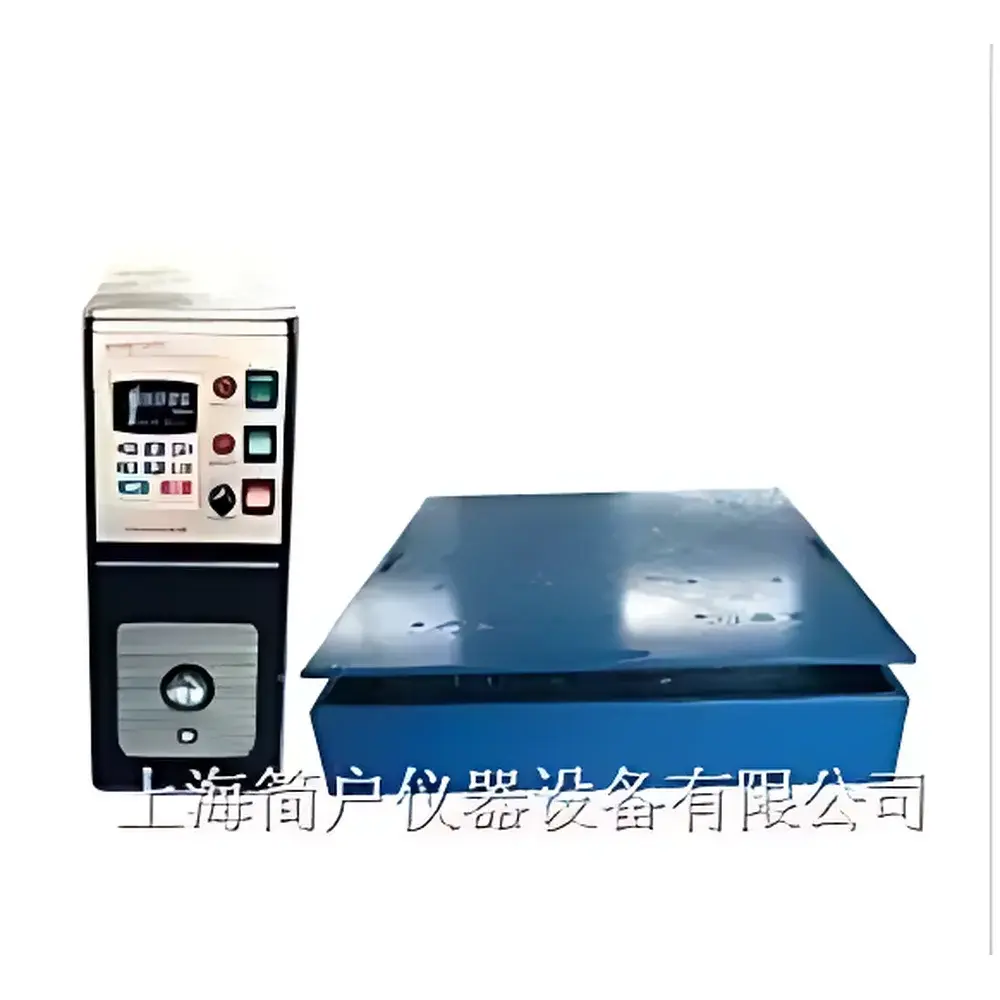
Jianhu JDZD-HF Electrodynamically Driven Vibration Shaker System
| Brand | Jianhu |
|---|---|
| Model | JDZD-HF |
| Type | Electrodynamically Driven Vibration Shaker |
| Rated Frequency Range | 1–5000 Hz |
| Maximum Test Load | 100 kg |
| Table Surface Dimensions | 500 mm × 500 mm |
| Peak-to-Peak Displacement | 0–5 mm |
| Maximum Acceleration | 20 g |
| Vibration Axes | Vertical, Horizontal, or Dual-Axis (Vertical + Horizontal) |
| Waveform | Sinusoidal |
| Drive Power | 2.2 kW |
| Input Voltage | 220 V ±20% |
| Compliance | GB/T 2423.10, IEC 60068-2-6 (Fc), JJG 189–1997, GB/T 13309–1991 |
Overview
The Jianhu JDZD-HF Electrodynamically Driven Vibration Shaker System is a precision-engineered test platform designed for controlled mechanical vibration simulation across industrial R&D, quality assurance, and reliability validation workflows. Operating on the principle of electromagnetic force generation—where voice-coil actuators convert electrical current into linear motion—the system delivers repeatable, traceable sinusoidal excitation across a broad frequency spectrum (1–5000 Hz). Its robust electrodynamic architecture ensures high fidelity in acceleration, displacement, and velocity profiles, making it suitable for both qualification-level environmental stress screening and development-stage durability assessment. Unlike hydraulic or servo-hydraulic shakers, the JDZD-HF offers rapid response dynamics, low thermal drift, and inherent compatibility with real-time closed-loop control—critical for compliance-driven applications in electronics, automotive components, consumer packaging, and electromechanical assemblies.
Key Features
- Electrodynamic actuation with 2.2 kW amplifier output, enabling stable 20 g peak acceleration at rated load
- Dual-axis capability (vertical, horizontal, or simultaneous vertical+horizontal) for multi-directional stress replication
- Programmable waveform generation: sine, swept-sine (linear/logarithmic), fixed-frequency, amplitude-modulated, and time-controlled profiles
- Integrated digital controller supporting sweep rate adjustment, dwell time definition, and breakpoint sequencing per IEC 60068-2-6 Annex B
- High-rigidity 500 mm × 500 mm aluminum table with threaded mounting holes (M6/M8 standard spacing) for secure fixture integration
- Real-time monitoring of acceleration (via IEPE accelerometer input), displacement (LVDT feedback), and drive current
- Front-panel LCD interface with intuitive navigation; optional Ethernet/USB connectivity for remote operation and data logging
Sample Compatibility & Compliance
The JDZD-HF accommodates test specimens up to 100 kg mass, with mechanical coupling optimized for rigidly mounted electronic enclosures, PCB subassemblies, automotive sensors, plastic housings, and packaged goods. Its displacement range (0–5 mm p-p) and acceleration envelope (up to 20 g) align with common mechanical shock and resonance testing requirements in manufacturing environments. The system is validated against multiple international and national standards—including GB/T 2423.10 (sinusoidal vibration), IEC 60068-2-6 (Fc), JJG 189–1997 (calibration methodology), and GB/T 13309–1991 (vibration test instrumentation)—ensuring metrological traceability and audit readiness. When operated within specified thermal and voltage tolerances (220 V ±20%), the shaker maintains amplitude linearity and phase stability across its full operational bandwidth, supporting GLP-compliant test documentation when paired with calibrated transducers and certified data acquisition hardware.
Software & Data Management
The JDZD-HF supports standalone operation via its embedded controller or integration with third-party PC-based platforms (e.g., MATLAB® Simulink®, LabVIEW™, or vendor-neutral SCPI command sets). Standard firmware includes built-in storage for up to 100 programmable test sequences, each configurable with up to 200 breakpoints, dwell times, sweep modes, and acceleration limits. All test logs—including timestamped acceleration spectra, drive voltage history, and thermal sensor readings—are exportable in CSV or ASCII format for post-processing. For regulated industries, optional software modules provide 21 CFR Part 11–compliant user access controls, electronic signatures, and immutable audit trails—enabling seamless alignment with FDA-regulated product validation protocols and ISO 17025-accredited laboratory practices.
Applications
This vibration shaker system serves as a core tool in multiple functional domains: structural resonance identification for printed circuit board (PCB) layout optimization; fatigue life prediction of automotive infotainment modules under road-spectrum excitation; packaging integrity verification for e-commerce logistics; modal analysis of optical sensor housings; and pre-shipment environmental stress screening for IoT edge devices. Its ability to replicate field-relevant vibration spectra—such as those defined in MIL-STD-810H Method 514.8 or ISO 16750-3—makes it indispensable for cross-functional teams engaged in design for reliability (DfR), failure mode and effects analysis (FMEA), and accelerated life testing (ALT). End-user sectors include Tier-1 automotive suppliers, medical device OEMs, consumer electronics manufacturers, and national metrology institutes conducting inter-laboratory comparison studies.
FAQ
What standards does the JDZD-HF comply with?
It meets GB/T 2423.10, IEC 60068-2-6 (Fc), JJG 189–1997, and GB/T 13309–1991 for vibration test execution, calibration, and instrumentation accuracy.
Can the system perform random vibration testing?
No—the JDZD-HF is configured exclusively for deterministic waveforms (sinusoidal, swept-sine, amplitude-modulated). Random vibration requires an optional upgrade path with dedicated power spectral density (PSD) controller hardware.
Is dual-axis simultaneous operation supported out-of-the-box?
Yes—mechanical and electrical interfaces allow synchronized vertical and horizontal excitation using a single controller unit, with independent amplitude and phase control per axis.
What is the recommended maintenance interval?
Annual verification of coil centering, suspension integrity, and amplifier thermal performance is advised; full recalibration per JJG 189–1997 is required every 12 months or after 2000 operational hours.
Does the system include transducer calibration certificates?
Calibration certificates for optional IEPE accelerometers and LVDT displacement sensors are available upon request and conform to ISO/IEC 17025 requirements when issued by accredited providers.



