
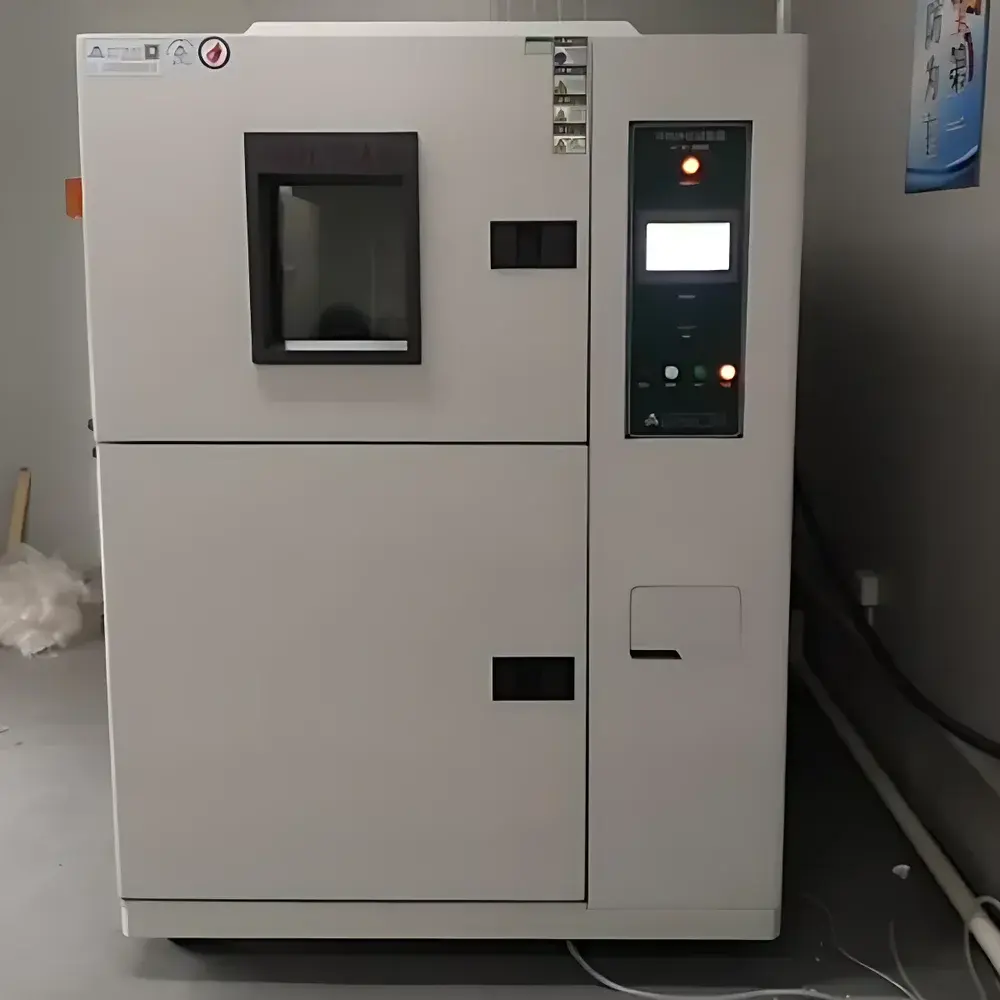
JianHu JH-Series Thermal Shock Test Chamber
| Brand | JianHu |
|---|---|
| Origin | Shanghai, China |
| Model | JH-Thermal Shock Test Chamber |
| Temperature Range (High) | +60 °C to +200 °C |
| Temperature Range (Low) | −70 °C to 0 °C |
| Thermal Shock Range | −60 °C to +150 °C |
| Temperature Stability | ±0.5 °C to ±2.0 °C |
| Heating Rate | 3–20 °C/min |
| Cooling Rate | 3–15 °C/min |
Overview
The JianHu JH-Series Thermal Shock Test Chamber is an engineered environmental test system designed for rapid, repeatable, and highly controlled thermal cycling between extreme high- and low-temperature zones. It operates on a two-chamber (hot/cold) or single-chamber with cryogenic and heating modules architecture—enabling precise simulation of abrupt temperature transitions encountered in real-world operational environments. The chamber implements dual-sensor feedback control with high-resolution Pt100 RTD probes and PID-based regulation logic to maintain tight thermal stability across the working volume. Its core function is to accelerate failure mechanisms related to thermal expansion mismatch, interfacial delamination, solder joint fatigue, and material embrittlement—making it indispensable for reliability validation in electronics, aerospace components, automotive ECUs, and advanced packaging materials.
Key Features
- High-fidelity dual-zone thermal shock capability with independent hot and cold chambers, minimizing cross-contamination and enabling true step-change transitions
- Advanced micro-differential temperature detection system: redundant high-accuracy RTD sensors distributed across critical load zones (top/mid/bottom, front/rear) continuously monitor spatial thermal gradients; real-time deviation analysis triggers localized compensation via modulated heater/cooler output
- Precision temperature control with stability maintained within ±0.5 °C (typical) under steady-state conditions and ±2.0 °C during dynamic ramping—verified per IEC 60068-2-14 and ASTM D5229
- Programmable ramp rates: heating from 3 °C/min up to 20 °C/min; cooling from 3 °C/min up to 15 °C/min—fully adjustable to match application-specific stress profiles
- Stainless steel 304 interior with insulated double-wall construction, forced-air convection circulation, and anti-condensation heating on viewing windows
- Compliance-ready architecture: supports audit trails, user-level access control, calibration lockout, and electronic signature logging compatible with GLP/GMP workflows
Sample Compatibility & Compliance
The JH-Series accommodates samples ranging from bare PCBs and IC packages to assembled modules, automotive sensors, optical housings, and polymer-metallized composites. Internal dimensions are configurable per model variant to support standard test fixtures (e.g., JEDEC trays, MIL-STD-810G compliant carriers). All units conform to key international standards including IEC 60068-2-14 (Environmental testing – Part 2-14: Tests – Test N: Change of temperature), ISO 16750-4 (Road vehicles – Environmental conditions and testing for electrical and electronic equipment – Part 4: Climatic loads), and ASTM E1656 (Standard Guide for Classifying Calibration Methods for Industrial Thermometers). Optional traceable NIST-calibrated sensor kits and IQ/OQ documentation packages are available for regulated industries.
Software & Data Management
Equipped with JianHu’s proprietary TSC-Manager™ software, the chamber provides full-cycle test programming, real-time multi-channel data acquisition (up to 16 auxiliary inputs), and automated report generation in PDF/CSV formats. The interface supports user-defined pass/fail criteria based on time-at-temperature, maximum gradient, or cumulative thermal cycles. Audit trail functionality records all parameter changes, operator logins, calibration events, and alarm triggers—meeting FDA 21 CFR Part 11 requirements when configured with electronic signatures and role-based permissions. Remote monitoring via Ethernet or optional Wi-Fi enables integration into centralized lab management systems (LIMS) and Industry 4.0 MES platforms.
Applications
- Qualification testing of semiconductor devices (e.g., flip-chip BGA, SiC MOSFETs) per JEDEC JESD22-A104
- Thermal fatigue evaluation of solder joints, underfill materials, and wafer-level CSPs
- Reliability screening of avionics hardware subjected to stratospheric-to-engine-bay thermal transients
- Material compatibility studies for space-grade polymers, thermal interface materials (TIMs), and encapsulants
- Accelerated aging of lithium-ion battery modules under repeated thermal stress
- Validation of medical device sterilization packaging integrity after thermal cycling
FAQ
What is the typical recovery time between thermal shock cycles?
Recovery time depends on setpoint delta and load mass but is typically ≤5 minutes for transitions within the −60 °C to +150 °C range under no-load conditions.
Can the chamber be integrated with external data loggers or PLC systems?
Yes—RS-485 Modbus RTU and Ethernet TCP/IP interfaces are standard; analog 4–20 mA and digital I/O ports support third-party automation integration.
Is calibration certification included with shipment?
A factory calibration certificate (traceable to national standards) is provided; optional UKAS/NIST-accredited calibration is available upon request.
How is temperature uniformity validated across the test chamber workspace?
Uniformity is verified using a 9-point sensor mapping protocol per IEC 60068-3-5, with results documented in the installation qualification (IQ) report.
Does the system support custom thermal profile scripting beyond standard step-ramp-hold sequences?
Yes—TSC-Manager™ supports complex multi-segment profiles with conditional branching, dwell timers, and event-triggered actions (e.g., initiate camera capture at peak temperature).



