
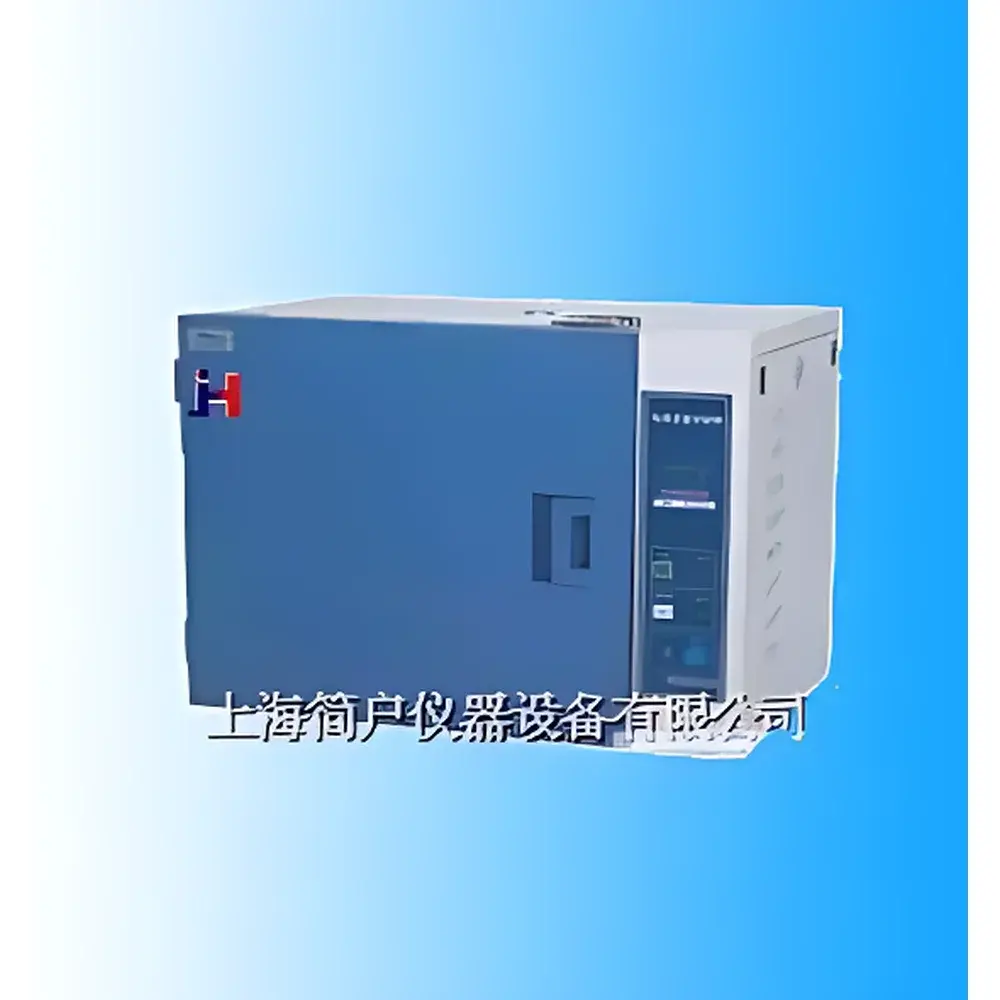
Jianhu JH-Series Forced-Air Hot Air Sterilizer (Dry Heat Sterilizer)
| Brand | Jianhu |
|---|---|
| Origin | Shanghai, China |
| Model | JH-9023A / JH-9053A / JH-9073A / JH-9123A |
| Power Supply | 220 V, 50 Hz |
| Temperature Range | RT+10 °C to 250 °C |
| Temperature Resolution | 0.1 °C |
| Temperature Uniformity | ±1 °C |
| Operating Ambient Temperature | +5 °C to +40 °C |
| Input Power | 600 W – 2100 W |
| Internal Chamber Dimensions (W×D×H, mm) | 340×325×320 to 600×550×600 |
| External Dimensions (W×D×H, mm) | 620×490×490 to 880×750×800 |
| Standard Shelving | 2 adjustable stainless steel shelves |
| Timer Range | 1–9999 minutes |
Overview
The Jianhu JH-Series Forced-Air Hot Air Sterilizer is an engineered dry heat sterilization system designed for reliable microbial inactivation in laboratory, pharmaceutical, and medical device settings. Unlike moist-heat methods such as autoclaving, dry heat sterilization relies on sustained elevated temperatures—typically ≥160 °C for ≥2 hours or ≥180 °C for ≥30 minutes—to achieve sterility through oxidative degradation of cellular components, irreversible protein denaturation, and electrolyte concentration-induced cytotoxicity. This mechanism ensures complete destruction of bacterial spores, including highly resistant strains such as *Geobacillus stearothermophilus*, without introducing moisture-related risks to heat-stable but water-sensitive materials (e.g., powders, oils, glassware, metal instruments, and anhydrous reagents). The unit employs a forced-air convection architecture with a high-efficiency axial fan and strategically positioned heating elements to ensure rapid thermal equilibration and uniform temperature distribution across the entire chamber volume—critical for validated sterilization cycles compliant with ISO 17665-2 and USP .
Key Features
- Precision Temperature Control: Equipped with a microprocessor-based PID controller offering 0.1 °C resolution and ±1 °C uniformity across the working range (RT+10 °C to 250 °C), enabling repeatable, protocol-driven thermal processing.
- Forced-Air Convection System: High-volume axial airflow ensures direct thermal transfer to load surfaces, reducing preheat time by up to 40% compared to natural-convection ovens and minimizing intra-chamber temperature gradients.
- Dual-Safety Architecture: Independent overtemperature cut-off (mechanical backup) and real-time sensor monitoring automatically interrupt power if setpoint deviation exceeds safety thresholds—meeting IEC 61010-1 requirements for laboratory equipment safety.
- Operator-Centric Design: Adjustable air damper, programmable digital timer (1–9999 min), removable stainless-steel shelves, and smooth interior surfaces facilitate routine cleaning, load configuration, and process documentation.
- Robust Thermal Insulation: Double-wall construction with high-density mineral wool insulation minimizes external surface temperature rise and improves energy efficiency during extended sterilization cycles.
Sample Compatibility & Compliance
The JH-Series accommodates a broad range of heat-stable items requiring depyrogenation or sterilization: borosilicate glass vials and pipettes, stainless-steel surgical tools, ceramic filters, silicone tubing, and powder excipients. It supports validation protocols per ISO 14644-1 (cleanroom-compatible operation), ISO 11138-4 (dry heat sterilization of medical devices), and EU GMP Annex 1 requirements for depyrogenation tunnels. All models are compatible with thermocouple mapping studies using Class A PT100 sensors and support audit-ready record retention when integrated with external data loggers compliant with FDA 21 CFR Part 11.
Software & Data Management
While the base unit operates via embedded firmware without proprietary software, its digital interface supports RS-485 Modbus RTU communication for integration into centralized lab management systems (LIMS) or SCADA platforms. Time-stamped cycle logs—including start/stop timestamps, setpoint, actual chamber temperature (every 10 s), and fault codes—are retained in non-volatile memory for ≥1000 cycles. Optional external USB data loggers enable GLP-compliant export of CSV-formatted temperature profiles for regulatory submission and trend analysis.
Applications
- Sterilization of glassware, metal instruments, and ceramic components prior to aseptic processing
- Depyrogenation of containers and closures in parenteral manufacturing environments
- Moisture-free drying of hygroscopic standards and reference materials
- Thermal validation of packaging integrity under accelerated aging conditions (e.g., ISO 11607)
- Pre-treatment of substrates for surface coating or analytical sample preparation
FAQ
What is the minimum holding time required for sterilization at 180 °C?
According to ISO 11138-4, a minimum exposure of 30 minutes at ≥180 °C is required for sterility assurance of dry heat–stable items.
Can this unit be used for depyrogenation of glass vials?
Yes—when operated at ≥250 °C for ≥45 minutes, it achieves ≥3-log reduction of endotoxin activity, satisfying USP criteria for depyrogenation.
Is calibration traceable to national standards?
The unit accepts external Class A PT100 probes; users may perform IQ/OQ/PQ validation using NIST-traceable reference thermometers per ASTM E2877.
Does the timer support automatic shutdown after cycle completion?
Yes—the digital timer halts heating and triggers audible/visual alerts upon reaching the programmed duration, preserving sample integrity and energy efficiency.
Are replacement shelves and filters available as spare parts?
Stainless-steel shelves, high-temp gaskets, and fan filter assemblies are stocked and supplied with OEM part numbers for seamless maintenance planning.



