
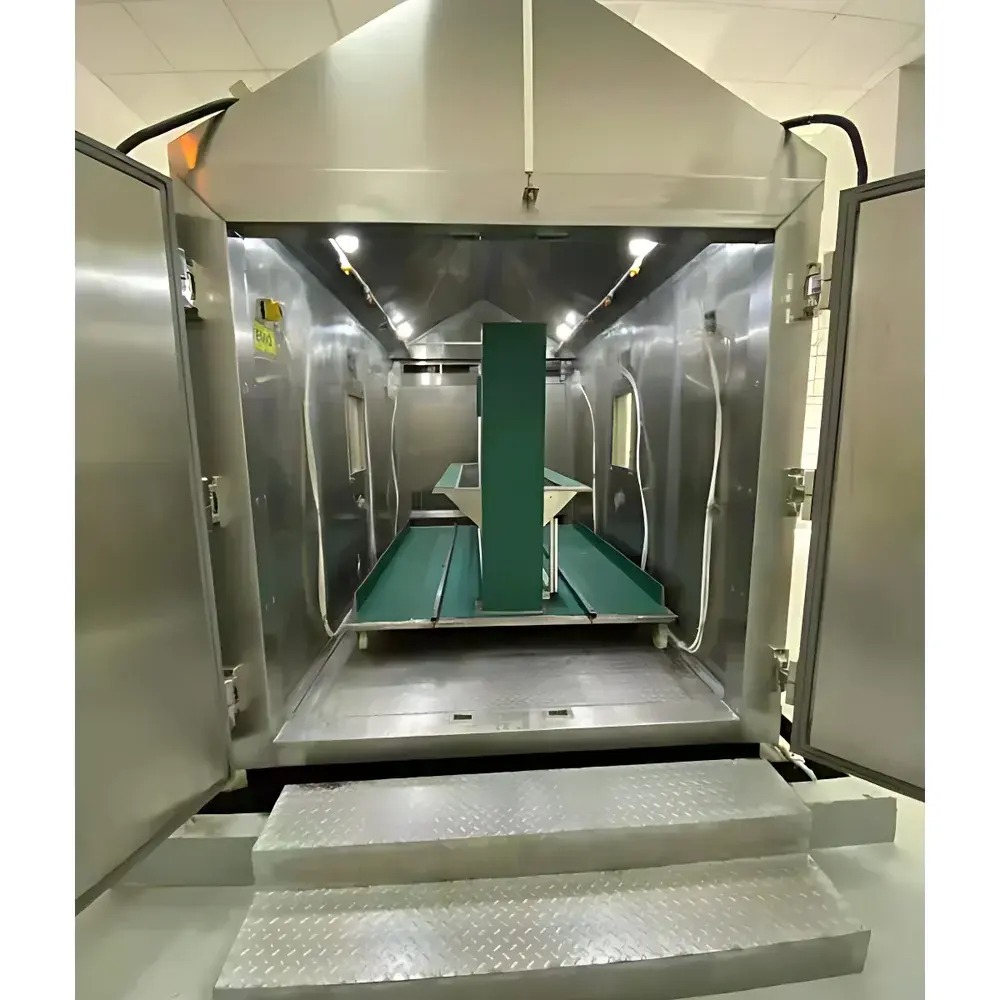
JianHu JH-Series Large Walk-In Salt Spray Test Chamber
| Brand | JianHu |
|---|---|
| Origin | Shanghai, China |
| Model | JH-Walk-In |
| Spray Method | Continuous Atomization |
| Fog Output | 1–2 mL per 80 cm² per hour |
| Nozzle Pressure | 0.7–1.0 kg/cm² |
| De-fogging Method | Air-Compression Exhaust |
| Compliance | ASTM B117, ISO 9227, GB/T 2423.17, JIS Z2371 |
Overview
The JianHu JH-Series Large Walk-In Salt Spray Test Chamber is an engineered environmental test system designed to accelerate corrosion evaluation of metallic materials, coated surfaces, electronic enclosures, automotive components, and aerospace hardware under controlled saline atmospheric conditions. Based on the standardized principles of continuous salt fog generation via pneumatic atomization—governed by the electrochemical corrosion mechanisms outlined in ASTM B117 and ISO 9227—this chamber replicates aggressive coastal or marine exposure environments. Its walk-in architecture enables full-scale testing of large assemblies (e.g., vehicle subframes, HVAC units, structural panels) without disassembly, supporting both qualitative pass/fail assessments and quantitative corrosion rate analysis over extended exposure durations (up to 6,000 hours). The chamber integrates dual-climate control logic for precise maintenance of chamber temperature (typically 35 °C ± 2 °C) and saturated humidity (>95% RH), ensuring thermodynamic stability critical for reproducible chloride deposition kinetics.
Key Features
- Walk-in configuration with internal dimensions customizable from 3 m³ to 20 m³, accommodating oversized test specimens including chassis modules, architectural façade mock-ups, and defense-grade equipment racks.
- Continuous spray system utilizing corrosion-resistant borosilicate glass nozzles and precision-regulated compressed air supply (0.7–1.0 kg/cm²) to deliver uniform NaCl aerosol distribution across the entire test volume.
- Fog deposition rate calibrated to 1.0–2.0 mL/80 cm²/hour, traceable to NIST-traceable volumetric standards and verified per ISO 9227 Annex A.
- Integrated de-fogging subsystem employing positive-pressure air displacement with exhaust filtration—eliminating residual salt aerosol prior to operator entry and preventing cross-contamination between test cycles.
- Dual-wall insulated construction with polyurethane foam (≥100 mm thickness) and stainless-steel 316L interior cladding, ensuring thermal efficiency and long-term resistance to chloride-induced pitting.
- Redundant safety architecture including over-temperature cut-off (±1 °C deviation), leakage current protection (≤30 mA), and real-time chamber pressure monitoring to prevent hazardous vapor accumulation.
Sample Compatibility & Compliance
This chamber accommodates a broad spectrum of sample types: ferrous and non-ferrous metal coupons, painted or galvanized substrates, printed circuit board assemblies (PCBAs), plastic housings with metallic inserts, and multi-material hybrid components. It supports standard test protocols including neutral salt spray (NSS), acetic acid salt spray (AASS), and copper-accelerated acetic acid salt spray (CASS), all executed in strict conformance with ASTM B117, ISO 9227, GB/T 2423.17, and JIS Z2371. Optional auxiliary modules enable synchronized humidity cycling (per IEC 60068-2-30) and post-test drying phases compliant with MIL-STD-810H Method 509.5. All operational parameters—including chamber temperature, solution pH (6.5–7.2 for NSS), and fog collection rate—are logged with timestamped audit trails meeting GLP and ISO/IEC 17025 documentation requirements.
Software & Data Management
The embedded controller features a 10.1″ industrial touchscreen HMI running real-time Linux OS, supporting up to 99 programmable test profiles with stepwise parameter sequencing (e.g., 24-hr spray → 4-hr dry → 2-hr humidity soak). Data acquisition includes continuous logging of chamber temperature, relative humidity, nozzle pressure, and solution tank level at 1-second intervals. Export formats include CSV and PDF reports compliant with FDA 21 CFR Part 11 (electronic signature support optional). Remote monitoring is enabled via Ethernet/IP or Modbus TCP; integration with LIMS platforms (e.g., LabVantage, Thermo Fisher SampleManager) is validated through OPC UA interface certification. Calibration records, maintenance logs, and user access permissions are stored locally with encrypted backup to external NAS devices.
Applications
- Automotive OEMs use this chamber to validate corrosion resistance of brake calipers, suspension arms, and EV battery enclosures per SAE J2334 and VW PV1210 specifications.
- Electronics manufacturers perform accelerated life testing on outdoor telecom cabinets, marine navigation displays, and military-grade connectors per IPC-J-STD-006 and MIL-STD-202G.
- Aerospace suppliers conduct qualification testing of titanium fasteners, aluminum wing skins, and composite bonding interfaces per Boeing D6-17487 and Airbus AITM 1-0003.
- Coatings laboratories assess performance of epoxy primers, zinc-rich paints, and ceramic conversion coatings using gravimetric mass loss measurement and ASTM D1654-rated scribe creep evaluation.
- Third-party testing labs (e.g., SGS, TÜV Rheinland, UL) deploy this system for certification reporting aligned with IECQ QC 080000 and ISO 14001 environmental compliance audits.
FAQ
What standards does this chamber fully support out-of-the-box?
ASTM B117, ISO 9227, GB/T 2423.17, JIS Z2371, and DIN 50021 are natively implemented in the control firmware with preloaded test templates and calibration verification routines.
Can the chamber operate continuously for 30 days without manual intervention?
Yes—when equipped with auto-refill reservoirs (optional), redundant pumps, and remote alarm notification (SMS/email), unattended operation exceeding 720 hours is validated per IEC 61508 SIL2 requirements.
Is stainless steel 316L used throughout the wetted path?
All fog generation components—including solution tanks, piping, nozzles, and collection trays—are fabricated from ASTM A240 UNS S31603 stainless steel; chamber walls utilize 316L cladding over carbon steel structural framing.
How is fog uniformity verified during installation qualification?
Uniformity is confirmed using 5–12 calibrated fog collectors (per ISO 9227 Figure A.1) placed across three vertical planes; deviation must remain within ±15% of mean deposition rate across all positions.
Does the system include validation documentation for GxP environments?
IQ/OQ documentation packages—including sensor calibration certificates (traceable to NPL or NIST), alarm response verification logs, and software validation summaries—are provided as standard deliverables for regulated industries.



