
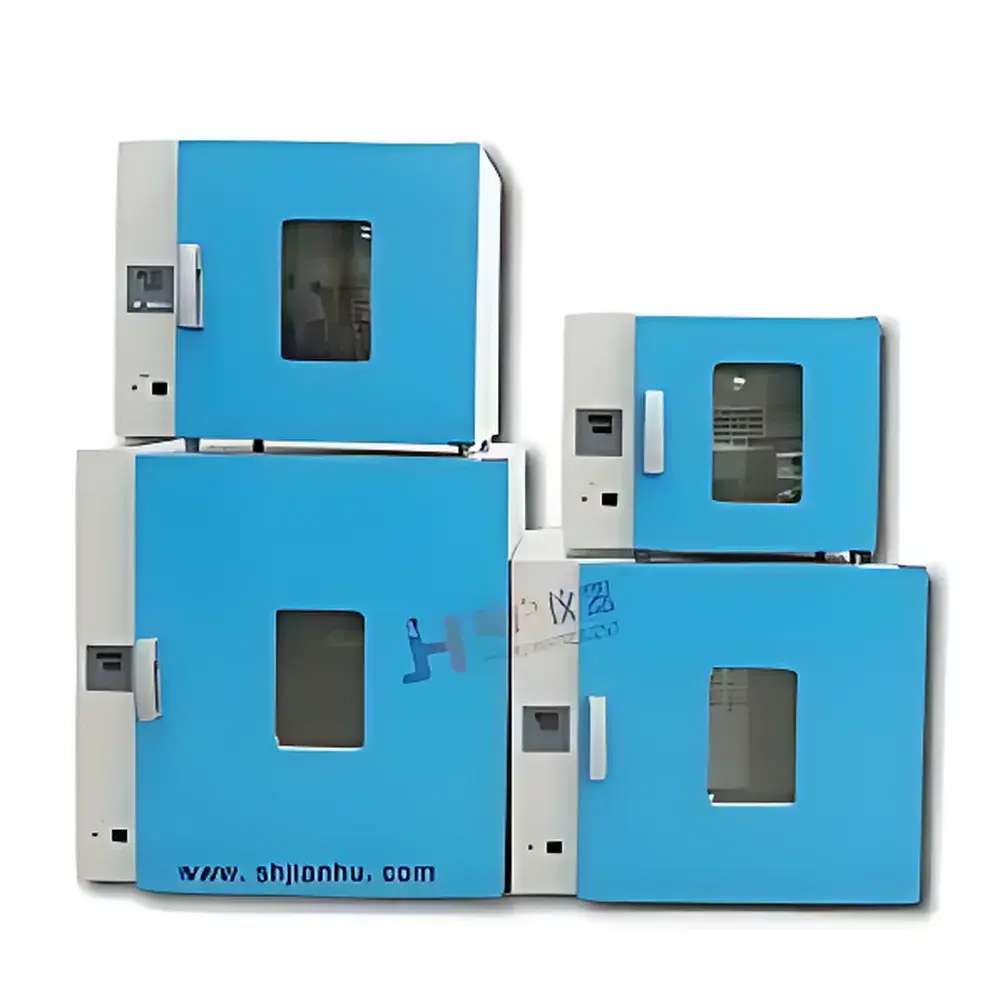
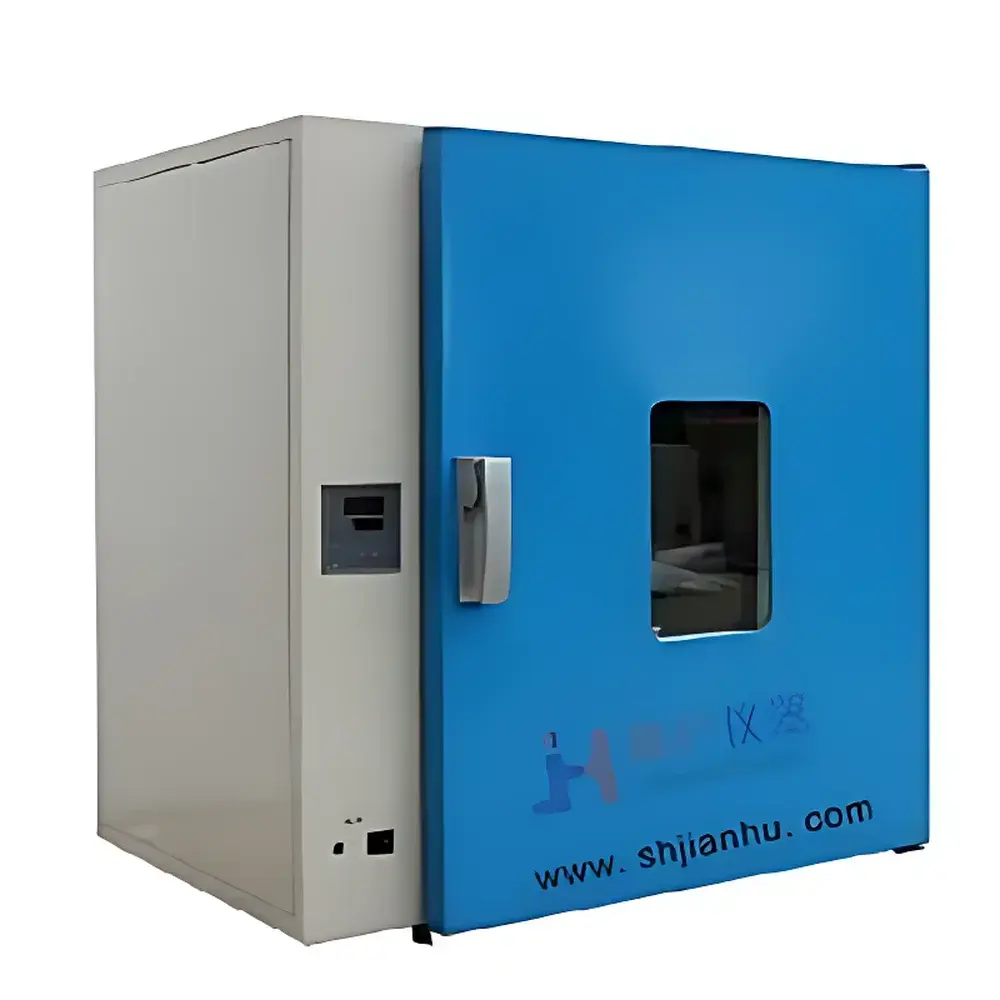
Jianhu JH Series Forced-Air Oven
| Brand | Jianhu |
|---|---|
| Origin | Shanghai, China |
| Model | JH |
| Power Supply | 220 V / 50 Hz or 380 V / 50 Hz |
| Temperature Range | RT+10°C to 250°C |
| Temperature Uniformity | ±1°C |
| Control Accuracy | ±1% of full scale |
| Timer Range | 1–9999 min |
| Chamber Volume | 30 L to 420 L (model-dependent) |
| Interior Material | Mirror-finish stainless steel (AISI 304) |
| Exterior Material | Powder-coated cold-rolled steel |
| Heating Power | 550 W to 4000 W |
| Operating Ambient | +5°C to +40°C |
| Shelves | 2 standard adjustable stainless-steel shelves |
Overview
The Jianhu JH Series Forced-Air Oven is a precision-engineered laboratory and industrial drying instrument designed for consistent thermal processing across diverse applications—including sample drying, sterilization, polymer curing, moisture content determination, and pre-conditioning of materials prior to analytical testing. Its operational principle relies on forced convection: a high-temperature-stable centrifugal blower circulates heated air uniformly throughout the chamber via optimized duct geometry and rear-mounted airflow channels. This architecture ensures superior temperature uniformity (±1°C) and minimizes thermal gradients—critical for reproducible results in QC/QA labs, R&D facilities, and GMP-compliant manufacturing environments. The oven complies with fundamental safety and performance expectations outlined in IEC 61010-1 (Safety Requirements for Electrical Equipment for Measurement, Control, and Laboratory Use) and aligns with general thermal stability requirements referenced in ASTM E145 and ISO 17025-accredited calibration practices.
Key Features
- Mirror-finish AISI 304 stainless-steel interior chamber fabricated using full-arc TIG welding—resistant to corrosion, easy to clean, and compliant with hygienic design principles for repeated sterilization cycles.
- Microprocessor-based digital temperature controller with PID algorithm, real-time display, and programmable timer (1–9999 minutes); optional upgrade to intelligent LCD programmable controller supporting multi-segment ramp/soak profiles.
- Robust forced-air circulation system featuring a high-efficiency, thermally stable motorized impeller and symmetrical air inlet/outlet configuration—ensuring ≤±1°C spatial uniformity across the entire working volume per ISO 14644-1 Class 8 cleanroom-compatible validation protocols.
- Dual-safety thermal protection: primary microcontroller-based regulation plus an independent mechanical over-temperature cut-off switch—automatically de-energizing heating elements if setpoint deviation exceeds safe thresholds.
- Ergonomic exterior housing constructed from powder-coated cold-rolled steel with reinforced structural framing, integrated door gasket seal, and smooth-opening counterbalanced hinge mechanism for long-term dimensional stability.
Sample Compatibility & Compliance
The JH Series accommodates a broad spectrum of sample types—including glassware, metal trays, ceramic crucibles, polymer substrates, biological tissue carriers, and pharmaceutical packaging components—without risk of cross-contamination or surface degradation. Its stainless-steel chamber meets general requirements for non-pyrogenic processing environments and supports routine cleaning with ethanol, isopropanol, or diluted sodium hypochlorite solutions. While not certified for Class B autoclave cycles, it satisfies baseline thermal validation criteria for dry-heat depyrogenation (e.g., 250°C for ≥45 min) as described in USP and EU Annex 1. Optional independent limit controllers facilitate compliance with internal SOPs requiring redundant temperature safeguards during unattended operation.
Software & Data Management
Standard operation requires no external software; all parameters are configured directly via front-panel interface. For laboratories implementing electronic record-keeping under FDA 21 CFR Part 11 or ISO/IEC 17025, the optional intelligent LCD controller provides RS-485 communication port (Modbus RTU protocol), enabling integration with LIMS or SCADA systems for automated data logging, alarm event timestamping, and audit-trail generation. Temperature profiles, runtime logs, and fault codes can be exported to CSV format via USB memory stick—supporting GLP/GMP traceability without proprietary software dependencies.
Applications
- Moisture loss-on-drying (LOD) analysis per USP , Ph. Eur. 2.2.32, and ASTM D2298 for pharmaceutical excipients, food powders, and battery electrode slurries.
- Pre-drying of filter papers, gravimetric vessels, and desiccators prior to quantitative analysis.
- Thermal aging studies of polymers, adhesives, and composite laminates per ASTM D3045 and ISO 2578.
- Post-cleaning drying of labware in clinical microbiology and environmental testing labs.
- Baking of thin-film coatings, PCB substrates, and sensor elements under controlled inert or ambient atmospheres.
FAQ
What is the maximum operating temperature?
The JH Series is rated for continuous operation up to 250°C, with thermal stability maintained within ±1°C across the specified working range (RT+10°C to 250°C).
Is the oven suitable for sterile processing?
It supports dry-heat sterilization protocols (e.g., 160°C for 120 min or 180°C for 30 min) but is not validated for sterility assurance level (SAL) certification; users must perform in-house biological indicator validation per ISO 11138-4.
Can I calibrate the temperature controller onsite?
Yes—the microcontroller includes user-accessible calibration offset adjustment (±5.0°C range) using a NIST-traceable reference thermometer; full calibration reports may be generated using optional data-logging accessories.
Are custom chamber dimensions available?
Standard models cover volumes from 30 L to 420 L; OEM configurations with modified internal geometry or specialized shelving layouts are available upon engineering review and minimum order quantity.
Does the oven meet CE or UL safety standards?
The base unit conforms to IEC 61010-1:2010 and GB 4793.1–2007 (Chinese national equivalent); CE marking requires additional regional conformity assessment including EMC testing (EN 61326-1) and RoHS verification—available as a factory-installed option.



