
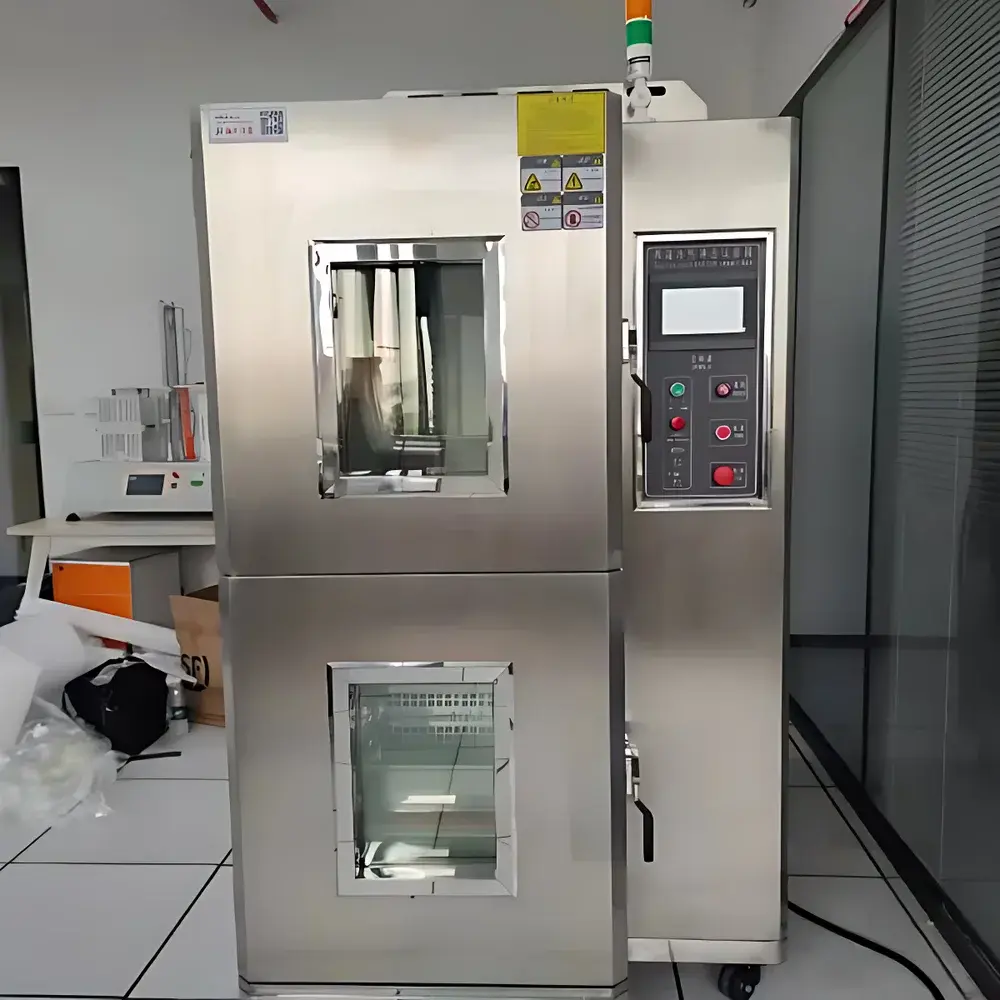
JianHu JH-Series Thermal Shock Test Chamber
| Brand | JianHu |
|---|---|
| Origin | Shanghai, China |
| Manufacturer Type | Authorized Distributor |
| Product Category | Domestic |
| Model | JH-Thermal Shock Test Chamber |
| Price Range | USD 9,800–11,200 (FOB Shanghai) |
| Temperature Range | −70 °C to +150 °C |
| Temperature Fluctuation | ±0.5 °C |
| Temperature Uniformity | ±2.0 °C |
| Temperature Deviation | ±2.0 °C |
| Heating Rate (Typical) | ≤60 min (from −40 °C to +150 °C) |
| Cooling Rate Options | ≤45 min / ≤60 min / ≤80 min (from +150 °C to −40 °C) |
| Internal Chamber Dimensions | Custom-configurable — consult technical sales for standard and bespoke volume options (e.g., 150 L, 300 L, 500 L) |
Overview
The JianHu JH-Series Thermal Shock Test Chamber is an engineered environmental simulation system designed to evaluate material and component reliability under rapid, repetitive transitions between extreme high- and low-temperature conditions. Based on the two-chamber (hot/cool) pneumatic transfer principle, it eliminates thermal inertia associated with single-chamber systems by physically moving test specimens between isolated temperature zones via a high-speed actuated lift mechanism. This architecture enables true thermal shock profiles compliant with IEC 60068-2-14, MIL-STD-810H Method 503.6, and GB/T 2423.22—ensuring reproducible, traceable, and audit-ready test cycles. The chamber’s dual-refrigeration circuit design (separate R404A/R23 cascade system for low-temp zone; independent electric heating for high-temp zone) delivers stable setpoint control across its full operating range (−70 °C to +150 °C), while optimized airflow dynamics and insulated stainless-steel chambers minimize energy consumption without compromising thermal response fidelity.
Key Features
- Two-zone independent temperature control: High-temp chamber (up to +150 °C) and low-temp chamber (down to −70 °C), each with dedicated PID-controlled heating/cooling circuits
- Pneumatically actuated specimen transfer mechanism with <1.5 s door transition time, minimizing ambient interference during thermal cycling
- High-efficiency cascade refrigeration system using environmentally compliant refrigerants (R404A/R23), meeting EU F-Gas Regulation Annex I requirements
- Temperature stability maintained at ±0.5 °C fluctuation and ±2.0 °C uniformity per IEC 60068-3-5 calibration methodology
- Energy-optimized insulation: 150 mm thick polyurethane foam (λ ≤ 0.022 W/m·K) with vacuum-degassed core and seamless welded inner chamber
- Industrial-grade PLC controller with 7-inch color touchscreen HMI, supporting programmable multi-step shock profiles, dwell times, cycle counts, and real-time deviation alarms
- Comprehensive safety architecture: Dual redundant over-temperature/over-pressure cutouts, refrigerant leak detection, and emergency power-off per EN 61000-6-2 EMC standards
Sample Compatibility & Compliance
The JH-Series accommodates a broad spectrum of test specimens—from PCB assemblies and automotive ECUs to aerospace composites and medical device housings—within configurable internal volumes (standard options: 150 L, 300 L, 500 L). All chambers conform to ISO/IEC 17025:2017 laboratory accreditation prerequisites for environmental testing equipment validation. System documentation includes factory-as-built drawings, refrigerant charge records, and NIST-traceable temperature mapping reports (per ASTM E741 and IEC 60068-3-5). Optional features include humidity control integration (for combined thermal/humidity shock per IEC 60068-2-30), inert gas purge capability (N₂ or dry air), and mechanical vibration coupling for multi-stress reliability screening. The unit meets CE marking requirements (2014/30/EU EMC Directive, 2014/35/EU LVD Directive) and is certified to ISO 9001:2015 for design, manufacturing, and service processes.
Software & Data Management
Embedded firmware supports full-cycle data logging at user-defined intervals (minimum 1 s resolution), storing temperature readings from ≥6 calibrated PT100 sensors (3 per zone + 2 in test space + 1 reference). Export formats include CSV, PDF test reports, and XML-compatible structured logs compatible with LIMS platforms. Optional PC-based JianHuTest Control Suite (v4.2) provides remote monitoring, automated report generation with digital signatures, and 21 CFR Part 11-compliant audit trails—including operator login history, parameter change logs, and electronic signature capture for GLP/GMP environments. All software modules undergo annual third-party validation per GAMP 5 guidelines.
Applications
This thermal shock chamber serves critical qualification and failure analysis workflows across regulated and high-reliability sectors. In electronics manufacturing, it validates solder joint integrity and die attach performance under JEDEC J-STD-020 moisture sensitivity level (MSL) preconditioning protocols. Automotive suppliers use it for AEC-Q200 stress screening of passive components and power modules. Aerospace Tier-1 contractors apply it to assess thermal cycling fatigue in carbon-fiber-reinforced polymer (CFRP) structural joints per SAE AS6012. Research institutions deploy it in materials science labs for studying phase-transition kinetics in shape-memory alloys and polymer crystallinity shifts. Its precision and repeatability also support accelerated life testing (ALT) models used in reliability prediction per MIL-HDBK-217F and Telcordia SR-332.
FAQ
What standards does the JH-Series comply with for thermal shock testing?
It supports test execution per IEC 60068-2-14, MIL-STD-810H Method 503.6, GB/T 2423.22, and JIS C 0042—with full documentation packages available for method validation.
Can the chamber be integrated into an existing factory MES or SCADA system?
Yes—via Modbus TCP/IP or OPC UA interface (optional hardware module), enabling real-time parameter readback, cycle status polling, and alarm forwarding.
Is on-site IQ/OQ/PQ validation support available?
JianHu provides turnkey installation qualification (IQ), operational qualification (OQ), and performance qualification (PQ) services performed by ISO/IEC 17025-accredited engineers, including thermocouple calibration certificates and mapping reports.
What maintenance intervals are recommended for long-term reliability?
Compressor oil and filter replacement every 12 months; refrigerant purity verification annually; full sensor recalibration every 24 months—detailed in the included Maintenance Logbook per ISO 13485 requirements.
Are custom chamber dimensions or special interior configurations supported?
Yes—JianHu offers engineering consultation for non-standard internal geometries, reinforced shelves, liquid-cooled fixture mounts, and ESD-safe conductive chamber linings upon request.



