
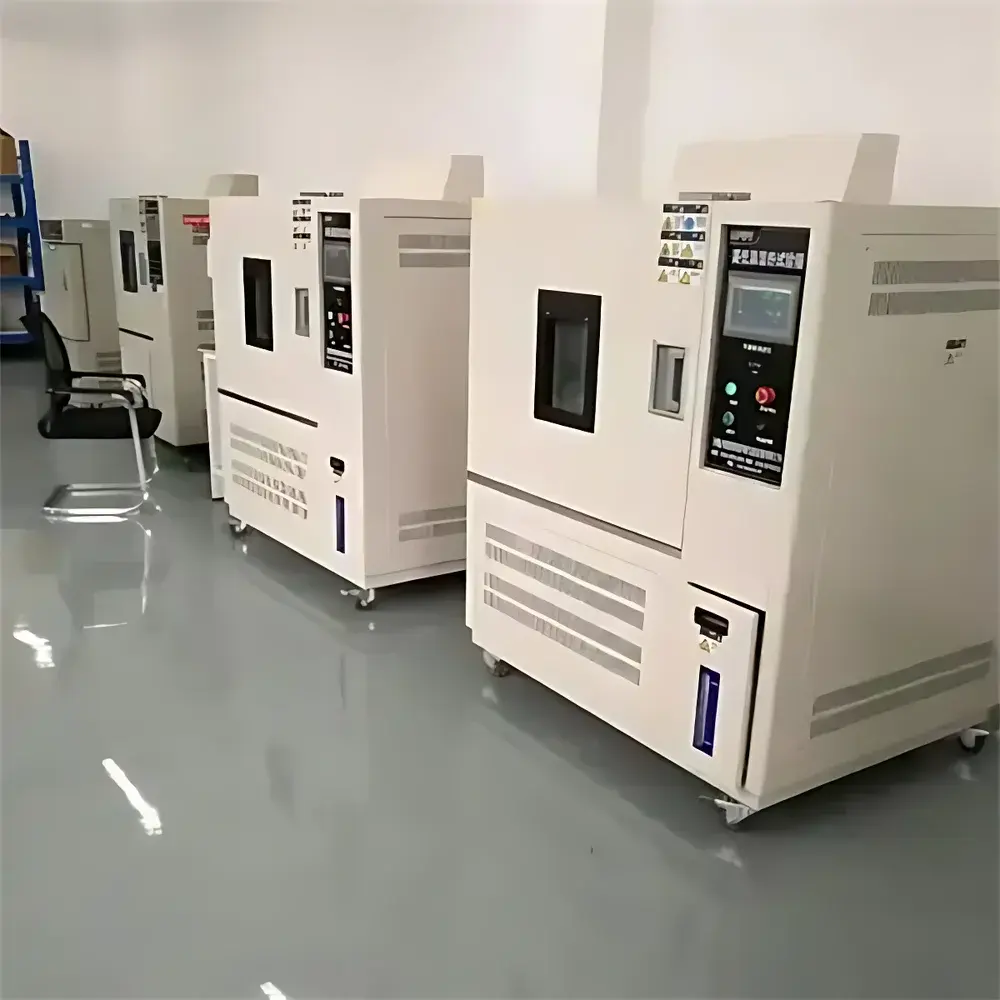
Jianhu JH-TSC Series Three-Zone Thermal Shock Test Chamber
| Brand | Jianhu |
|---|---|
| Origin | Shanghai, China |
| Manufacturer Type | OEM/ODM Manufacturer |
| Product Category | Domestic |
| Model | JH-TSC Series |
| Price Range | USD 170 – 1,700 |
| High-Temperature Range (°C) | +150 |
| Low-Temperature Range (°C) | -70 |
| Thermal Shock Range (°C) | -70 to +150 |
| Temperature Stability (°C) | ±0.5 |
| Ramp-Up Rate (°C/min) | ≥10 |
| Ramp-Down Rate (°C/min) | ≥10 |
Overview
The Jianhu JH-TSC Series Three-Zone Thermal Shock Test Chamber is an engineered solution for accelerated reliability validation of electronic components, automotive ECUs, sensors, and aerospace subsystems under extreme transient thermal stress. Based on the three-chamber (hot / cold / test) architecture, it eliminates mechanical movement of test specimens—reducing thermal inertia and enabling precise, repeatable shock transitions between extremes. The system operates on the principle of rapid air transfer via high-efficiency pneumatic actuators and optimized airflow ducting, delivering true step-change thermal profiles compliant with MIL-STD-810H Method 503.5, IEC 60068-2-14, and ISO 16750-4. Unlike single- or dual-zone chambers, the JH-TSC design ensures zero thermal carryover between zones, eliminating hysteresis-induced measurement drift during repeated cycling—a critical requirement for automotive-grade AEC-Q200 qualification testing.
Key Features
- Triple independent chamber architecture (hot zone: +150°C; cold zone: -70°C; test zone: ambient to ±0.3°C control stability)
- Dual-stage semi-hermetic scroll compressors with economizer circuits—enabling stable operation at -70°C with ≤3% energy penalty vs. single-stage systems
- Tri-redundant temperature sensing: Pt100 RTD (primary), Type T thermocouple (backup), and non-contact infrared surface sensor (validation)—all independently calibrated per ISO/IEC 17025
- CFD-optimized airflow system with honeycomb diffusers and laminar flow guides—achieving ≤±1.0°C uniformity (empty) and ≤±1.8°C (60% load) per ISO 16750-4 Annex B
- Real-time dynamic accuracy monitoring: 1 Hz data logging of zone temperatures during ramp phases; ±1.0°C max deviation over full transition (e.g., +150°C → -70°C in ≤15 min)
- Stainless steel 316L inner chamber with PTFE-coated surfaces—validated for >1,000 hr salt fog exposure (ASTM B117) without corrosion
Sample Compatibility & Compliance
The JH-TSC accommodates test specimens up to 500 mm × 500 mm × 500 mm (W×D×H) with configurable mounting fixtures for PCBs, connectors, modules, and encapsulated assemblies. Its design satisfies functional safety and traceability requirements for GMP/GLP environments: full audit trail logging (user actions, parameter changes, alarms), electronic signature support per FDA 21 CFR Part 11, and calibration certificate traceability to NIM (China National Institute of Metrology). All thermal profiles are programmable per GJB 150.5A (military), ISO 16750-4 (automotive), and JEDEC JESD22-A104F (semiconductor). Humidity control is not integrated—ensuring unambiguous thermal-only stress isolation; optional desiccant-based dew point suppression (< -50°C) available for low-RH cold-phase operation.
Software & Data Management
Equipped with Jianhu’s proprietary TSC-Link™ control software (v4.2), the chamber supports multi-level user authentication, SOP-driven test sequencing, and real-time SPC charting (X̄/R, Cpk, trend analysis). Data export formats include CSV, XML, and PDF reports compliant with ISO/IEC 17025 documentation standards. Ethernet and USB 3.0 interfaces enable seamless integration into lab-wide MES/LIMS platforms. Remote monitoring is supported via secure TLS 1.2–encrypted web interface; push notifications trigger on alarm events (e.g., temperature deviation > ±1.2°C for >30 s). Firmware updates preserve historical calibration records and maintain full 21 CFR Part 11 compliance—including immutable event logs with timestamp, operator ID, and digital signature.
Applications
The JH-TSC Series is deployed in Tier-1 automotive R&D labs for AEC-Q200 stress screening of ADAS radar modules, battery management ICs, and powertrain controllers. It is also used in semiconductor packaging qualification (JEDEC J-STD-020), photonics device burn-in (fiber optic transceivers), and aerospace avionics HALT pre-screening. Typical use cases include: solder joint fatigue assessment under 1,000-cycle -40°C ↔ +125°C profiles; thermal expansion coefficient mismatch evaluation of heterogeneous substrates; and validation of hermetic seal integrity in MEMS pressure sensors. Its dynamic precision enables detection of sub-50 µm intermetallic growth at solder interfaces—correlating directly with field-failure modes observed in engine bay deployments.
FAQ
What distinguishes three-zone thermal shock from two-zone systems?
Three-zone architecture eliminates specimen movement and thermal mass interference, delivering faster transition times, superior repeatability (<0.8% CV across 100 cycles), and no warm-up/cool-down contamination between zones.
Is calibration certification included with shipment?
Yes—each unit ships with a factory calibration report traceable to NIM, covering all temperature zones at three setpoints (-70°C, 25°C, +150°C), including stability, uniformity, and ramp rate verification.
Can the chamber be validated for ISO 17025-compliant testing labs?
Absolutely—the system meets ISO/IEC 17025:2017 clause 6.4.10 (equipment verification) and supports uncertainty budgeting per GUM (JCGM 100:2008) when paired with accredited external thermocouple calibrators.
What maintenance intervals are recommended for long-term reliability?
Compressor oil and filter replacement every 3,000 operating hours; annual full airflow path inspection and RTD recalibration; biannual verification of actuator timing and door seal integrity per ASTM E2877.
Does the system support custom profile scripting beyond standard ramps?
Yes—TSC-Link™ supports user-defined time-temperature-hold sequences with conditional branching (e.g., “if temp deviation > ±0.7°C, pause and re-equilibrate”), enabling complex mission-profile emulation such as ISO 16750-4 Annex D driving cycles.
Related Products



