
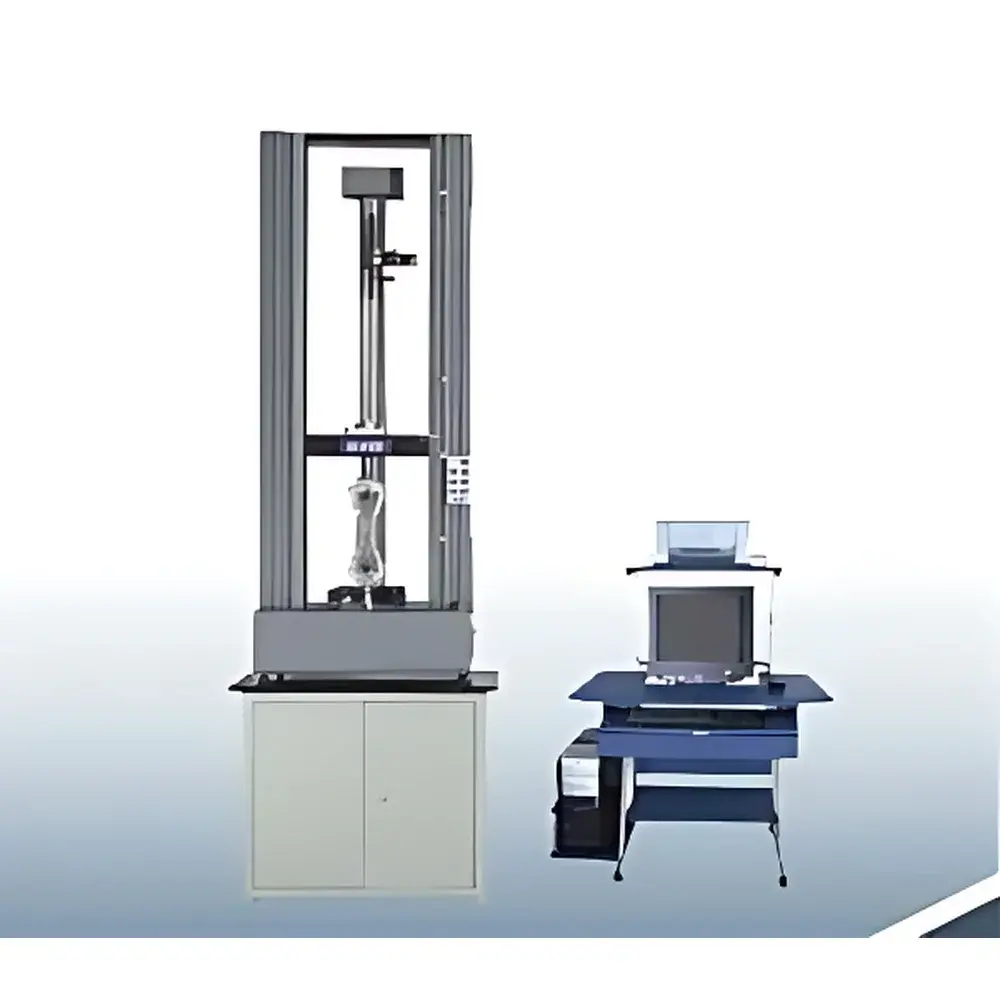
Jianhu DV-10T Advanced Universal Testing Machine
| Brand | Jianhu |
|---|---|
| Origin | Shanghai, China |
| Instrument Type | Electromechanical Universal Testing Machine |
| Max Load Capacity | 10 ton (US) |
| Load Cell Options | 5–10,000 kg (auto-ranging, resolution 1:200,000) |
| Test Speed Range | 0.00005–1000 mm/min (programmable, multi-step & continuous) |
| Crosshead Travel | ~1000 mm |
| Test Width | ~380 mm |
| Displacement Resolution | 0.005 mm (Japan-made encoder, 1000 P/R) |
| Load Accuracy | ±1% FS |
| Control System | Windows-based Trapezium software with full PC integration |
| Safety Features | Upper/lower travel limit switches, automatic stop at break point |
| Power Supply | AC 220 V, 50 Hz |
| Dimensions (L×W×H) | Main unit 88×48×215 cm |
| Weight | ~480 kg |
| Compliance | ASTM E4, ASTM E8, ISO 6892-1, ISO 178, ISO 14129, GB/T 228.1, GB/T 1449, GB/T 17657 |
| Software Capabilities | Real-time force–displacement curve plotting, multi-curve overlay analysis, customizable report generation, GLP-compliant audit trail (optional), user-defined test protocols, batch data management |
Overview
The Jianhu DV-10T Advanced Universal Testing Machine is a high-stiffness, electromechanical universal testing system engineered for precision mechanical characterization of structural and functional materials across research, quality control, and production environments. It operates on the fundamental principle of controlled uniaxial force application—measuring load response via calibrated strain-gauge load cells and displacement via high-resolution optical encoders—while maintaining strict compliance with internationally recognized static mechanical testing standards including ASTM E4 (load verification), ASTM E8/E21 (tensile testing of metals), ISO 6892-1 (metallic materials tensile testing), ISO 178 (flexural properties of plastics), and ISO 14129 (shear properties of fiber-reinforced composites). Its rigid C-frame architecture, coupled with a Japanese-sourced AC servo motor and planetary gear reducer, ensures minimal frame deflection (<0.02 mm under full 10-ton load) and exceptional force linearity across the entire dynamic range. The system supports both closed-loop displacement and load control modes, enabling accurate capture of elastic modulus, yield strength, ultimate tensile strength, fracture elongation, flexural modulus, and compressive yield behavior in a single platform.
Key Features
- High-precision dual-range load measurement: Interchangeable load cells from 5 kg to 10,000 kg (10 ton US), auto-ranging with 200,000-count internal resolution and ±1% full-scale accuracy per ASTM E4 calibration protocol.
- Ultra-wide speed capability: Programmable test speeds from 0.00005 mm/min (creep/stress-relaxation studies) up to 1000 mm/min (impact simulation), with selectable fixed-speed steps (10, 20, 50, 100, 200, 250, 300 mm/min) and fully variable continuous control.
- Real-time synchronized data acquisition: 1.25 ms sampling interval enables precise capture of transient mechanical events—including crack initiation, yielding onset, and brittle fracture—without signal aliasing.
- Modular fixture interface: Standard T-slot crosshead and base plate accommodate custom-designed grips and fixtures; one set of application-specific fixtures provided free of charge per order.
- Integrated safety architecture: Dual mechanical limit switches, emergency stop circuitry, overload cut-off, and programmable break-point termination ensure operator and specimen protection in accordance with ISO 13857 and EN 61508 functional safety guidelines.
- Human-centered industrial design: Floor-standing configuration with ergonomically optimized control panel height, powder-coated steel enclosure, and vibration-damped base structure compliant with ISO 2041 (vibration terminology) and ISO 5347 (vibration transducer mounting).
Sample Compatibility & Compliance
The DV-10T accommodates a broad spectrum of specimen geometries and material classes, including metallic alloys (rods, sheets, welds), polymer composites (FRP laminates, thermoset panels), wood-based panels (plywood, MDF, particleboard per GB/T 17657 and EN 310), elastomers, textiles, adhesives, packaging films, and biomedical polymers. Its 380 mm test width and 1000 mm vertical stroke enable evaluation of full-size structural components such as door cores, insulation boards, and automotive trim modules. All mechanical test procedures align with regulatory frameworks applicable to certified laboratories: ASTM International standards for metals and polymers; ISO series for international harmonization; Chinese national standards (GB/T) for domestic certification and inspection; and EN standards for CE-marked construction products. Optional GLP/GMP audit trail logging and 21 CFR Part 11-compliant electronic signatures are available upon request for pharmaceutical packaging or medical device validation.
Software & Data Management
Control and analysis are executed through Trapezium X—a Windows-based, modular testing software platform developed for metrological integrity and laboratory workflow integration. The interface supports intuitive test method definition (ASTM/ISO templates preloaded), real-time dual-axis plotting (force vs. displacement, stress vs. strain), multi-curve statistical overlay with confidence band visualization, and automated calculation of mechanical parameters per standard equations. Raw data export is supported in CSV, XML, and proprietary .TRZ formats; reports are fully customizable using Microsoft Word–compatible templates and may include company logos, QA stamps, and digital signatures. The software maintains a tamper-evident audit trail of all user actions, parameter changes, and calibration events—essential for ISO/IEC 17025-accredited labs. Data archiving complies with ICH M7 and FDA guidance on electronic records retention.
Applications
This system serves as a primary mechanical characterization tool in accredited materials testing laboratories, university research centers, and industrial QC departments. Typical use cases include tensile testing of aerospace aluminum alloys per AMS 4027; flexural evaluation of marine-grade plywood per EN 310; peel strength assessment of pressure-sensitive adhesives per ASTM D903; compression testing of thermal insulation boards per ASTM C365; shear strength determination of bonded joints in automotive composites per ISO 14129; and cyclic fatigue pre-screening of orthopedic implant polymers per ISO 14801. Its versatility extends to failure mode analysis in R&D settings—enabling correlation between microstructural features (e.g., fiber orientation, interfacial debonding) and macroscopic mechanical response.
FAQ
What standards does the DV-10T support out-of-the-box?
Preconfigured test methods include ASTM E8, ASTM D638, ISO 6892-1, ISO 527, ISO 178, ISO 14129, GB/T 228.1, GB/T 1449, and GB/T 17657—with additional standards deployable via software update.
Can the system be integrated into an existing LIMS or MES environment?
Yes—Trapezium X supports OPC UA and TCP/IP-based data exchange; API documentation and HL7/FHIR adapters are available for enterprise-level integration.
Is third-party calibration certification included?
A NIST-traceable calibration certificate (per ISO/IEC 17025) is provided with initial delivery; annual recalibration services are offered with documented uncertainty budgets.
What is the warranty coverage and service response time?
Standard coverage includes 12 months parts-and-labor warranty; extended service contracts provide 4-hour remote diagnostics and 72-hour on-site technician dispatch for critical failures.
Are environmental test chamber options available?
Yes—integrated temperature chambers (−70°C to +300°C) and humidity-controlled enclosures (10–95% RH) can be mounted directly onto the frame with synchronized environmental feedback control.



