
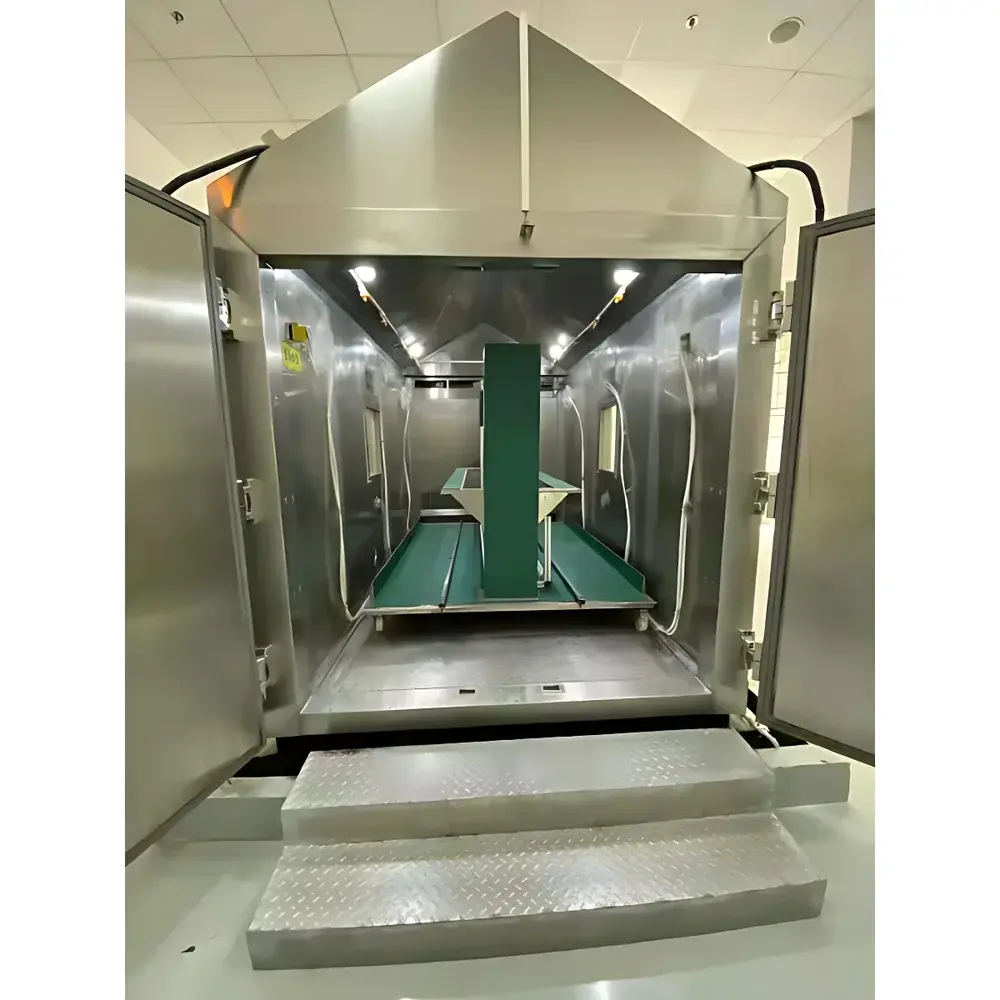
JianHu JH-Series High-Precision Walk-In Salt Spray Test Chamber
| Brand | JianHu |
|---|---|
| Origin | Shanghai, China |
| Model | JH-Series Walk-In Salt Spray Test Chamber |
| Spray Method | Continuous Atomization |
| Fog Output | 1–2 mL / 80 cm²·hr |
| Nozzle Pressure | 0.7–1.0 kg/cm² |
| De-fogging Method | Compressed Air Exhaust System |
| Compliance | ASTM B117, ISO 9227, JIS Z2371, GB/T 2423.17 |
Overview
The JianHu JH-Series High-Precision Walk-In Salt Spray Test Chamber is an engineered environmental test system designed to accelerate corrosion evaluation of metallic substrates, protective coatings, electroplated finishes, and assembled components under controlled saline atmospheric conditions. Based on the fundamental principle of continuous salt fog generation via pneumatic atomization—where a pressurized sodium chloride (NaCl) solution is converted into a stable, uniform aerosol mist—the chamber replicates aggressive marine or industrial coastal environments in accordance with internationally recognized accelerated corrosion standards. Unlike benchtop units, the walk-in configuration enables full-scale testing of large-format specimens—including automotive body panels, aerospace structural assemblies, electronic enclosures, and industrial machinery parts—without disassembly or dimensional compromise. Its thermal-stabilized chamber walls, corrosion-resistant PVC-coated stainless-steel construction, and precision-regulated saturation tower ensure long-term operational stability and measurement repeatability across extended test durations (up to 1,000+ hours). This architecture supports rigorous quality assurance workflows in R&D labs, production QC departments, and third-party certification laboratories requiring GLP-compliant, auditable corrosion performance data.
Key Features
- Walk-in ergonomic design with hinged double-door access and internal lighting for safe, unobstructed sample loading and real-time visual inspection
- Continuous spray mode compliant with ASTM B117 and ISO 9227, delivering consistent fog density (1–2 mL/80 cm²·hr) across the entire test volume
- Pneumatically driven nozzle system operating at 0.7–1.0 kg/cm² pressure, minimizing clogging and enabling stable droplet size distribution (median diameter ≈ 1–3 µm)
- Integrated compressed-air de-fogging mechanism that evacuates residual mist post-test without thermal shock or condensation carryover
- Microprocessor-based PID temperature controller maintaining chamber air temperature within ±1.0°C of setpoint (typically 35°C ± 1°C for neutral salt spray)
- Corrosion-resistant chamber interior: 6 mm PVC-coated SUS316L stainless steel walls, non-metallic support racks, and acid-resistant glass observation window
- Redundant safety interlocks including over-temperature cutoff, low-level reservoir alarm, and emergency power-off circuitry
Sample Compatibility & Compliance
The JH-Series accommodates specimens up to 3,000 mm (L) × 1,500 mm (W) × 1,800 mm (H), supporting full-system validation for automotive modules, solar panel frames, marine hardware, and military-grade connectors. Sample mounting fixtures are configurable to meet ISO 7870-2 orientation requirements (15°–30° from vertical). The system is validated for conformance with ASTM B117 (Neutral Salt Spray), ASTM G85 Annex A5 (Acetic Acid Salt Spray), ISO 9227 (Corrosion tests in artificial atmospheres), and GB/T 2423.17 (Chinese national standard for salt mist testing). Calibration documentation includes NIST-traceable temperature and humidity sensor certificates. All control logs—including spray duration, chamber temperature, and reservoir level—are timestamped and stored locally for FDA 21 CFR Part 11–compatible audit trails when integrated with optional networked data acquisition modules.
Software & Data Management
The embedded 10.1-inch capacitive touchscreen interface runs a deterministic real-time OS with dual-language support (English/Chinese). Users configure multi-step test profiles—including ramp-hold cycles, intermittent spray sequences, and humidity-modulated variants—via intuitive drag-and-drop logic. All operational parameters (temperature, spray status, elapsed time, fault codes) are logged at 10-second intervals and exportable in CSV or PDF format via USB 3.0 or Ethernet. Optional cloud connectivity enables remote monitoring through secure TLS-encrypted REST APIs, with role-based user access control aligned with ISO/IEC 27001 information security frameworks. Historical datasets integrate natively with LIMS platforms (e.g., LabWare, Thermo Fisher SampleManager) and support automated report generation per ISO/IEC 17025 accreditation requirements.
Applications
- Automotive OEMs validating zinc-nickel plating adhesion on brake calipers and chassis components
- Aerospace suppliers verifying chromate conversion coating integrity on aluminum 7075-T6 fasteners
- Electronics manufacturers assessing conformal coating resistance on PCBAs exposed to coastal humidity
- Medical device firms qualifying stainless-steel surgical instrument passivation per ASTM F86 and ISO 10993-15
- Renewable energy labs testing anti-corrosion performance of galvanized steel support structures for offshore wind turbines
- Academic research groups studying electrochemical degradation kinetics of Mg-alloy biomedical implants
FAQ
What standards does the JH-Series chamber comply with?
ASTM B117, ISO 9227, JIS Z2371, GB/T 2423.17, and DIN 50021.
Can the chamber operate in cyclic corrosion test (CCT) modes?
Yes—when equipped with optional humidity and drying modules, it supports ASTM D6899 and VDA 621-415 protocols.
Is calibration traceability provided with delivery?
Each unit ships with factory calibration certificates for temperature and spray rate sensors, traceable to CNAS-accredited laboratories.
What maintenance intervals are recommended?
Daily visual inspection of nozzles and saturation tower; monthly cleaning of PVC-coated surfaces with deionized water; annual verification of pressure regulators and PID tuning parameters.
Does the system support remote diagnostics?
Yes—integrated Modbus TCP and SNMP interfaces allow integration with facility-wide building management systems (BMS) and predictive maintenance platforms.



