
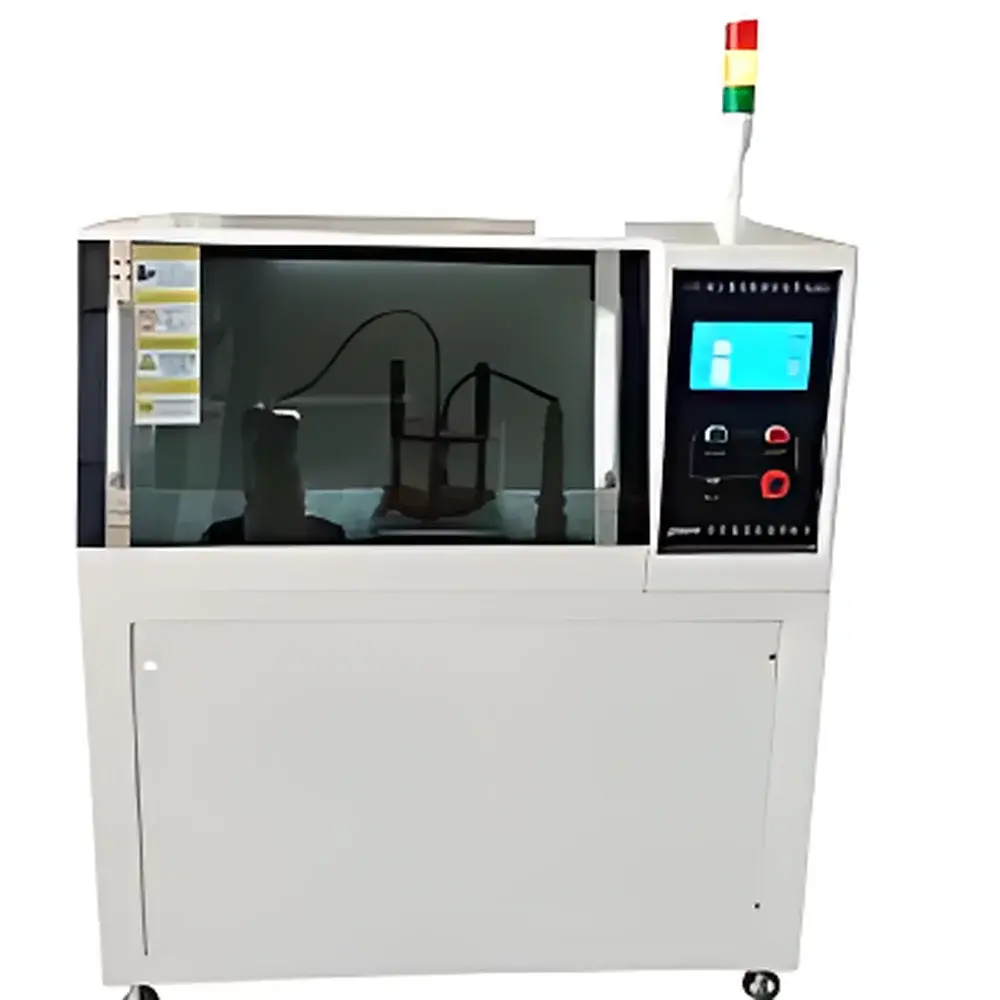
Jianhu JH Series Electrical Performance Tester — Dielectric Strength, Surface Resistivity & Permittivity Analyzer
| Brand | Jianhu |
|---|---|
| Origin | Shanghai, China |
| Manufacturer Type | Authorized Distributor |
| Product Category | Domestic Instrumentation |
| Model | JH-Dielectric Strength & Resistivity Analyzer |
| Price Range | USD 650 – 65,000 |
Overview
The Jianhu JH Series Electrical Performance Tester is an integrated benchtop instrumentation platform engineered for precise measurement of three fundamental electrical properties of insulating and semiconducting materials: dielectric breakdown strength (per ASTM D149 and IEC 60243), surface resistivity (per ASTM D257 and IEC 60093), and complex permittivity (dielectric constant ε′ and loss factor ε″). Unlike modular single-function testers, the JH platform consolidates high-voltage DC/AC withstand testing, guarded four-terminal resistivity measurement, and frequency-swept impedance analysis into a unified hardware architecture with shared calibration traceability and synchronized data acquisition. The system employs a digitally controlled high-voltage generator (0–20 kV DC/peak AC, ±1% accuracy), a microprocessor-driven electrometer with guarded input stage (10³–10¹⁸ Ω range), and a vector network analyzer-compatible RF module (100 Hz–1 GHz) operating under fixed-geometry parallel-plate or coaxial fixture configurations. All measurements conform to internationally recognized test methodologies and are designed to support GLP-compliant reporting workflows.
Key Features
- Triple-mode operation: Simultaneous or sequential execution of dielectric breakdown, surface resistivity, and permittivity tests without hardware reconfiguration
- Digital high-voltage source with programmable ramp rate (0.1–5 kV/s), dwell time control, and automatic arc detection and shutdown
- Four-electrode surface resistivity measurement using concentric ring electrodes per ASTM D257, eliminating contact resistance artifacts
- Integrated RF impedance analyzer with calibrated S-parameter extraction for ε′ and ε″ calculation via Nicholson–Ross or Cole–Cole models
- Embedded real-time data logging with timestamped voltage, current, resistance, capacitance, and phase angle records
- Front-panel touchscreen interface with preloaded test templates for plastics, ceramics, elastomers, thin films, and laminates
- Hardware-level safety interlocks including door-switch monitoring, ground-fault detection, overcurrent cutoff, and HV discharge timer
- CE-marked enclosure with reinforced insulation barriers and dual-redundant emergency stop circuitry
Sample Compatibility & Compliance
The JH analyzer accommodates solid sheet, film, and molded specimens (thickness: 0.1–25 mm; max. dimension: 150 × 150 mm) as well as liquid samples in standardized cup electrodes. It supports standard electrode geometries defined in ASTM D149 (disk electrodes), ASTM D257 (guarded electrode assembly), and ASTM D150 (parallel-plate fixtures). All test protocols align with ISO/IEC 17025 laboratory accreditation requirements. Software-generated reports include full metadata—operator ID, environmental conditions (temperature/humidity logged via optional sensor input), calibration certificate IDs, and instrument serial numbers—to satisfy FDA 21 CFR Part 11 electronic record integrity criteria. Traceable calibration is performed against NIST-traceable high-voltage dividers and precision resistors, with annual recalibration intervals recommended.
Software & Data Management
The proprietary Jianhu TestSuite v3.2 software runs on Windows OS and provides role-based user accounts with configurable access levels (operator, supervisor, administrator). It enables method creation with parameter constraints (e.g., max voltage limits per material class), automated pass/fail evaluation against user-defined thresholds, and statistical process control (SPC) charting (X-bar/R, Cpk). Raw data exports to CSV, XML, and PDF formats include embedded digital signatures and audit trails compliant with ALCOA+ principles (Attributable, Legible, Contemporaneous, Original, Accurate, Complete, Consistent, Enduring, Available). Optional integration with LIMS platforms is supported via HL7 and ASTM E1384 interfaces. Firmware updates are delivered via secure HTTPS channel with SHA-256 signature verification.
Applications
- Quality assurance of polymer insulators used in high-voltage cable jackets, transformer bushings, and PCB substrates
- R&D screening of dielectric nanocomposites for capacitive energy storage and RF shielding applications
- Validation of anti-static packaging materials per ANSI/ESD S20.20 requirements
- Characterization of ferroelectric thin films in MEMS actuators and non-volatile memory devices
- Regulatory submission support for UL 746C, IEC 60674-2, and MIL-STD-202G electrical insulation testing
- Academic research in condensed matter physics laboratories studying dipole relaxation dynamics and space charge accumulation
FAQ
Does the JH system comply with ASTM D149 for dielectric breakdown testing?
Yes—the high-voltage section meets all mechanical, electrical, and procedural requirements specified in ASTM D149-20, including electrode geometry tolerances, voltage rise rate control, and failure detection sensitivity.
Can surface resistivity be measured on curved or irregular surfaces?
No—the standard guarded electrode configuration requires flat, parallel surfaces. For non-planar samples, users must prepare representative flat coupons or use alternative probe-based methods not supported by this platform.
Is firmware validation documentation available for GxP environments?
Yes—validation protocols (IQ/OQ/PQ), risk assessments, and traceability matrices are provided upon request for regulated pharmaceutical and medical device customers.
What is the minimum sample thickness required for permittivity measurement at 1 GHz?
For reliable ε′ extraction at 1 GHz using the standard parallel-plate fixture, minimum thickness is 0.5 mm to avoid fringing field dominance and ensure quasi-static field distribution.
Does the system support external environmental chamber integration?
Yes—via analog voltage inputs (0–10 V) and digital I/O triggers, enabling synchronized testing under controlled temperature/humidity per ASTM D150 Annex A4.



