
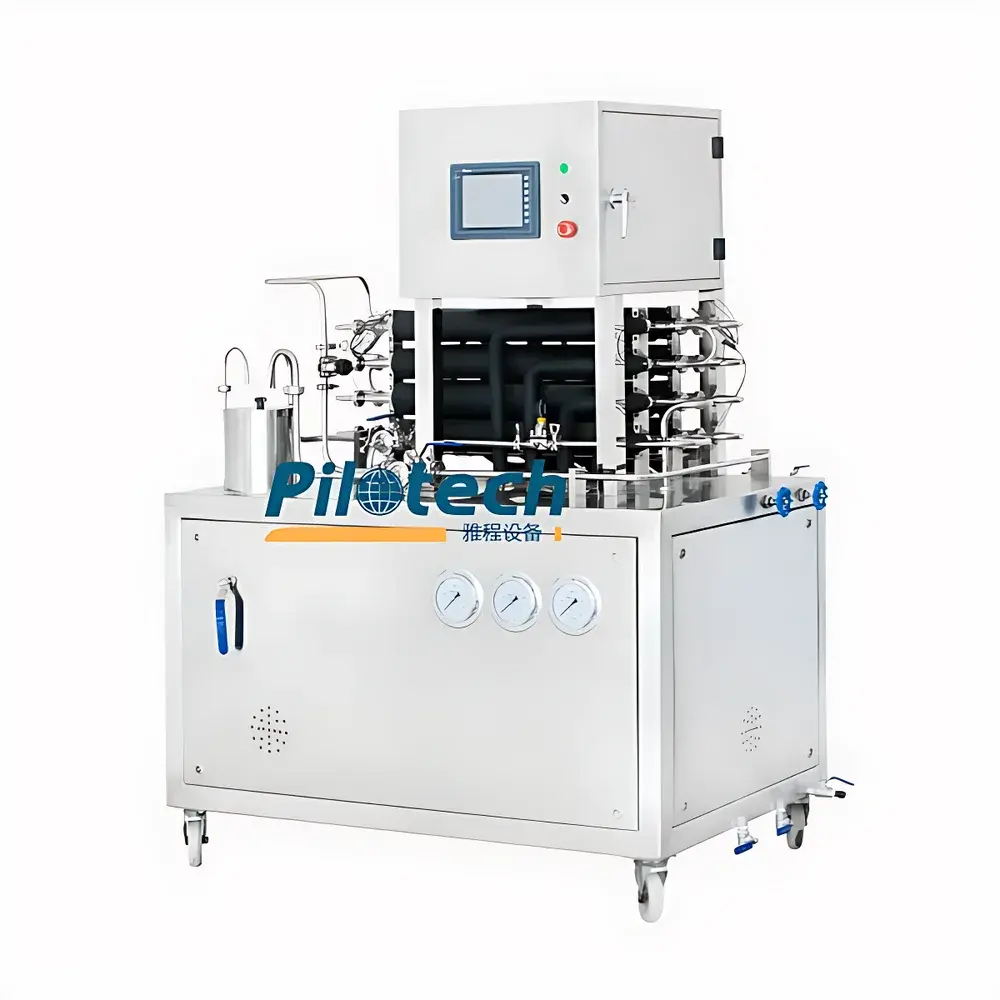
YaCheng YC-02 Miniature Laboratory Ultra-High Temperature (UHT) Sterilizer
| Brand | YaCheng / PILOTECH |
|---|---|
| Origin | Shanghai, China |
| Manufacturer Type | Direct Manufacturer |
| Model | YC-02 |
| Rated Capacity | 20–25 L/h (adjustable flow: 5–50 L/h) |
| Minimum Sample Volume | 3–5 L |
| Sterilization Temperature Range | Up to 150 °C |
| Temperature Control Accuracy | ±1 °C (PID-controlled) |
| Sterilization Hold Time | 5–300 s (standard: 5 s, 10 s |
| optional | 30 s, 300 s) |
| System Pressure | 5 bar |
| CIP Flow Rate | 400 L/h |
| Product Transfer Flow Rate | 5–25 L/h |
| Heating Method | Integrated electric overheated water generator with dual high-temp circulating pumps |
| Cooling | Dual-tube preheating sections + single-tube cooling section (tap-water cooled to near ambient) |
| Construction Material | Full 316L stainless steel |
| Compliance Features | Built-in SIP capability, online CIP, back-pressure control valves (imported diaphragm type), tri-way diverting valve, pressure sensors with real-time HMI display |
| Control System | PLC-based, color TFT touchscreen interface with animated process visualization, USB data export (Excel-compatible), print-ready output |
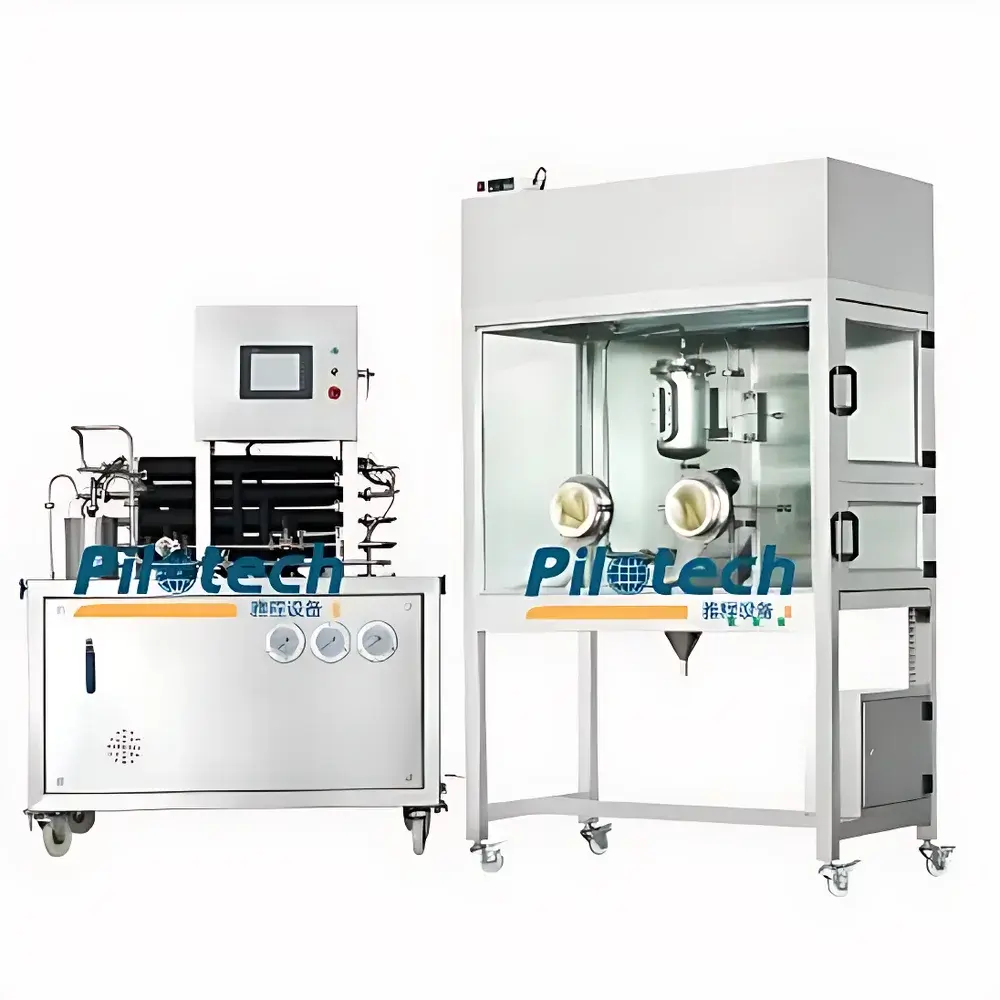
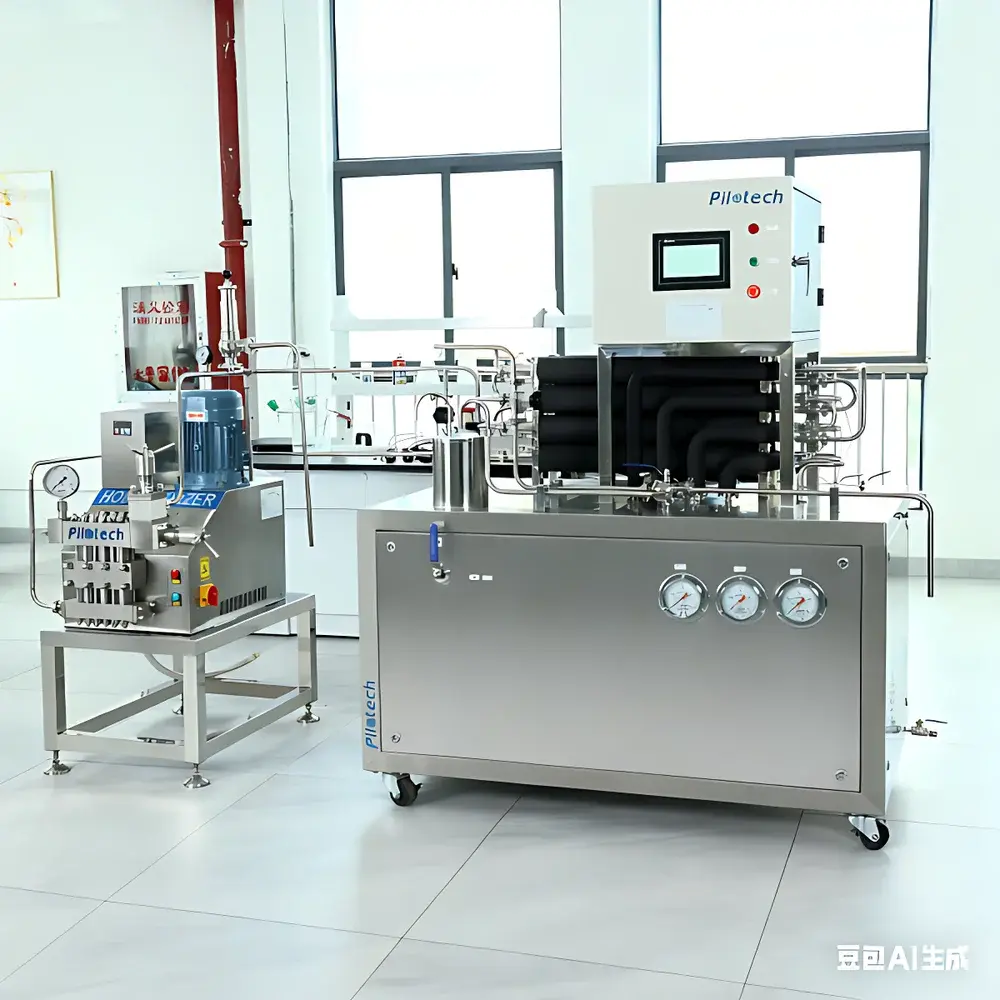
| Optional Add-ons | Homogenizer integration, sterile filling chamber (10 L jacketed buffer tank with single-head aseptic filler) |
Overview
The YaCheng YC-02 Miniature Laboratory Ultra-High Temperature (UHT) Sterilizer is a fully self-contained, pilot-scale thermal processing system engineered for rigorous R&D in food science, dairy technology, beverage formulation, and flavor & fragrance development. Unlike conventional benchtop sterilizers, the YC-02 replicates industrial UHT processing conditions—including precise time-temperature-integration (TTI), controlled back-pressure management, and continuous flow dynamics—enabling direct scalability of experimental protocols to commercial production lines. Its core operating principle relies on indirect heating via pressurized overheated water circulated through double-tube heat exchangers, ensuring uniform thermal treatment without localized hot spots or product degradation. The system complies with fundamental thermal process validation requirements outlined in FDA Guidance for Industry (2017), ISO 11133:2014 (microbiological media preparation), and relevant sections of Codex Alimentarius CAC/RCP 51-2003 for UHT-treated products.
Key Features
- PLC-controlled automation with intuitive color TFT touchscreen HMI, supporting both manual operation and PC-linked monitoring via USB interface
- Dual operational modes—“Rapid Mode” for screening trials and “Standard Mode” for validated thermal process studies—with animated real-time flow visualization
- Integrated SIS (Sterilization-In-Place) and online CIP (Clean-In-Place) architecture compliant with ASME BPE-2022 hygienic design standards
- German-made NETZSCH (formerly SEEPEX) hygienic screw pump certified to EHEDG Doc. 8 and 3-A Sanitary Standards #74-01, featuring self-cleaning capability and full traceability during cleaning cycles
- PID-regulated temperature control across the entire thermal profile (preheat → sterilization → cooling), maintaining ±1 °C accuracy at the sterilization zone outlet
- Adjustable hold time from 5 seconds to 300 seconds, programmable in 1-second increments to support kinetic modeling of microbial inactivation (e.g., D-value and z-value determination)
- Real-time pressure monitoring at critical points (inlet, sterilization zone, outlet) via calibrated stainless-steel transducers displayed directly on HMI
- Modular design permitting seamless integration of optional components: high-pressure homogenizer (up to 1500 bar), sterile filling chamber (10 L jacketed buffer tank with single-head aseptic valve), and chilled glycol cooling loop (optional upgrade)
Sample Compatibility & Compliance
The YC-02 accommodates a broad range of liquid matrices—including low- to high-viscosity dairy emulsions, fruit pulps containing suspended particles ≤2 mm, plant-based beverages with fiber content, and heat-sensitive flavor concentrates—without clogging or thermal segregation. Its sanitary 316L stainless-steel wetted path meets FDA 21 CFR Part 110 and EC No. 1935/2004 requirements for food contact surfaces. All fluid-handling components—including tri-way diverting valves, diaphragm back-pressure regulators, and sanitary gaskets—are certified to 3-A Symbol #74-01 and EHEDG EL Class I standards. The system supports GLP-compliant documentation: audit trails for all parameter changes, electronic signatures for method validation, and timestamped Excel-exportable thermal profiles compatible with FDA 21 CFR Part 11 data integrity frameworks.
Software & Data Management
The embedded control software enables full method lifecycle management: creation, versioning, execution, and archival of thermal processing protocols. Each run generates a timestamped .CSV file containing second-by-second records of inlet/outlet temperatures, pressure differentials, flow rates, and PID output signals—all directly importable into Microsoft Excel or statistical analysis platforms (e.g., JMP, Minitab). Experimental data can be exported via USB to external storage or printed locally using integrated thermal printer support. The system maintains a secure internal database with role-based access control (administrator/operator), supporting IQ/OQ documentation packages required for laboratory accreditation under ISO/IEC 17025:2017.
Applications
- Thermal stability testing of novel probiotic strains, enzymes, and bioactive peptides under UHT conditions
- Accelerated shelf-life studies for aseptically filled dairy alternatives (oat, almond, soy)
- Optimization of sterilization parameters for high-fiber functional beverages while preserving rheological integrity
- Validation of thermal death time (TDT) curves for spore-forming pathogens (e.g., Geobacillus stearothermophilus, Bacillus coagulans) in low-acid liquid foods
- Process mapping for regulatory submissions (e.g., FDA GRAS, EFSA QPS dossiers) requiring empirical thermal history data
- Training platform for food engineering students on continuous-flow heat transfer, residence time distribution (RTD), and F0 calculation methodologies
FAQ
Can the YC-02 be used for non-dairy applications such as plant-based milks or juice blends?
Yes—the system’s wide viscosity tolerance (1–10,000 cP) and particle-handling capability (≤2 mm solids) make it suitable for heterogeneous liquid foods including nut milks, vegetable broths, and pulpy citrus beverages.
Is the sterilization temperature verified independently at the holding tube outlet?
Yes—dual redundant Pt100 RTD sensors are installed at the sterilization zone exit, with real-time deviation alarms triggered if readings diverge by >0.5 °C.
Does the system meet requirements for GMP-compliant pilot-scale manufacturing?
The YC-02 satisfies core GMP Annex 15 (Validation and Qualification) prerequisites for equipment qualification (IQ/OQ/PQ), particularly when configured with optional SIP and sterile filling modules.
What is the minimum volume required to achieve stable thermal equilibrium during a run?
Stable thermal profiling is achieved after processing ≥3 L; however, method development runs may begin at 5 L to ensure representative residence time distribution.
Are calibration certificates provided for onboard sensors?
Factory calibration certificates (traceable to NIST standards) are supplied for all temperature, pressure, and flow sensors, with recommended recalibration intervals aligned to ISO/IEC 17025:2017 guidelines.




