
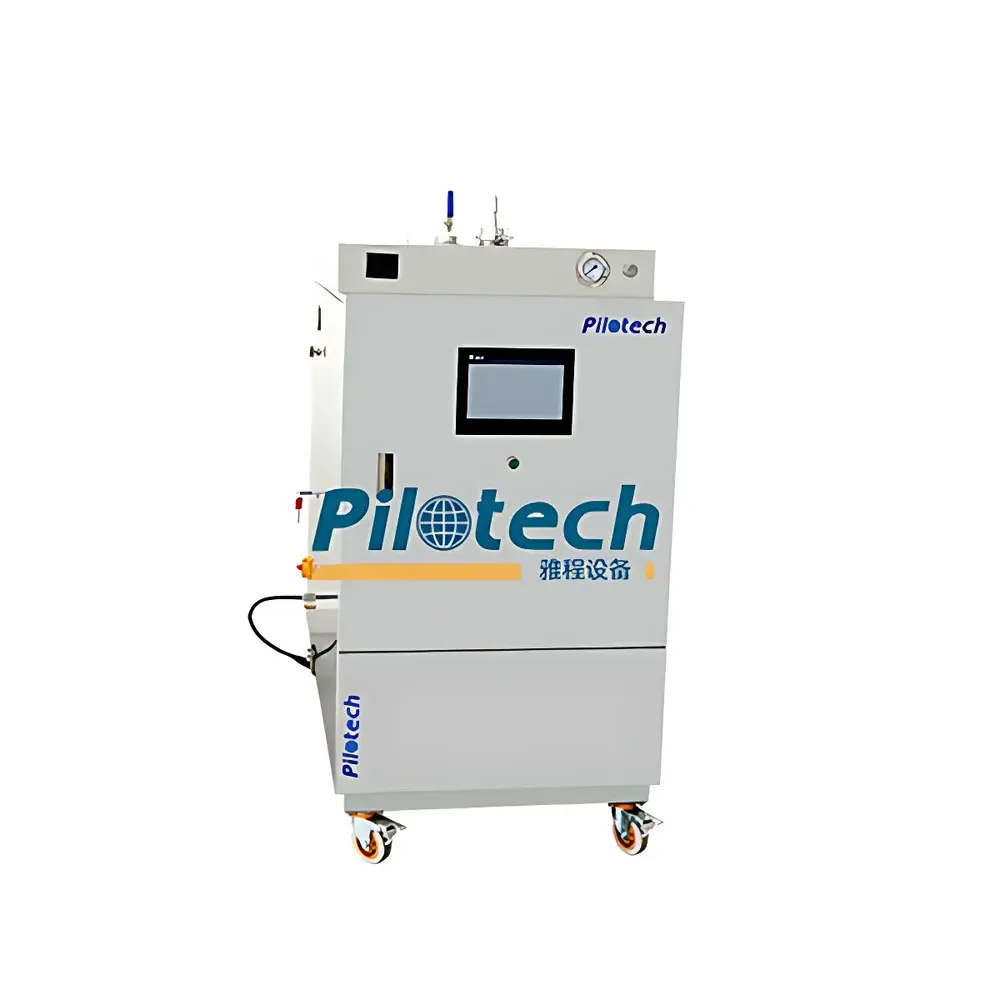
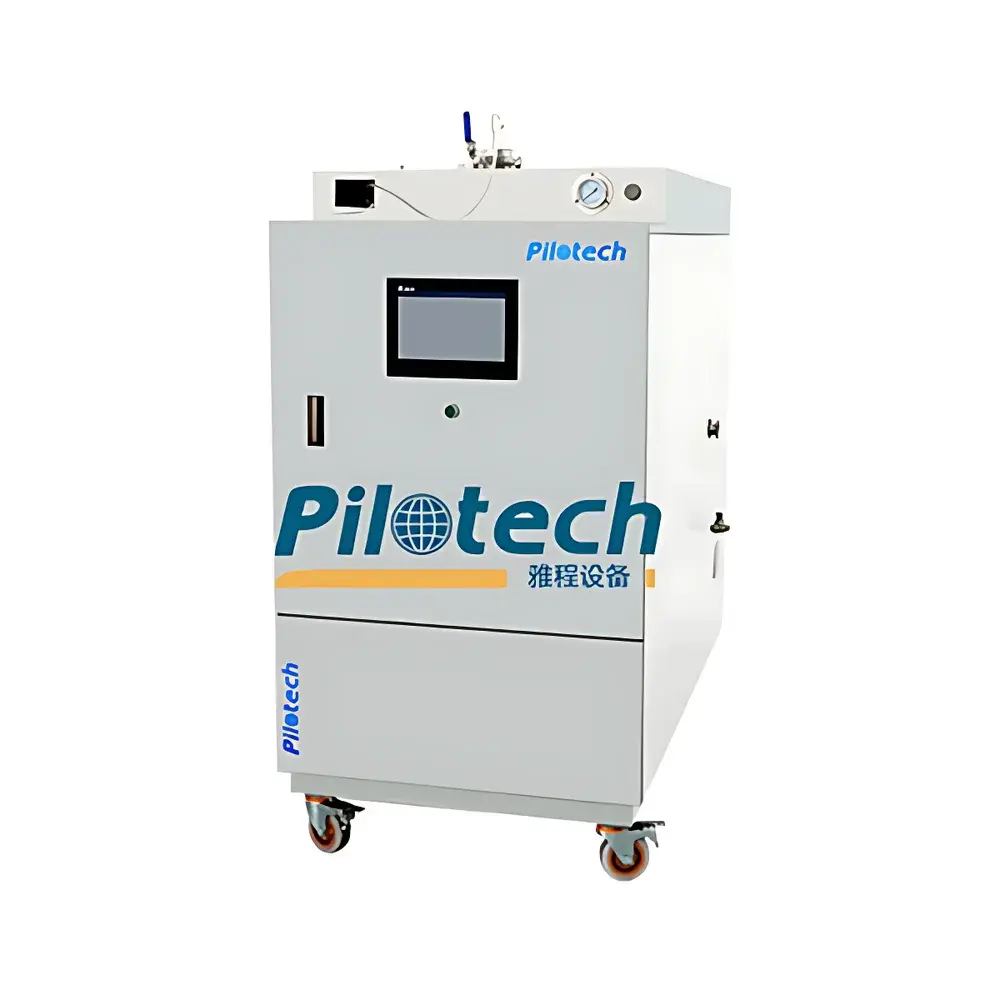
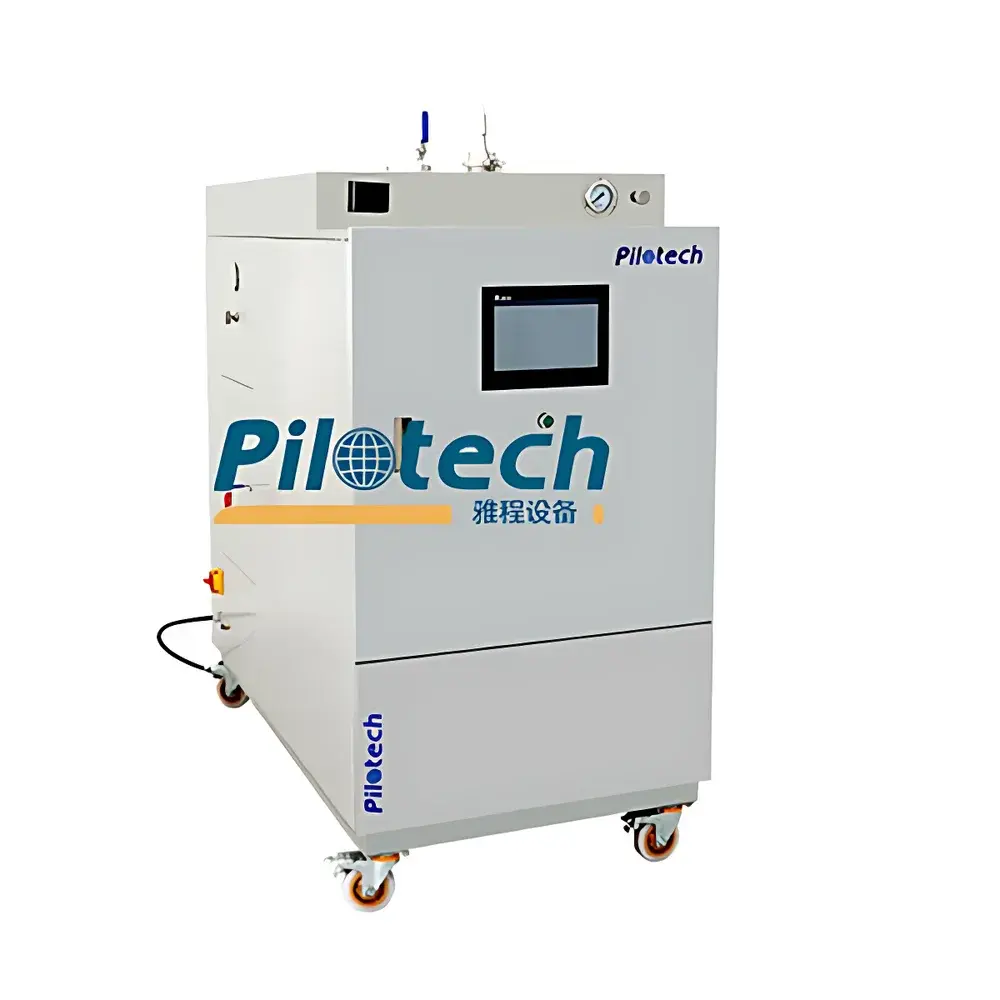
Yacheng YC-01 Laboratory Spray Freeze Dryer
| Brand | Yacheng / PILOTECH |
|---|---|
| Origin | Shanghai, China |
| Manufacturer Type | Direct Manufacturer |
| Product Category | Domestic |
| Model | YC-01 |
| Instrument Type | Benchtop Spray Freeze Dryer |
| Application Scope | R&D and Analytical Laboratories |
| Maximum Batch Capacity | 3 L per cycle |
| Spray Freezing Rate | 300–2500 mL/h |
| Collection Efficiency | ≥98% (based on 15% dextrin solution) |
| Construction Material | SUS304 Stainless Steel |
| Control System | PLC with 10-inch Color Touchscreen |
| Integrated Refrigeration | Built-in Compressor (No External Chiller Required) |
| Power Supply | 220 V AC, 3 kW |
| Heating Method | Radiant Heating with Adjustable Temperature Setpoint |
| Footprint | ~1 m² |
| Vacuum Interface & Compressed Air Inlet | Standard Fitted |
Overview
The Yacheng YC-01 Laboratory Spray Freeze Dryer is an integrated benchtop system engineered for the controlled production of freeze-dried particulates from liquid feedstocks via simultaneous atomization and cryogenic solidification. Unlike conventional lyophilizers—where bulk freezing precedes primary drying—the YC-01 employs a spray-freeze-drying (SFD) principle: liquid samples are pneumatically or peristaltically metered through a precision nozzle into a cryogenic environment (typically liquid nitrogen-cooled zone), where droplets undergo rapid vitrification upon contact with sub-ambient gas streams. This yields discrete, spherical ice particles with high specific surface area, enabling uniform sublimation during subsequent primary drying under vacuum. The process preserves thermolabile structures—including proteins, enzymes, probiotics, and nanosuspensions—without denaturation or aggregation commonly observed in spray drying or conventional freeze drying. Designed for laboratory-scale formulation development, the YC-01 supports method optimization for pharmaceutical, nutraceutical, and biomaterial applications requiring high reconstitution fidelity, low residual moisture (<2%), and narrow particle size distribution.
Key Features
- Integrated cryogenic spray-freeze-drying architecture with built-in refrigeration compressor—eliminates dependency on external chillers or liquid nitrogen dewars during continuous operation.
- PLC-controlled 10-inch color touchscreen interface displaying real-time data: chamber temperature, condenser temperature, vacuum pressure (mbar), spray rate, and radiant heater setpoint.
- Center-aligned spray gun design ensures symmetrical droplet trajectory and uniform ice particle formation within the freezing zone.
- SUS304 stainless steel construction throughout wetted and vacuum-contact surfaces, compliant with ISO 14644-1 Class 7 cleanroom compatibility guidelines.
- Automated product collector with vertical lift mechanism enables full recovery of dried particulates; validated collection efficiency ≥98% using 15% dextrin model solutions.
- Peristaltic feed pump with adjustable flow rate (300–2500 mL/h) coupled to precision nozzles supporting droplet diameters from 20–150 µm—tunable for crystalline vs. amorphous morphology control.
- Radiant heating system with programmable ramp/soak profiles facilitates precise secondary drying without thermal stress to heat-sensitive actives.
Sample Compatibility & Compliance
The YC-01 accommodates aqueous and organic solvent-based solutions, colloidal dispersions, emulsions, and polymer melts—provided viscosity remains below 500 cP at processing temperature. It supports sterile processing when operated inside laminar flow hoods or isolators. All electrical components meet CE and IEC 61000-6-3 EMC standards. Vacuum system complies with ISO 2746 for freeze-drying equipment performance verification. Data logging functionality supports audit trails aligned with GLP and FDA 21 CFR Part 11 requirements when paired with validated software extensions (optional). No hazardous refrigerants are used; the internal compressor utilizes R404A or R507 alternatives compliant with EU F-Gas Regulation Annex I.
Software & Data Management
The embedded HMI logs all operational parameters at user-defined intervals (default: 10 s) to internal flash memory (≥16 GB). Export formats include CSV and PDF reports compatible with LIMS integration. Optional Ethernet/Wi-Fi module enables remote monitoring via secure HTTPS interface and synchronization with enterprise SCADA platforms. Event-driven alarms (e.g., vacuum breach, temperature deviation >±2°C, feed interruption) trigger automatic process halt and timestamped notification. Full calibration history and user access logs are retained for regulatory review.
Applications
- Pharmaceutical R&D: Stabilization of monoclonal antibodies, mRNA-LNPs, and peptide vaccines with enhanced shelf-life and reconstitution kinetics.
- Nutraceuticals: Encapsulation of probiotics, omega-3 oils, and polyphenols into free-flowing, non-hygroscopic powders.
- Materials Science: Synthesis of porous ceramic precursors, MOF nanoparticles, and aerogel templates with controllable pore architecture.
- Academic Research: Fundamental studies of ice nucleation kinetics, solute segregation behavior, and drying-induced phase transitions.
- QC/QA Labs: Reference standard preparation for dissolution testing, content uniformity assays, and stability-indicating methods.
FAQ
What is the maximum sample volume per batch?
The YC-01 supports up to 3 L of liquid feed per complete cycle, with scalable throughput achieved via sequential batches.
Does the system require external cooling infrastructure?
No—integrated refrigeration eliminates need for external chillers, glycol loops, or continuous liquid nitrogen supply.
Can the YC-01 be used for GMP-compliant manufacturing?
It is designed for R&D and pilot-scale development; full GMP validation requires additional IQ/OQ/PQ protocols and optional 21 CFR Part 11 software modules.
What particle size range can be achieved?
Droplet size—and thus final dried particle diameter—is determined by nozzle geometry and feed concentration; typical range is 10–200 µm after drying.
Is the system compatible with organic solvents?
Yes, provided vapor pressure and flash point allow safe operation under vacuum and radiant heating conditions; consult safety documentation prior to use.



