
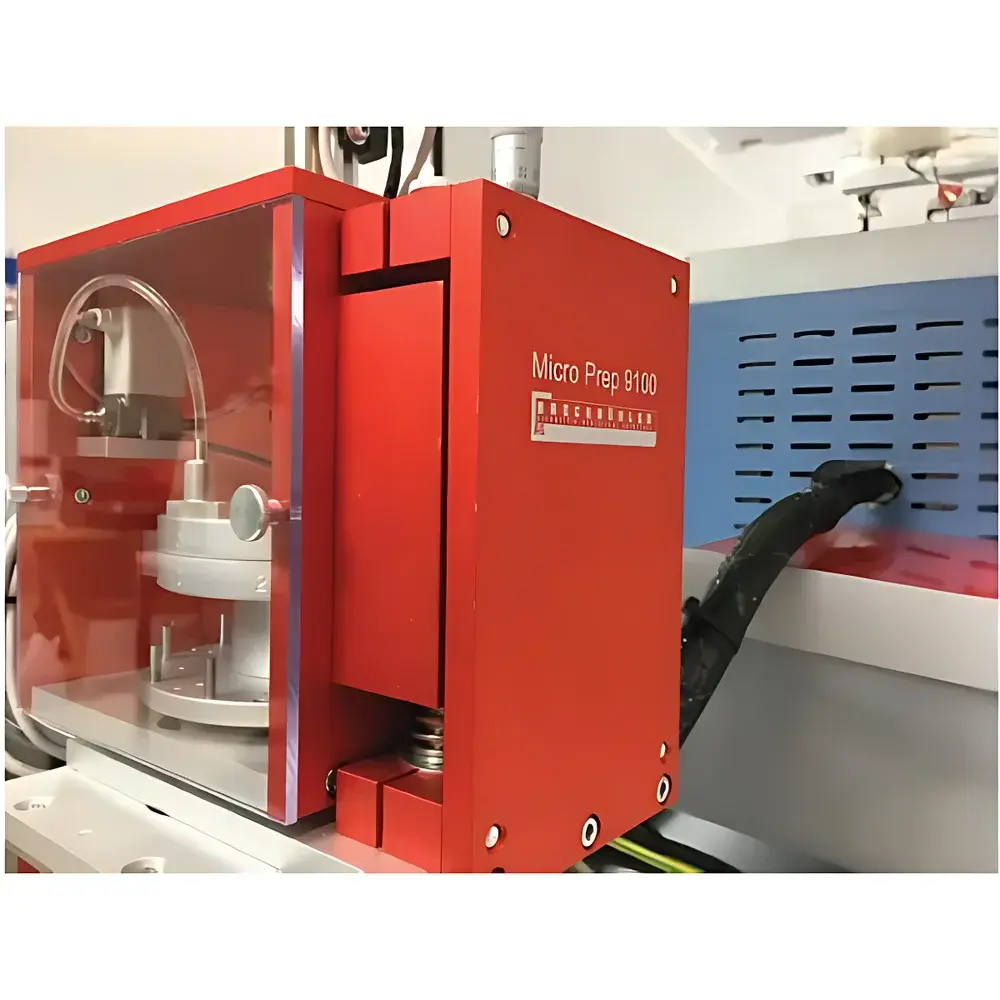
Prep 9100 GC Fraction Collector for Odorant Isolation
| Brand | Brechbühler |
|---|---|
| Origin | Switzerland |
| Model | Prep 9100 |
| Application | Olfactometric Fraction Collection |
| Capacity | 10 adsorption tubes per run |
| Interface | Direct coupling to Sniffer 9100 olfactometer and GC systems |
| Control | PC-based software with pneumatic tube switching |
| Adsorbent | Customized high-affinity sorbent cartridges (e.g., Tenax TA, Carbotrap, or mixed-bed configurations) |
| Compliance | Designed for GLP-compliant odor fractionation workflows |
Overview
The Prep 9100 GC Fraction Collector is a precision-engineered interface system developed by Brechbühler (Switzerland) for targeted isolation of volatile organic compounds (VOCs) and odor-active fractions directly from gas chromatographic effluents. Unlike conventional fraction collectors, the Prep 9100 is purpose-built for sensory-driven chemical analysis — specifically as a preparative extension of the Sniffer 9100 human-olfactometry platform. It operates on the principle of time-resolved, software-synchronized cryo- or ambient-temperature trapping: when an odor-active peak is detected in real time via simultaneous sniffing or electronic nose correlation, the system triggers pneumatic actuation to divert the corresponding GC effluent segment into a dedicated adsorption tube. This enables selective, non-destructive capture of trace-level aroma compounds — even at sub-nanogram concentrations — preserving molecular integrity for downstream structural elucidation.
Key Features
- Direct, leak-tight coupling to both Sniffer 9100 olfactometers and standard GC systems (including Agilent, Thermo Fisher, and Shimadzu platforms) via heated transfer lines and pressure-balanced interfaces.
- Automated 10-position adsorption tube carousel with programmable dwell time, flow rate, and trap temperature profiles — configurable per fraction to accommodate volatility and polarity gradients.
- PC-controlled acquisition logic synchronized with GC retention time windows; supports user-defined trigger thresholds based on FID, MS, or olfactometric response signals.
- Adsorption tubes pre-packed with validated sorbent chemistries (e.g., Tenax TA for mid-to-high volatility compounds, Carbopack B/C for low-boiling aldehydes and sulfur species, or custom mixed beds for broad-spectrum capture).
- Integrated purge-and-trap validation protocol to confirm quantitative recovery prior to elution — essential for quantitative structure–activity relationship (QSAR) studies and reference material generation.
Sample Compatibility & Compliance
The Prep 9100 accommodates headspace, SPME, thermal desorption, and direct-injection GC effluents. It is routinely deployed in laboratories adhering to ISO 11035 (sensory analysis — methodology for establishing analytical sensory profiles), ASTM E679 (standard practice for determining odor and taste thresholds), and EU Regulation (EC) No 1334/2008 (flavoring substances). All hardware materials comply with USP Class VI biocompatibility standards, and the system architecture supports audit trails, electronic signatures, and 21 CFR Part 11–compliant data handling when integrated with validated LIMS or chromatography data systems (CDS).
Software & Data Management
Control and method development are performed via Brechbühler’s proprietary PrepControl software (v3.2+), which provides dual-mode operation: manual fraction triggering (for exploratory sniffing sessions) and automated retention-time–based collection (for reproducible method transfer). Raw collection logs include timestamped GC retention indices, tube IDs, trap durations, carrier gas flow rates, and optional correlation metadata from linked olfactometry or e-nose datasets. Export formats include CSV, XML, and CDF — fully compatible with NMR processing suites (e.g., MestReNova, TopSpin) and mass spectral libraries (NIST, Wiley).
Applications
- Isolation of key odorants from complex matrices (e.g., food volatiles, environmental emissions, cosmetic essences) for structural identification via GC×GC-TOFMS, high-field NMR, or micro-cryo IR spectroscopy.
- Generation of authentic reference standards for quantitative sensory analysis (QSA) and odor threshold determination.
- Deconvolution of co-eluting peaks in chiral or isomeric mixtures where sensory perception diverges despite identical mass spectra.
- Supporting fragrance design pipelines by linking perceptual quality (e.g., “green”, “fruity”, “sulfury”) to molecular scaffolds through iterative fractionation–bioassay loops.
- Method development for regulatory submissions requiring analyte-specific recovery validation (e.g., EFSA flavoring evaluation dossiers).
FAQ
Can the Prep 9100 be used without a Sniffer 9100 olfactometer?
Yes — it supports standalone GC-triggered collection using external TTL pulses or retention-time tables imported from CDS software.
What is the typical recovery yield for trapped odorants?
Recovery exceeds 85% for compounds with log P ≥ 1.5 and boiling points between 50–250 °C, verified via isotopically labeled internal standards and thermal desorption–GC/MS quantitation.
Are adsorption tubes supplied pre-packed and certified?
All tubes are factory-packed under inert atmosphere, individually tested for blank levels (<0.1 pg benzaldehyde equivalent), and supplied with CoA referencing ISO 17025-accredited validation data.
Does the system support method transfer between labs?
Yes — method files include full instrument configuration metadata, enabling cross-platform replication on any GC system equipped with standard analog/digital I/O and compatible carrier gas control.
Is remote monitoring or integration with laboratory automation systems possible?
The Prep 9100 features Ethernet and RS-232 ports; OPC UA and Modbus TCP drivers are available for integration into centralized lab automation frameworks (e.g., Siemens Desigo, LabVantage).
Related Products






