
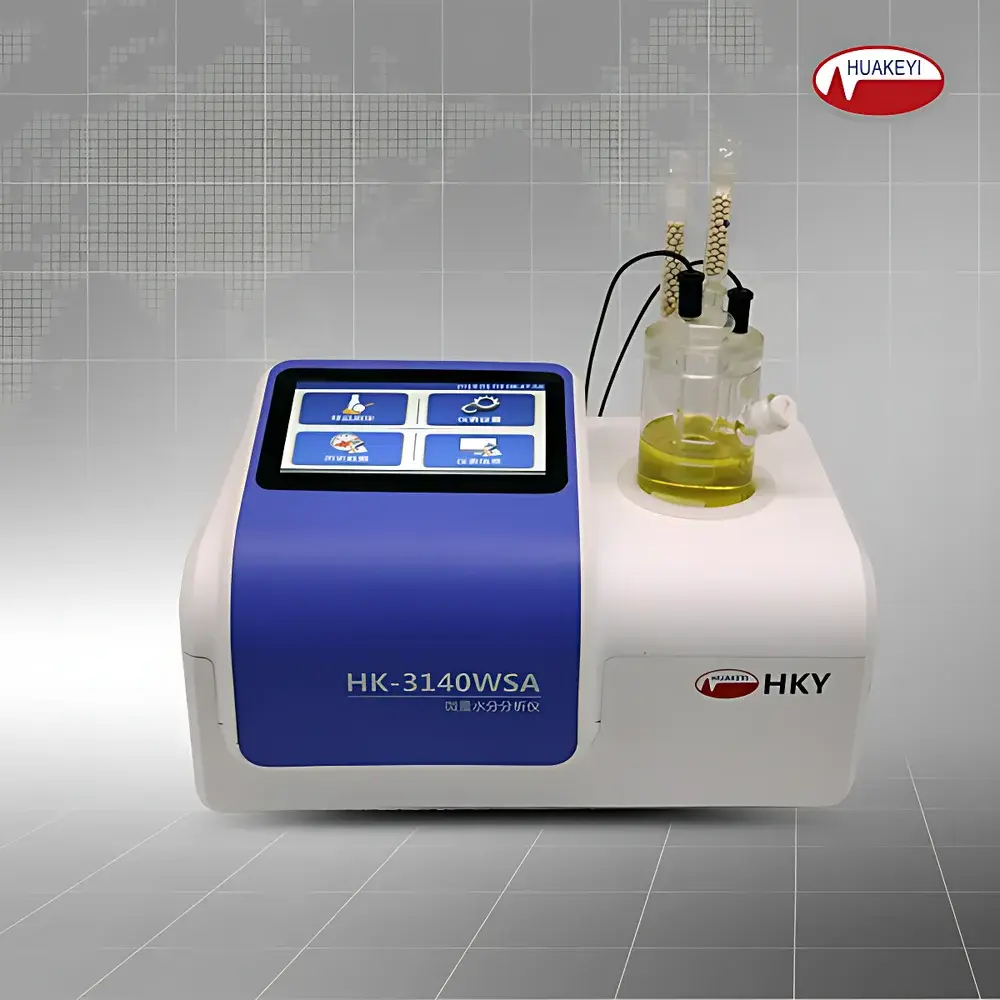
Huakeyi HK-3140WSA Karl Fischer Coulometric Moisture Analyzer
| Brand | Huakeyi |
|---|---|
| Origin | Beijing, China |
| Manufacturer Type | Authorized Distributor |
| Country of Origin | China |
| Model | HK-3140WSA |
| Pricing Range | USD 7,000–14,000 (FOB) |
| Titration Method | Fully Automatic Coulometric Titration |
| Instrument Type | Coulometric Karl Fischer Moisture Analyzer |
| Water Content Measurement Range | 1 µg – 200 mg H₂O |
| Resolution | 0.1 µg |
| Accuracy | ±2 µg for 3–1000 µg H₂O |
| Minimum Dispensed Volume | 1 µL (via syringe) |
| Electrolytic Current Output | 0–400 mA |
| Electrolysis Rate | 2.2 mg/min (37 µg/s) |
| Power Consumption | 50 W |
| Operating Voltage | 100–240 VAC, 50/60 Hz |
| Dimensions | 400 × 260 × 240 mm (L×W×H) |
| Weight | 2.0 kg |
| Data Storage | 500 timestamped records with searchable filters (date range, sample ID) |
| Connectivity | Standard USB 2.0, RJ-45 Ethernet port |
| Display | 800×480 color TFT-LCD touchscreen with bilingual (English/Chinese) UI |
| Stirring Speed | 5 adjustable levels |
| Safety & Diagnostics | Real-time electrode open/short circuit detection, blank current auto-compensation, endpoint drift correction, overcurrent/overheat protection |
Overview
The Huakeyi HK-3140WSA Karl Fischer Coulometric Moisture Analyzer is a precision electrochemical instrument engineered for trace-level water quantification in liquid, solid, and gaseous samples using the coulometric principle of the Karl Fischer reaction. Unlike volumetric KF methods, this analyzer generates iodine *in situ* via controlled electrolysis of an iodide-containing reagent solution. In the presence of water, iodine reacts stoichiometrically (1 mol I₂ ≡ 1 mol H₂O) to form hydroiodic acid and sulfuric acid derivatives—enabling direct mass calculation from Faraday’s law: total charge passed (coulombs) correlates linearly with water mass. With a measurement range spanning 1 µg to 200 mg H₂O and sub-microgram resolution (0.1 µg), the HK-3140WSA meets stringent requirements for low-moisture applications in pharmaceutical excipient release testing, lithium battery electrolyte certification, transformer oil moisture compliance (IEC 60814), and high-purity solvent QC per ASTM D6304 and ISO 12937.
Key Features
- High-fidelity coulometric detection system featuring dual-platinum indicator electrodes and optimized cell geometry for rapid, noise-immune endpoint discrimination
- Stable 0–400 mA constant-current electrolysis circuit enabling reproducible iodine generation and <2.5 s response time to endpoint transition
- Intelligent baseline compensation algorithms—including automatic blank current subtraction and dynamic drift correction—to minimize systematic bias from reagent aging or ambient humidity ingress
- Bilingual (English/Chinese) 800×480 color touchscreen interface with intuitive workflow navigation, real-time titration curve visualization, and context-sensitive help prompts
- Five-step magnetic stirring control (200–1200 rpm) ensures homogeneous mixing without vortexing or splashing—critical for viscous oils and hygroscopic powders
- Comprehensive hardware diagnostics: continuous monitoring of electrode impedance, electrolysis voltage stability, cell temperature, and reagent saturation status
- Modular electrolysis cell design with quick-release fittings and standardized O-ring seals (silicone rubber, 10 pcs included) for rapid maintenance and cross-contamination prevention
- Integrated data integrity safeguards: electronic audit trail (user ID, timestamp, method parameters, raw charge integrals), password-protected method editing, and tamper-evident record export
Sample Compatibility & Compliance
The HK-3140WSA accommodates diverse matrices through configurable sample introduction: direct injection (0.5 µL–1 mL via supplied gas-tight syringes), headspace analysis (for volatile or reactive samples), and oven coupling (optional accessory). It complies with regulatory expectations for analytical instrumentation under GLP and GMP environments, supporting 21 CFR Part 11–compliant operation when paired with validated LIMS interfaces (e.g., LabWare LIMS, Thermo Fisher SampleManager). Reagent compatibility includes standard two-component KF reagents (e.g., Hydranal-Coulomat AG/AG-H, Metrohm Aquastar) and single-solution formulations. The analyzer satisfies performance verification criteria outlined in USP , Ph. Eur. 2.5.12, and ASTM D7554 for coulometric moisture determination.
Software & Data Management
Data acquisition and reporting are managed through embedded firmware with local storage of 500 fully timestamped analyses—including sample ID, operator name, method version, raw coulombic integral, calculated water mass, %RSD, and environmental metadata (ambient T/RH if external sensor connected). Records support export in CSV and PDF formats via USB flash drive or network transfer. The Ethernet port enables remote configuration, firmware updates, and secure TLS-encrypted data streaming to central repositories. Optional Wi-Fi module supports IEEE 802.11n connectivity with WPA2-Enterprise authentication. All exported files retain digital signatures and checksums to fulfill ALCOA+ data integrity principles.
Applications
- Pharmaceuticals: Residual moisture in lyophilized APIs, excipients (e.g., mannitol, lactose), and packaging headspace validation
- Electronics: Water content in lithium-ion battery electrolytes (LiPF₆ in EC/DMC), solder paste fluxes, and semiconductor-grade solvents
- Energy: Moisture monitoring in insulating oils (ASTM D1533), biodiesel (EN 14104), and natural gas hydrate inhibition fluids
- Chemicals: Purity assurance of acetonitrile, THF, chlorobenzene, and other KF-sensitive solvents
- Polymers: Hydrolysis susceptibility assessment of polyamide (nylon), polyesters, and polycarbonates
FAQ
What is the difference between coulometric and volumetric Karl Fischer titration?
Coulometric KF generates iodine electrolytically at the anode, making it ideal for samples containing ≤1000 µg water; volumetric KF delivers pre-standardized iodine solution and suits higher water concentrations.
Does the HK-3140WSA support 21 CFR Part 11 compliance?
Yes—when operated with enabled user authentication, electronic signatures, and audit-trail logging, and integrated into a validated LIMS environment with role-based access control.
Can the instrument be calibrated with certified water standards?
Yes—traceable calibration is performed using certified water standards (e.g., 1.00 ± 0.02 mg H₂O/ampoule, NIST-traceable) and verified against gravimetric spike recovery (98.5–101.5%).
Is oven heating integration available?
An optional heated sample oven (temperature range: 50–250 °C, ±0.5 °C stability) is available for solids and thermally labile materials requiring vapor-phase extraction.
How often does the electrolyte require replacement?
Typical reagent lifetime is 30–50 coulombs per 100 mL under normal use; the system alerts users when conductivity drops below 12 mS/cm or endpoint response degrades beyond ±5% repeatability threshold.






