
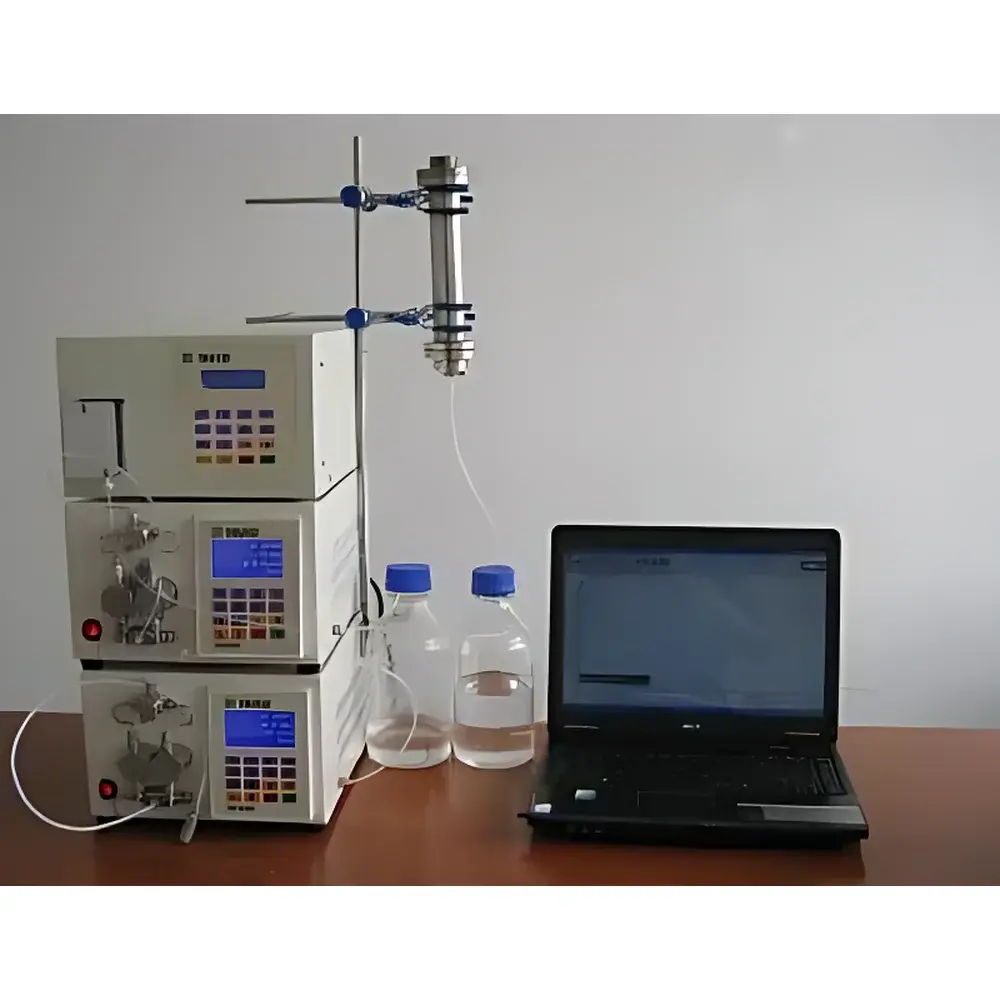
Tongtian C500 Medium-Pressure Preparative Liquid Chromatography System
| Brand | Tongtian |
|---|---|
| Origin | Shanghai, China |
| Model | C500 |
| Instrument Type | Medium-Pressure Preparative HPLC System |
| Flow Rate Range | 0.1–50.0 mL/min |
| Flow Accuracy | ≤±1% |
| Flow RSD | ≤1% |
| Operating Pressure Range | 0.1–8.0 MPa |
| Pressure Accuracy | ±0.05 MPa |
| Pressure Pulsation | 0.1 MPa |
| UV Detector Wavelength Range | 195–700 nm |
| Wavelength Accuracy | ±2.0 nm |
| Wavelength Precision | ±0.1 nm |
| Spectral Bandwidth | ≤8.0 nm (at 250 nm, FWHM) |
| Linear Range | 3.0 AU |
| Baseline Noise | <±2.0×10⁻⁵ AU |
| Baseline Drift | <2.0×10⁻⁴ AU/h |
| Flow Cell Path Length | 4.5 mm |
| Flow Cell Volume | 10 µL (standard) |
| Gradient Pump | Grad50 dual-piston constant-flow pump |
| Injection Valve | V541 medium-pressure valve (69 bar rating) or Rheodyne 3725-038 preparative valve |
| Column Interface | Convertible stainless-steel column adapter (316L) |
| Software | Dedicated chromatography workstation with method storage, real-time monitoring, and peak integration |
Overview
The Tongtian C500 Medium-Pressure Preparative Liquid Chromatography System is an engineered solution for scalable, reproducible purification of natural products, peptides, small-molecule pharmaceuticals, and biologically active compounds. Operating in the 0.1–8.0 MPa pressure range—distinct from both analytical HPLC (typically >10 MPa) and low-pressure gravity/column chromatography (<0.5 MPa)—the C500 bridges resolution, throughput, and robustness. Its core architecture employs a dual-piston constant-flow pump (Grad50) to deliver precise, pulse-dampened solvent delivery, ensuring stable column backpressure and consistent retention time alignment across repeated runs. The system utilizes standard 10–50 mm ID preparative columns and supports both isocratic and gradient elution protocols. Designed for laboratory-scale isolation (milligram-to-gram quantities), it serves as a critical bridge between discovery-phase screening and process development—enabling method transfer to higher-pressure systems while maintaining compatibility with common silica- and polymer-based stationary phases.
Key Features
- Dual-piston Grad50 high-stability pump with digital flow control: delivers 0.1–50.0 mL/min with ≤±1% accuracy and ≤1% RSD, minimizing band broadening and improving fraction homogeneity.
- Full-spectrum UV-500 detector featuring deuterium lamp source (195–700 nm), ±2.0 nm wavelength accuracy, and ≤8.0 nm spectral bandwidth at 250 nm—optimized for detection of chromophores across diverse compound classes including flavonoids, alkaloids, and nucleotides.
- Integrated pressure monitoring and overpressure protection circuitry, coupled with automatic flow calibration routines—ensuring operational safety and long-term pump integrity under variable load conditions.
- Microprocessor-based controller with non-volatile memory for up to 100 method presets, including flow rate, pressure limit, gradient profile, and detector wavelength settings—supporting GLP-compliant experimental traceability.
- Gas-degassing manifold with integrated inline degasser design reduces bubble formation in mobile phase lines, preventing baseline instability and detector cell air-lock events during extended runs.
- Stainless-steel (316L) fluidic path components—including three-way switching valves and column adapters—ensure chemical compatibility with acidic, basic, and organic solvent systems (e.g., MeOH, ACN, THF, EtOAc, and aqueous buffers).
Sample Compatibility & Compliance
The C500 accommodates a wide range of sample matrices, including crude plant extracts, fermentation broths, enzymatic digests, and synthetic reaction mixtures. Its flow cell (4.5 mm path length, 10 µL volume) and selectable sample loops (2–20 mL) support both dilute and concentrated injections without overloading. Column compatibility extends to reversed-phase (C18, C8), normal-phase (silica, amino), and ion-exchange media—validated per ASTM D7092 and ISO 13877 for method robustness in natural product isolation. The system’s hardware and software architecture align with foundational elements of FDA 21 CFR Part 11 readiness: electronic signatures, audit-trail logging, and user-access-level controls are implemented via the embedded chromatography workstation—facilitating internal QA/QC validation and external regulatory review.
Software & Data Management
The dedicated chromatography workstation provides real-time acquisition, peak detection, integration, and fraction-triggered collection logic. Raw data are stored in vendor-neutral .cdf format (compatible with OpenChrom and Chromeleon), enabling cross-platform reprocessing. Method templates include built-in compliance fields for operator ID, instrument ID, date/time stamp, and version-controlled parameter sets. All detector signals, pressure traces, and flow logs are time-synchronized and exportable as CSV or PDF reports—supporting ISO/IEC 17025 documentation requirements. Optional add-ons include automated fraction collector interfacing and barcode-assisted vial tracking for high-throughput purification workflows.
Applications
- Purification of bioactive constituents from botanical extracts (e.g., curcuminoids, ginsenosides, paclitaxel precursors).
- Desalting and buffer exchange of synthetic peptides prior to lyophilization or structural analysis.
- Removal of residual catalysts and protecting groups in fine chemical synthesis.
- Isolation of metabolites from microbial culture supernatants for NMR characterization.
- Preparative separation of diastereomers and regioisomers where chiral HPLC is cost-prohibitive at early-stage development.
- Method scouting and optimization for downstream scale-up to industrial SFC or flash chromatography platforms.
FAQ
What is the maximum recommended operating pressure for the C500 system?
The system is rated for continuous operation up to 8.0 MPa (80 bar), with hardware safety cutoff activated at 8.5 MPa.
Can the UV-500 detector be calibrated in-house using standard reference materials?
Yes—the detector supports user-executed wavelength calibration using holmium oxide and didymium filters per USP guidelines.
Is the chromatography workstation validated for GMP environments?
While the base software meets functional requirements for 21 CFR Part 11, formal GMP validation requires site-specific IQ/OQ/PQ protocols executed by qualified personnel.
Does the system support gradient mixing with more than two solvents?
The standard Grad50 pump is configured for binary gradient; quaternary mixing requires optional external low-pressure mixing module (sold separately).
What column dimensions are most commonly used with the C500 for natural product purification?
Typical configurations include 25 × 100 mm, 30 × 250 mm, and 50 × 300 mm columns packed with 10–25 µm silica or C18 media—balancing resolution, loading capacity, and backpressure constraints.





