
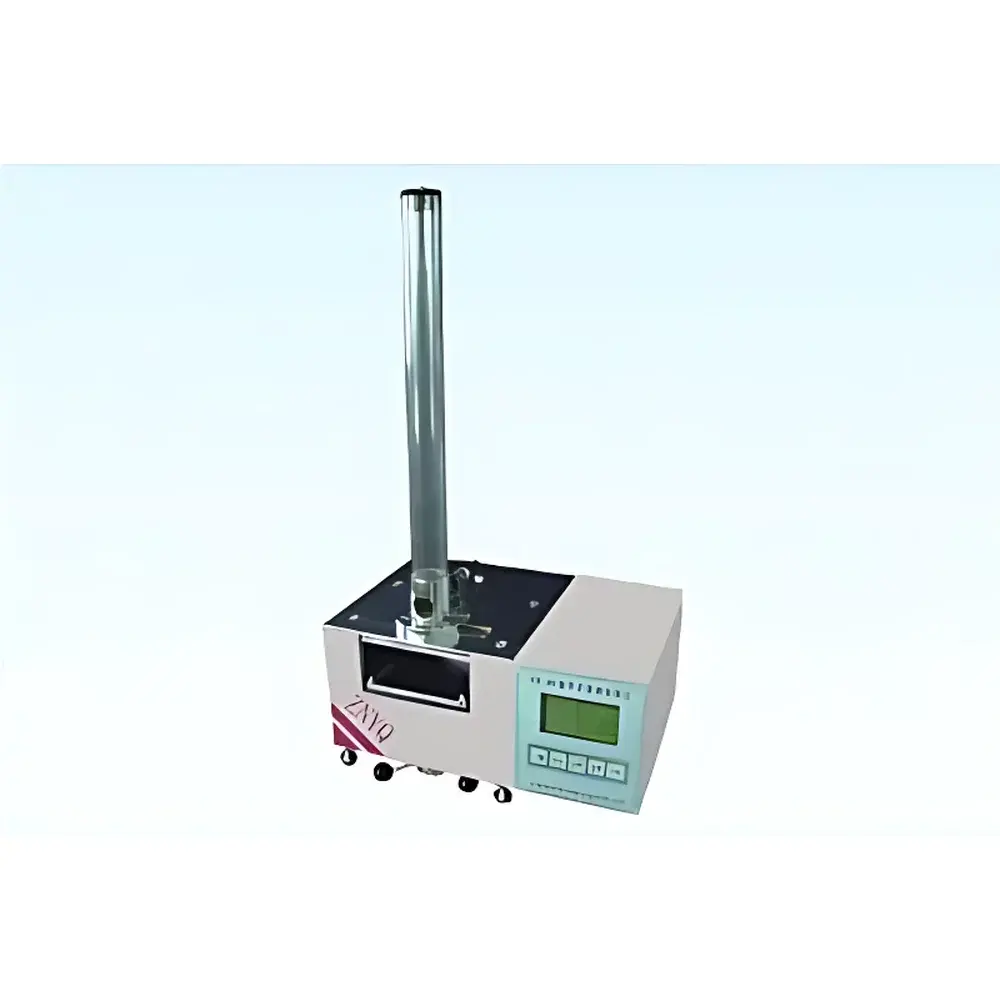
Brookfield LT-16 Digital Ball Rebound Tester
| Origin | Jilin, China |
|---|---|
| Manufacturer Type | Authorized Distributor |
| Origin Category | Domestic (PRC) |
| Model | LT-16 |
| Price | USD 3,100 (FOB Jilin) |
| Rebound Accuracy | ±1.5% rel. |
| Drop Height | 460 mm ±0.5% |
| Guide Tube ID | 40 mm ±4 mm |
| Steel Ball Diameter | 16.0 mm −0.15 mm |
| Steel Ball Mass | 16.7 g ±0.5 g |
| Rebound Range | 10–100% |
| Display | 4-digit LED digital readout |
| Specimen Dimensions | 100 × 100 × 50 mm (L×W×H) |
| Compliance | GB/T 6670–1986 (equivalent to ISO 8307:2021 for elastomeric materials) |
Overview
The Brookfield LT-16 Digital Ball Rebound Tester is a precision mechanical instrument engineered for the quantitative evaluation of resilience in elastomeric and polymeric materials. It operates on the classical principle of vertical free-fall impact: a standardized steel ball is released from a fixed height onto a horizontally mounted specimen; the rebound height is measured optically or via high-speed photogate timing, and the rebound ratio—expressed as a percentage—is calculated as (rebound height / drop height) × 100%. This method provides a direct, non-destructive measure of energy return under controlled dynamic compression, directly correlating with crosslink density, viscoelastic relaxation behavior, and hysteresis loss. Designed in strict conformance with GB/T 6670–1986 (which aligns technically with ISO 8307:2021, “Rubber, vulcanized or thermoplastic — Determination of resilience by vertical rebound”), the LT-16 delivers repeatable, traceable results suitable for QC release testing, formulation development, and incoming raw material verification in rubber compounding, footwear, automotive NVH components, and sports equipment manufacturing.
Key Features
- High-stability drop column with precision-machined 40 mm internal-diameter acrylic guide tube (tolerance ±4 mm), minimizing lateral deviation and air resistance effects during descent;
- Calibrated steel impact sphere (Φ16.0 mm −0.15 mm, mass 16.7 g ±0.5 g) manufactured to ISO 3290 Grade 1 tolerances for sphericity and surface finish;
- Digital optical sensing system with dual infrared photogates and microsecond-resolution timing circuitry, enabling ±1.5% relative accuracy in rebound ratio calculation per ASTM D3574 Annex A2 validation protocols;
- Adjustable test platform accommodating specimens up to 100 × 100 × 50 mm, with leveling feet and anti-vibration rubber mounts to isolate ambient floor vibrations;
- Integrated 4-digit LED display with zero-reset function and unit-independent numeric output (no auto-scaling), ensuring unambiguous reading under laboratory lighting conditions;
- Onboard thermal printer (included) provides immediate hard-copy records compliant with GLP documentation requirements—each printout includes timestamp, operator ID field, sample ID input, and raw rebound/drop height values;
- Compact footprint (W320 × D280 × H620 mm) and lightweight aluminum-alloy frame (≤18 kg) facilitate benchtop deployment in shared analytical labs or mobile QA carts.
Sample Compatibility & Compliance
The LT-16 accepts flat, homogeneous specimens with parallel top/bottom surfaces and minimal surface curvature (radius >500 mm). Validated substrates include natural rubber (NR), styrene-butadiene rubber (SBR), ethylene propylene diene monomer (EPDM), thermoplastic elastomers (TPEs), polyurethane foams (flexible and semi-rigid), and silicone elastomers. Specimens must be conditioned per ISO 23529 at 23 °C ±2 °C and 50% ±5% RH for ≥16 h prior to testing. The instrument satisfies mandatory metrological requirements outlined in JJF 1001–2011 (General Requirements for Metrological Terminology) and supports audit-ready documentation for ISO/IEC 17025-accredited laboratories. While not intrinsically 21 CFR Part 11 compliant, its printed output and manual entry fields support ALCOA+ data integrity principles when used within documented SOPs.
Software & Data Management
The LT-16 operates as a standalone hardware system without embedded firmware-based data logging. All measurement data are captured externally via the integrated thermal printer or manually transcribed into LIMS or Excel-based tracking templates. For automated data capture, users may interface the printer’s serial (RS-232) or USB port with third-party acquisition software (e.g., LabVIEW, MATLAB, or custom Python scripts using pySerial) to parse timestamped ASCII output. No proprietary drivers or cloud services are required. Raw data files retain full traceability: each record contains test date/time, operator initials, sample identification, observed rebound height (mm), nominal drop height (460 mm), calculated % rebound, and pass/fail status against user-defined specification limits.
Applications
- Quality control of cured rubber compounds in tire tread, sidewall, and innerliner production;
- Evaluation of resilience loss during thermal aging or ozone exposure per ASTM D573 and ISO 1431;
- Comparative screening of plasticizer efficiency in PVC gel formulations;
- Validation of crosslink uniformity in electron-beam or gamma-irradiated medical-grade silicones;
- Batch-to-batch consistency assessment of EVA midsoles in athletic footwear manufacturing;
- Teaching laboratories for polymer physics courses covering viscoelastic energy dissipation models (e.g., Maxwell–Wiechert spectra interpretation).
FAQ
Does the LT-16 comply with international standards beyond GB/T 6670?
Yes—the test methodology, ball geometry, and drop height specifications are technically harmonized with ISO 8307:2021 and ASTM D3574 Method A (Rebound Resilience of Flexible Cellular Materials). Calibration certificates reference NIM (National Institute of Metrology, China) traceability.
Can the instrument test curved or irregularly shaped samples?
No—only flat, rigid-backed specimens meeting the 100 × 100 × 50 mm dimensional envelope and surface flatness requirement (<0.1 mm deviation) yield valid results per standard protocol.
Is periodic recalibration required, and by whom?
Annual calibration against certified height gauges and calibrated mass standards is recommended. Accredited third-party metrology labs (e.g., CNAS-certified providers in China or A2LA-accredited labs internationally) perform full performance verification including photogate timing linearity and mechanical alignment checks.
What maintenance is necessary to sustain measurement accuracy?
Daily visual inspection of guide tube clarity and ball surface for scratches or contamination; monthly cleaning of photogate lenses with lens-grade isopropyl alcohol; annual torque verification of leveling feet mounting bolts per manufacturer’s service manual.
Is the thermal printer compatible with networked lab environments?
The printer supports direct RS-232 or USB connection to Windows/macOS workstations but lacks Ethernet/Wi-Fi capability. Network integration requires a dedicated print server or virtual COM port driver configuration.



